

Posts tagged papers
Goldilocks Inspires Useful Clues for How to Really Let Go

Do you remember the story of Goldilocks and the Three Bears? One of the main themes is Goldilocks’ search for what felt “just right.” One chair was too big, and another too small. She rejected both. However, when she found the one that fit, she knew it was the one for her and used it. The chair was right-sized and “just right” for her.

At the core of the Goldilocks philosophy is finding the sweet spot, the optimal place where things feel balanced, comfortable, and supportive. Who knew Goldilocks could help with letting go?

Are you struggling to let go of things, ideas, habits, or commitments? If so, a Goldilocks approach could help. Her decision tree went like this:

“This bed is too hard.”

“This bed is too soft.”

“This bed is just right.”

What will “just right” look and feel like for you?


Why is Letting Go Overwhelming?

There can be a lot to sort through, which can make letting go feel overwhelming. Clutter can accumulate from:

  • years of acquiring

  • gifts and inherited items from others

  • postponed decisions

  • emotional attachments

  • unclear or nonexistent organizational systems

  • being overscheduled

  • unclear boundaries

  • not following through on closure loops

Time is part of the equation, too. You need time to make decisions and to align what you own with who you are and what you need now. This can be tricky if you feel stuck in the past or are holding onto things for an aspirational future or self.

However, when you start making decisions based on who you are now and your current needs, it brings greater clarity as you let go.


Are You Sacrificing the Present?

Many years ago, I attended an ICD class on consumerism, minimalism, and experimentalism, presented by my friend and colleague, Lynne Johnson. She shared a quote about letting go.

How much of your present are you willing to sacrifice in order to save remembrances of your past to ponder in your future?
— Anonymous

The question aligns with the Goldilocks philosophy of the three-point decision tree, but from a time-based perspective. Consider what you are holding onto in relation to the:

  • Past - Are you willing to hold on to things from your past that keep you stuck and no longer serve you? Can you release them and move on?

  • Present - Are you willing to let those things take up physical space and mental energy, distracting you from the present? Can you let go and be more aligned with the present?

  • Future - Are you holding onto things with a glimmer of hope that you will revisit, use, or need them someday? Can you say goodbye to them in service of an unencumbered future?


What DOES Letting GO Look Like?

When you release what you no longer need, you invite more ease, better life alignment, joy, and growth. Even releasing one thing makes room for what’s most important, essential, and valued by you.

Letting go can look like this:

  • Donate the never-used pots and pans to make the ones used regularly more accessible.

  • Release rarely-used purses to make room for the ones you do use.

  • Recycle the papers that ‘time took care of’ so you can focus on what’s current.

  • Skip the to-do list to enjoy a beautiful spring weekend day.

What does letting go look like for you?


The Goldilocks of Letting Go

What happens when you begin to align your life so it feels “just right?” Will you release what no longer belongs, brings you joy, or is useful? Will letting go bring you closer to living your best life now? When you release what's blocking your energy, space, and thoughts, you create room for calm, growth, and happiness.

Which ideas resonate with you most? I’d love to hear your thoughts. I invite you to join the conversation.


How Can I Help?

Do you feel overwhelmed or disorganized? Do you want to let go of the unnecessary but feel stuck or unsure where to start? I’m here to help! You don’t have to do this alone. Virtual organizing is an extraordinary path forward – Local feel with a global reach.

Let’s connect! I’m easy to reach.

Letting go and getting organized are possible, especially with support.


Ways to Easily Make Next Step by Joyfully Losing Your Negative List

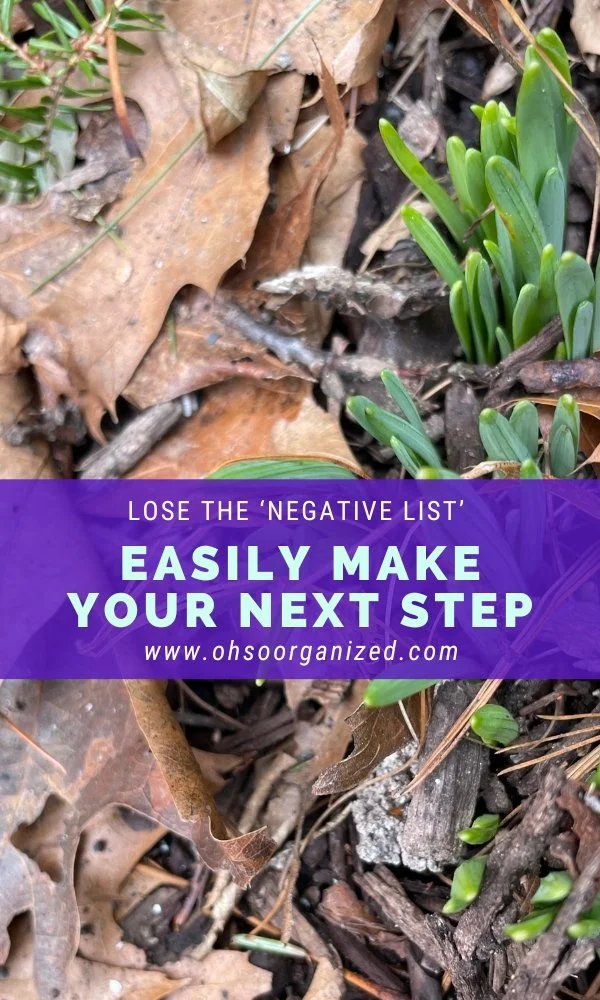
Yes. It’s still officially winter, and our recent run of several warm days has reverted to colder temperatures. Despite the fluctuating thermometer, I notice hopeful signs of spring as nature begins its blooming ritual. Frequent sightings of green plants push through the ground to greet the blue sun-filled sky. They don’t hesitate. After being dormant for months, rejoining life with gusto is their next step.

Nature’s confident growth got me thinking about things that prevent us from moving forward.

  • How about the mile-long to-do list?

  • Is yours dormant and paralyzing?

  • Or are you actively working on it?

  • Is your list meaningful and necessary?

  • Or is it filled with tasks that aren’t essential and you don’t care about?

  • Is your list so daunting that it brings up negative feelings, regret, and disappointment?

  • Or instead does it inspire you to act?

If you are struggling to determine your next step, here is a novel idea: Lose your ‘negative list.’ Crumple it up, let it go, and say buh-bye! That might sound radical, and perhaps it is. But can you imagine doing it anyway? And if you did, what might happen?


What’s On Your Negative List

Things holding you back can be concrete or emotional. They might include things like:

  • Thought loops with messages such as “I can’t” or “I’m not good enough”

  • Projects that would be nice to do, but realistically you’ll never get to

  • Thank you notes that are years overdue

  • Plans you wanted to make with friends or family, but never did

  • Piles of magazines with articles to clip and file

  • Stuff inherited from other people’s lives to sort and edit

  • Papers and objects representing previous careers or life stages to curate and edit

Without realizing it, I had a negative list. It included feeling bad about not yet:


Make Your Next Step Easier

It may sound too simplistic to lose or release your negative list. However, recognizing how it might be holding you back makes it worth trying.

Maybe you’ll decide you still want to attend to some things on that list. And if so, perhaps a reframe of how you think about that ‘thing’ will make the difference. For example, instead of the projects you’ll never get to demotivating you, celebrate the ones you have accomplished. Review the remaining ones to decide if one is worth pursuing. If so, think about it as a project you get to, not have to do. Release the rest.

As Oliver Burkeman says in Four Thousand Weeks, our time is limited. “The average human lifespan is absurdly, terrifyingly, insultingly short.” We will never get everything done or be able to pursue every possibility that exists. Burkeman says, “we’ve been granted the mental capacities to make almost infinitely ambitious plans, yet practically no time at all to put them into action.”

Recognizing these limitations can be freeing. Don’t try to do everything. Instead, let go of what is holding you back and pursue what’s most meaningful and necessary.

Selecting next will become easier. Guilt will be gone. Action and intention will rule the day. What comes next will be joyfully embraced once you are unencumbered by the lingering tasks you’ve chosen to release from your list.

The average human lifespan is absurdly, terrifyingly, insultingly short.
— Oliver Burkeman

What’s Next?

I might forgo choosing a new word and motto this year and even skip a deeper review of 2024. Just considering that option makes me feel lighter and more energetic. After all, I imposed these things on myself, and I can just as quickly release them from my list.

My next steps will prioritize energizing and nourishing actions, projects, and ideas. What will be next for you? What can you release that is holding you back? I’d love to hear your thoughts. I invite you to join the conversation.


How Can I Help?

Do you want support organizing, planning, or figuring out your next step? I’d love to help! Virtual organizing is an extraordinary path forward – local feel with a global reach.

Please schedule a Discovery Call, email me at linda@ohsorganized.com, or call 914-271-5673. Change is possible, especially with support.


5 Positive Benefits of Creating More Balance for Happy Holidays

We’re in the thick of the holiday season. Holiday music permeates the background as you stroll through stores, restaurants, and grocery stores. Is it just me, or do you catch yourself singing along? I can’t help it. The music is contagious. Your balance might be excellent right now. You feel unencumbered, giddy, and joyful with the glitter and whimsy of the holiday season. Or, you might feel overwhelmed by your physical or mind clutter. The overwhelm makes it challenging to focus on twinkling lights, time with loved ones, and feeling at ease.

Finding balance is a constantly moving pursuit. When your balance wanders too far in one direction, it’s time to adjust. It’s an excellent season to make some changes. It will set you up for a happier, more peaceful holiday time. No one wants to be preoccupied with clutter at the expense of enjoying celebrations, cozy time around the fire with family and friends, and quiet moments of relaxation or reflection.

My clients have been especially motivated and focused on recalibrating their balance in the past several weeks. Their physical and mental clutter reached a tipping point, encouraging them to edit, let go, and organize. It’s been exciting to help them make the changes they desire. Enlisting my help enabled them to clarify and recommit to their goals, get unstuck, reduce overwhelm, and feel energized with hope. Making small steps, taking action, and experiencing progress are the secret ingredients to finding your desired balance.

While there are many potential areas to balance, I’ll share five common ones that can inspire positive changes for you.  


5 Positive Benefits of Creating More Balance for Happy Holidays

1. Balance Clothing Clutter

Are you familiar with the One-in, One-Out Rule, a commonly used organizing principle? This encourages you to release one equivalent-type item you no longer want, like a pair of pants or a sweater, when you bring in something new. This concept helps you maintain your current space and organization.

A more substantial edit is helpful if your clothing closets are already tight or overflowing. Especially at this time of year when we are gifted things, including clothing, it’s beneficial to do some closet and dresser editing now. I encourage you to release those items that no longer fit, you don’t like, are worn or stained beyond repair, and are never selected to wear. Let those go. Create visual and physical space for your clothing. You’ll be able to get dressed more easily and know that you love wearing what remains.


2. Balance Mind Clutter

What thoughts are swirling around in your brain? Are your tasks, projects, and decisions to make preoccupying your thoughts? You may have one particularly significant project that is shouting the loudest and making it challenging to focus on other commitments. It’s time to rebalance with the Brain Dump.

An excellent first step is releasing your thoughts from your head and capturing them on paper, a digital document, or a voice recording. Let them out! What happens when we keep them in? The mind clutter continues to swirl around. It keeps us stuck and preventing us from taking action. You can get easily fooled when thinking overtakes doing. It might seem like you’re accomplishing something because that ‘thing’ is all you think about. But you aren’t doing, you’re ruminating.

Action, which brings about progress, is the key to reducing your mind clutter. Select one tiny task from your list. It can be the next step in moving forward on that big project or a single one-and-done-type task. Continue to select something from your list and turn your tasks into small, doable actions.


3. Balance Desk Clutter

Often, my clients tell me they can't think or work when their desks are out of balance and cluttered. Paying bills, writing, scheduling, making calls, or responding to emails can be challenging when your desk surfaces contain visual and physical clutter. The items that collect over time onto your surfaces are waiting for decisions. The objective is to remove things you don’t need visible or belong elsewhere, like

  • Old or fileable papers

  • Extra office supplies

  • Random items that ‘landed’ there or

  • Other people’s stuff

When your desk balance is off, invest time to recalibrate. This doesn’t mean it needs to be completely empty. Find a balance between what you need to be immediately visible and accessible and those things that can be stored or moved elsewhere.

Edit, let go, reroute, and breathe. Can you feel a sense of relief?


When your balance wanders too far in one direction, it’s time to adjust.
— Linda Samuels, CPO-CD®, CVOP™


4. Balance Pile Clutter

Are you a piler? You might see stacks of books, magazines, gifts, toiletries, craft supplies, and more. Guess what happens when a pile gets too big? It becomes off balance with the potential to tip. The tipping can cause a tripping hazard. Who needs that during the holiday or any season?

Here’s the good news about these piles containing larger physical objects. Each item takes up a significant volume of space. That means your editing and decision-making power creates visible results more quickly. Here are some examples:

  • A one-foot pile of sweaters to edit = about 5 decisions

  • A one-foot pile of books to edit = about 18 decisions

  • A one-foot pile of magazines to edit = about 36 decisions

Compare these to:

  • A one-foot pile of papers to edit = about 240 decisions

If you want quicker progress on your piles, focus on editing the objects that take up more space and require fewer decisions. You’ll be less likely to experience decision fatigue.


5. Balance Paper Clutter

Why does paper collect? There are several reasons, such as

  • It needs to be filed

  • It is out as a visual cue

  • Belongs to someone else

  • Requires a decision

  • Is pending

  • Is part of an active project

  • It needs to be routed elsewhere

  • It needs to be shredded, tossed, recycled, or digitized

While the reasons are valid, the paper clutter often seems to multiply when we’re sleeping. Getting papers into a manageable balance hinges on your paper management system. This will include an area to

  • Store frequently referenced files

  • Organize current action items

  • Archive less frequently accessed files

  • Recycling container

  • Garbage container

  • Shredder or container to collect shredding

Investing in your paper management system will create flow, reduce paper clutter, and increase productivity. What a beautiful gift to give yourself in preparation for the holidays. And if you can’t focus on this before the season, why not set it as a goal for the New Year?

As you navigate the fullness of the holiday season, what will help you recalibrate your balance? Let me know how I can help with editing, decluttering, and organizing. I’m here for you. Schedule your virtual organizing session today. Reach me, Linda, at 914-271-5637, linda@ohsoorganized.com, or through my contact form.

I wish you a happy, joyful, and organized holiday season!


How to Make the Courageous Connection Between Risk and Change Really Helpful

Let’s face it. Making a change involves taking risks. No matter the size of the risk, you’ll need the courage to dive into unknown waters. Your risk tolerance level will influence how easy or challenging it will be to pursue change. If you are comfortable taking risks, you will more likely welcome change and take necessary actions without too much deliberation. If you are risk-averse, change is still possible, but the journey will be more difficult.


Risk Tolerance Scale

Your response will vary depending on the scenario and type of risk. Consider your risk tolerance level concerning change using a scale from 1 to 10.

1   =   Risk-Averse:  Reluctant to take risks

10 =   Risk-Taker:  Eager to take risks

Imagine the change you want is to have less clutter in your home. Part of that process will include editing and releasing things. Using the Risk Tolerance Scale, you recognize how easily you can let go of junk mail and old newspapers. You give yourself a 10 because you can recycle them without much thought. However, when it comes to mementos, you struggle to make decisions because of your emotional attachments. You feel a sense of loss when letting go of things from the past, and give yourself a 2.


Preparing for Change

There are a few ways to facilitate change. Using the example above, refer to the Risk Tolerance Scale to identify the areas that feel less risky to work on, like junk mail and newspapers. As you build confidence and progress in those areas, you’re preparing to tackle the more challenging things next.

Another idea, which is especially helpful in risk-averse scenarios, is to ask the question,

What risk are you happy you took?

Revisiting risks you handled in the past that had successful outcomes will help build confidence in taking new risks and making changes. Invest time in remembering.


Making a change involves taking risks.
— Linda Samuels, CPO-CD®, CVOP™

Taking Risks in Pursuit of Change

There’s no question that when we pursue change, letting go occurs. This can include physical stuff, places, people, or ideas. During a recent virtual organizing session, my client shared something while gently releasing a category of papers from the past. It spoke to one of the benefits of embracing risk in pursuit of change and was so moving. She said,

“I’m letting go of part of my life that is no longer part of my life.”

What an insightful recognition that in moving forward and embracing change, you can let go of those things that no longer have a place in your present.


How does your risk tolerance level influence the changes you seek? In what ways have you noticed a connection? I’d love to hear your thoughts. I invite you to join the conversation.