

Posts tagged release
How to Easily Decide It's Time to Release Something Irritating

Do you hold too much in your time or space containers? It’s interesting how often you keep things that are annoying, unsatisfying, or in your way. These could be things that take up physical space, creating cluttered rooms and areas. The volume of stuff has become a tripping hazard. Or, having so many things makes it difficult to know what you own or to find what you’re looking for. Your space containers are beyond full, and it may be time to let go of some things.

There are also time containers that can overflow. Instead of physical items, a time challenge can look like-

  • Crammed schedules

  • Saying “yes” to too many requests

  • Underestimating how long a task will take

  • Always running late because you have just one more thing to do

  • Having unhealthy boundaries

  • Spending more time than needed to get something “just right”

  • Being constantly interrupted or distracted

  • Multitasking and trying to do too many things at once

Letting go creates space for what’s most important and valued. That might mean more time to enjoy doing what you truly love, like kayaking, spending time with family and friends, or learning something new.


Asking One Simple Question

A while ago, I read something in James Clear’s 3-2-1 newsletter that resonated with me. He asked a direct question that gets to the heart of what I just shared with you – how to manage your space or time containers when they’re overflowing.

Clear’s question is,

What can you eliminate this week?
— James Clear

Setting a deadline (this week) creates urgency and encourages you to act sooner rather than later. Pick an area of focus, such as your full calendar or the distractions you're facing.

Then ask, “What can you eliminate this week?” This might include-

  • Removing or rescheduling an appointment to make your day flow better

  • Pausing to evaluate before saying “yes” to anything else

  • Delegating some tasks or errands

  • Setting a time limit on social media scrolling

Is there anything specific that came up when you thought about removing something this week?


Decide to Let Go

Your space and time can quickly overflow. The good news is that you can change the dynamic through the process of elimination. One question, one focus area, one decision, and one action at a time.

What is making your space or time feel too full? What would it be like to practice letting go? Which area would you like to focus on first? I’d love to hear your thoughts. I invite you to join the conversation.


How Can I Help?

Do you feel overwhelmed and disorganized? Are your space and time containers overflowing? I’m here to help! You don’t have to do this alone. Virtual organizing is an extraordinary path forward – Local feel with a global reach.

Let’s connect! I’m easy to reach.

Managing your time, getting organized, and living with more ease are possible, especially with support.

 
 
One Powerful Question: A Shortcut to Help You Release and Let Go

What’s not to love about shortcuts? They aren’t always equally effective. However, when you find one that helps you reach your desired goal more quickly and is less taxing on your brain, that’s a good thing.

Recently, I read an article in Real Simple about interior designer Young Huh and how to create spaces that feel calm. Huh just published a new book, A Mood, A Thought, A Feeling. When starting work on a room, Huh asks a simple question,

“What can I take out?”

Her philosophy encourages you to remove what doesn’t belong and surround yourself with what feels calming and peaceful.

Huh’s question caught my attention. I thought about how helpful it could be during the editing, letting go, and organizing process. There are many ways to approach getting organized. One method is to identify what doesn’t belong, or what you no longer need or want. Or, as Huh says, “What can I take out?”

Spring’s arrival prompts me to clear the landscape and make room for the blooms. What can you let go of to create space for calm and growth?


Letting Go Starts with Removing Things

Less Clutter, Less Noise

Often, I hear clients describe their environment as:

  • “My house is filled with too much clutter.”

  • “There is so much clutter, I can’t even think.”

  • “I can’t find anything because the things I want and don’t want are jumbled together.”

  • “The clutter paralyzes me.”

  • “I feel chaotic because of the clutter and disorganization in my home.”

Do any of these statements resonate with you? If so, consider asking yourself Huh’s powerful question: "What can I take out?”

This question is a good starting point.

What can I take out?
— Young Huh

More Great Letting Go Questions

Not all questions work for everyone. If Huh’s “take out” question doesn’t resonate with you, consider some alternatives, which you can find in my article: 21 Questions to Exercise Your Letting Go Muscles.

A few of my favorites are:

  • Has it overstayed its welcome?

  • Is it worth the real estate, energy, and maintenance?

  • Does it support your current needs?

  • What will become possible for you when you let go?

Releasing the Stuff

Are you ready to start letting go? If so, here’s a method to try.

  • Choose a room to work in.

  • Gather boxes and trash bags. These will help you easily sort what’s being removed from that space.

  • Label and set up those containers for > Belongs Elsewhere > Donate > Trash > Recycle.

  • With the question in mind, “What can I take out?" start in one corner or area of the room.

  • Focus on releasing items you no longer want or that belong elsewhere. Place items into their designated sorting containers.

  • After you finish one area or surface, move on to the next.

  • Repeat until the room has been decluttered.

  • Route the items you let go of to their ‘homes.’

  • Return to the room and notice how it feels. Does your space feel different? What are you noticing?


What Does Less Feel Like?

When you let go of things that no longer serve a purpose or belong elsewhere, the energy in the space begins to shift. This, in turn, influences how you feel when you're in that environment. Our possessions affect our space, time, and mental clarity. Releasing excess items helps you feel calmer, more focused, and less distracted.

Which ideas resonate with you the most? I’d love to hear your thoughts. I invite you to join the conversation.


How Can I Help?

Do you feel overwhelmed or disorganized? Do you want to let go of the unnecessary but feel stuck or unsure where to start? I’m here to help! You don’t have to do this alone. Virtual organizing is an extraordinary path forward – Local feel with a global reach.

Let’s connect! I’m easy to reach.

Letting go and getting organized are possible, especially with support.
 
 
3 Easy Ways to Help Shift Your Energy, Especially When You’re Stuck

It’s no fun to feel stuck, stressed, or overwhelmed. Remaining that way for a long time isn’t good for your mental health or well-being. Take a moment to check in with yourself and see how you’re feeling. Do you need help making a change right now?

The good news is that you can make minor adjustments. These tiny shifts can have positive influences on your energy and overall well-being. I’ve often written about ways to calm and ground yourself.

For me, activities like walking in nature, journaling, eating nutritious foods, and getting enough sleep are my go-to methods for boosting energy and improving my mood. They also reduce stress and overwhelm and help you get unstuck

Recently, I discovered several new energy-changing strategies to help reduce morning stress, create momentum, and embrace relaxation.


3 Easy Ways to Help Shift Your Energy and Get Unstuck

1. Help Reduce Morning Stress

Just give your brain 10 minutes to wake up.
— Jay Shetty

In a recent issue of Real Simple, Jay Shetty, author and On Purpose podcast host, advises against checking your phone first thing. Allowing your brain a few minutes to wake up without that distraction will have a positive effect on your entire day.

Jay says, “You would never wake up and let 100 people into your bedroom before you showered or brushed your teeth. But when you look at your phone first thing in the morning, you’re letting 100 people into your mind. Then you end up chasing dopamine the rest of the day. Just give your brain 10 minutes to wake up. If you do that, your whole day will be different and you’ll have less anxiety. Try it for seven days, and you will feel so much better.”

I’ve been working on this. One challenge I face is that I meditate first thing in the morning using an app on my phone. My goal is to meditate with the app before checking email, texts, or social media. I notice a clear difference in my practice when I meditate first. However, when I get distracted by other inputs, it’s harder to settle into my meditation.

As I consider Jay’s strategy to “just give your brain 10 minutes to wake up,” I’m reaffirming my commitment to my morning routine. I will meditate first before doing any other phone-related activities. 


2. Help Create Momentum

Clear enough space for momentum to arrive.
— Oliver Burkeman

In one of Oliver Burkeman’s newsletters, The Imperfectionist, he wrote, “If you’re stuck in a rut, and you feel like you’ve stopped making progress on things that matter, it could be that you need more immediacy in your life.”

He discussed ways to build momentum through concrete actions, like recycling the “300 articles I’d saved to read later.” How many things have you saved for someday—things to do, read, or take care of? Those piles of unfinished projects, unread books, clothes you’ll never wear, or gadgets you’ll never use occupy valuable physical and mental space in our homes and minds.

To get unstuck, create momentum, and spark creativity, do some “stuff” clearing. Oliver said, “It was as if I’d been assuming that what I needed was to collect sufficient resources to create momentum, when what I really needed was to clear enough space for momentum to arrive.”

What can you release, recycle, or donate today?


3. Help Embrace Relaxation

Rushing tends to trigger the stress response, and slowing down helps switch it off.
— Nicola Jane Hobbs

In a recent Real Simple article about how to relax and unwind, especially at the start of your vacation, Nicola Jane Hobbs, a psychologist and author of The Relaxed Woman, offers excellent advice. She understands how difficult it can be to switch from the stress and fast pace of your work life to taking time off and relaxing. I don’t know about you, but when I’m on vacation, it usually takes me a day or two to transition from go-go-going to just being.

One of Nicola’s strategies is simple and can be helpful beyond just vacations. She explains that slowing down even the smallest parts of your daily routine can act as a reset. “Rushing tends to trigger the stress response, and slowing down helps switch it off.” Slowing down your “daily actions” will “help your mind and body relax.”

Some ways to slow down (as in doing these things more slowly) include:

  • Walking

  • Chewing

  • Drinking

  • Breathing

  • Stretching

  • Washing your hands

  • Brushing your teeth

Next time you feel stressed or overwhelmed, try slowing down a small action and watch how it changes your experience.


What Helps You Get Unstuck?

There are so many ways to get unstuck, reduce overwhelm, or shift your mood. What are some of your go-to strategies? Which strategy that I shared resonates with you the most?

I’d love to hear your thoughts. I invite you to join the conversation.


How Can I Help?

Do you feel overwhelmed, stuck, or disorganized? I’m here to help! Virtual organizing is an extraordinary path forward – Local feel with a global reach.

Let’s talk. I’m easy to reach. 

Getting organized is possible, especially with support.
 
 
One Fun and Informative Letting Go Exploration with Organizing Colleagues

Letting go is a main focus of my work with clients. They feel overwhelmed and burdened by the stuff in their lives and want my help to let go, organize, and live with more ease. The “stuff” appears as rooms overflowing with physical belongings, calendars scheduled with no breathing space, or minds filled with a barrage of ideas and thoughts.

Recently, I viewed letting go from another perspective. I had the great joy of meeting with my Westchester NAPO Neighborhood Group organizing colleagues for a field trip and tour of a local auction house, The Benefit Shop in Mt Kisco, NY. This is where the things that have been let go of land on their way to their new home.

Our group was graciously welcomed by Pam Stone, Founder and President of The Benefit Shop Foundation Inc. After working on Wall Street for over two decades, Pam changed careers to pursue her passion project. She set up The Benefit Shop, a charitable 501(c)3 non-profit. Proceeds from sales (100% of the profit) go to over 40 charities, which directly help local community organizations. As Pam said, “I really wanted the beneficiary to be my community, for the people who live and work here.”


How Letting Go is Facilitated

The Benefit Shop is what Pam refers to as “one-stop shopping.” They accept items for:

You can bring your things to their 16,000-square-foot gallery and office space. Or, depending on your location, they will bring a truck and a team to you, pack up what you’re letting go of, and transport it to their facility to prepare for auction and sale. With estate buyouts, they will take 90% of a house’s contents.

Pam suggests tagging your items using a colored sticker system.

  • Red = Keep

  • Green = Go

  • Yellow = Think on it.

If you’re not ready to let go of everything at once, they recommend that clients “think on it," which allows them to release things in stages.

They also encourage clients to contribute to the catalogue entries by sharing stories and histories about their objects. Capturing the object’s story enhances its saleability and helps the client feel better about letting go.

Let go, organize, and live with more ease.
— Linda Samuels, CPO-CD®, CVOP™

How Do the Auctions Work?

The Benefit Shop hosts weekly online auctions. They sell around 3,000 items each month to a global audience.

  • All bids, with a few exceptions, start at $1.

  • Items sold at auction are reconciled within 45 days.

  • Clients receive 65%, and The Benefit Shop keeps 35%.

  • Consignors receive a tax-deductible receipt along with their settlement checks.

  • Unsold items can be donated or retrieved by the consignor.

  • The Benefit Shop doesn’t provide shipping for purchased auction items. You can either pick them up at their office or arrange for shipping. They offer resources for several vetted and recommended shipping vendors.


Letting Go Considerations

Are you curious which items are the easiest or most difficult to sell at auction?

Pam said that jewelry (fine and costume) and handbags consistently sell well.

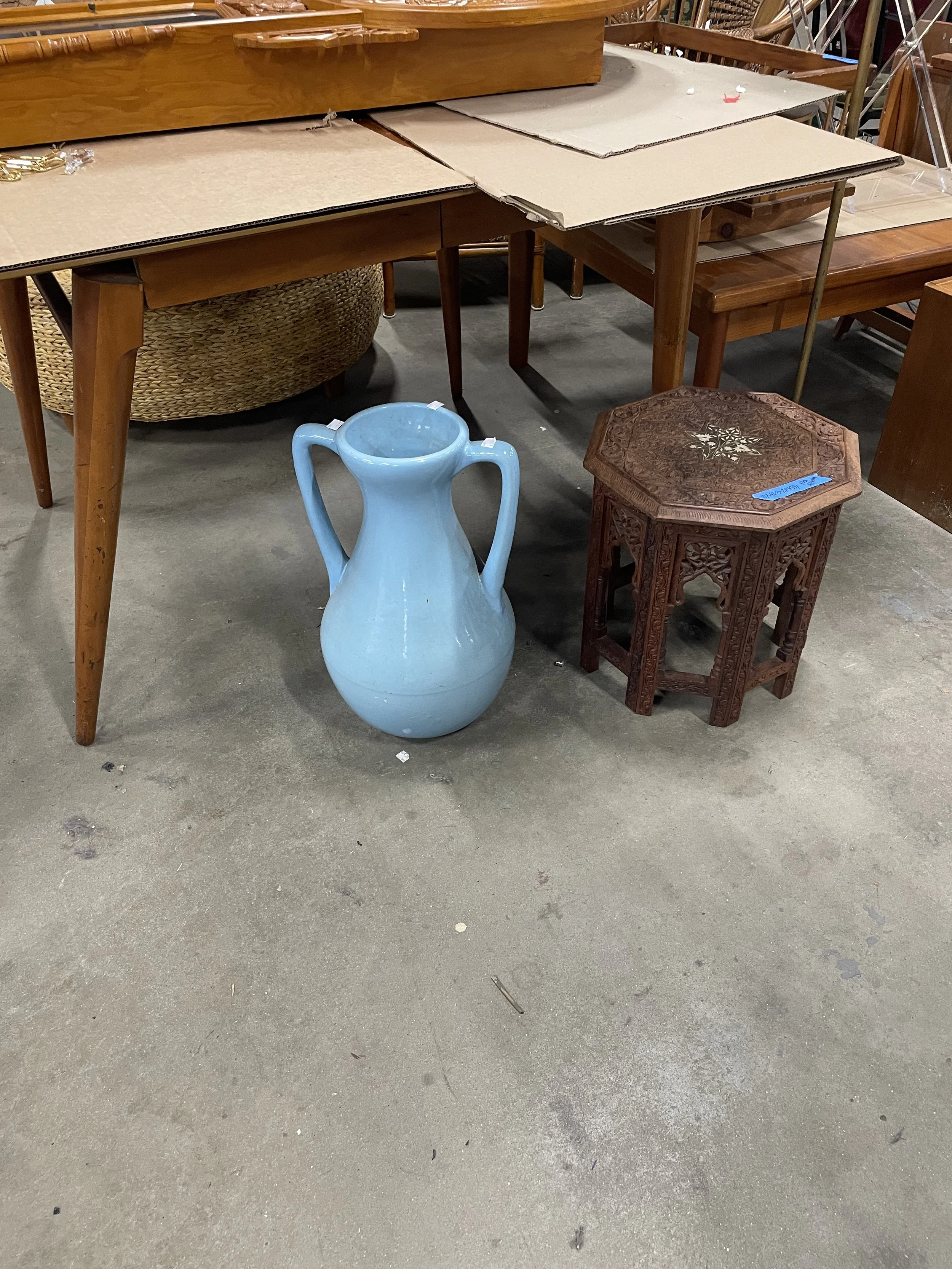
Large china cabinets and dark wood furniture are not good sellers. While mid-century furniture is popular, only high-end, name-recognizable brands such as Eames, Knoll, or Saarinen sell well at auction. The Danish teak mid-century modern style of furniture doesn’t do well.


More Fun Facts About The Benefit Shop

Organization

I was impressed by the organization at The Benefit Shop.

  • Items for sale are logged in, tagged, and grouped by category.

  • They get coded and routed for the auctions in which they will be included.

  • Each category has separate sections at the facility, such as housewares, textiles, clothing, purses, jewelry, art, and furniture.

  • There is a photography area for taking quality photos of every piece.


The Shop Mascot

When you enter the space, a giant taxidermy elk is one of the first things you see. When I asked about it, Pam said it wasn’t for sale because it has become their gallery mascot.

Pop-Ups and Cash & Carry

  • Aside from the online auctions, they also hold occasional onsite pop-up events at their place.

  • In the gallery, there is also a $1 only group of items to purchase as ‘cash and carry’. The items are sold and replenished regularly.


Why Let Go?

It was fun visiting a place representing so many decisions to let go of stuff. The objects received were treated with care and respect. It felt good knowing these things would go to a good home, stay out of the landfill, and the proceeds would help those in need.

The Benefit Shop Foundation

The Westchester NAPO Neighborhood Group visits Pam Stone, Founder and President of The Benefit Shop Foundation in Mt. Kisco, NY


Where Do Your Things Go?

When you let go of things, where do they go? Do you have favorite charities? Have you used auction houses? What helps you release things that have overstayed their welcome?  I’d love to hear your thoughts. I invite you to join the conversation.


How Can I Help?

Do you want support organizing, editing, or letting go? I’d love to help! Virtual organizing is an extraordinary path forward – Local feel with a global reach.

Please schedule a Discovery Call, email me at linda@ohsoorganized.com, or call 914-271-5673. Letting go is possible, especially with support.