


Posts tagged control
3 Useful Ways for Better and More Compassionate Time Management

You and I share at least two things in common. We both have 24 hours in a day, and our days are finite. Yet how we experience and use our time varies widely.

Perhaps you are time-aware. You know how much time you have and spend it intentionally. Or maybe you have difficulty keeping track of time, feel time-poor, are easily distracted, and never have enough hours to get things done.

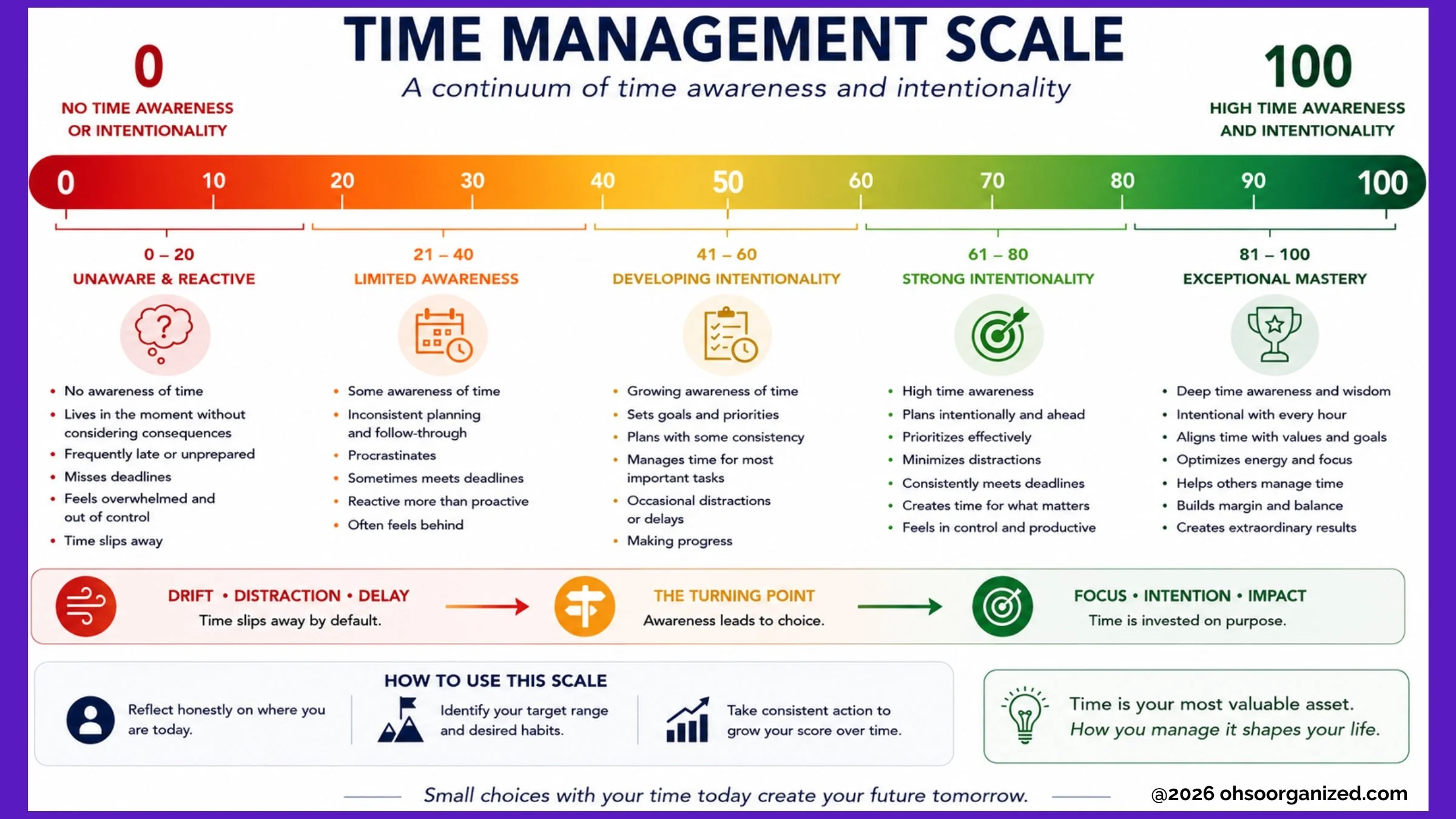
If you think of your relationship to time on a scale from zero to one hundred, with one end representing a total lack of time awareness and intentionality and the other representing high time awareness and intentionality, where would you place yourself? Whether your number is zero or one hundred, several concepts can improve your relationship with time and help you approach it more compassionately.


Time Management Scale

Before I share the strategies, review the Time Management Scale to get a sense of where you are right now. This isn’t an exact science, but the scale will help you identify your strengths and challenges. Understanding your relationship with time, combined with the concepts I’m about to share, can be a game-changer for you.

How to Use the Scale

  • Reflect honestly on where you are today

  • Identify your target range and desired habits

  • Take consistent action to improve your score over time

Remember that small choices about how you spend your time today shape your future.


3 Ideas to Encourage More Compassionate and Aligned Time Management

There are three ways to align your time in a more compassionate and powerful way. As I mentioned earlier, the time available each day is fixed. Your life and the time you have left are finite. None of us knows how many days remain. How you use this precious resource shapes your life.

1. Energy

Have you noticed how your energy ebbs and flows throughout the day? For example, I have more energy and mental clarity earlier in the day, and my energy lessens as the day goes on. Matching high-brain-demand tasks, such as planning or writing, with the time of day I’m ‘fully charged’ works better for me. Lower-brain-demand tasks, like resetting spaces or grocery shopping, can be done when my energy is less.

As you plan your available time and how you will spend it, factor in your energy. A while ago, Executive Coach Marcy Stoudt introduced me to the reframing of time management as energy management.

It’s helpful to consider how you’re planning and using your time. One thing I’ve learned is how much longer tasks take when my energy isn’t aligned. For example, when I’m tired and my energy is low, it takes me two to three times as long to do certain tasks as when I’m well-rested and in my high-energy, brain-power part of the day.

Aligning your energy management with how you use your time is a compassionate practice.

Small choices about how you spend your time today shape your future.
— Linda Samuels, CPO-CD®, CVOP™

2. Priorities

Have you noticed that some priorities, especially those tied to values, are fixed while others are flexible? For example, family might always be a top priority, so you’ll drop everything if someone in your family needs you. Or, when planning, family considerations drive your choices.

Flexible priorities are tasks, goals, and commitments that matter but don’t require immediate action or have a set deadline.

Flexible priorities could include:

  • Projects with open deadlines

  • Buy groceries sometime this week

  • Meet a friend for coffee in the next few months

  • Edit belongings to downsize

  • Plant flowers in the garden

  • Clean out the garage this season

  • Improve sleep habits

  • Try a meditation app

When considering your available time, aligning your priorities with your values and clarifying which tasks are fixed or flexible can lead to a more compassionate way forward.


3. Reality

Ah, yes! The old reality check. Here’s where time management can go sideways. Many people I know, including clients, struggle to align their available time with how long tasks take. This is where optimism needs to be balanced with a realistic understanding of time.

Has this happened to you? I see it most often on ambitious to-do lists. For example, you sit down to write your daily list. You have twenty or thirty items and expect to do them all today because they’re all “equally important.” Yet as the day goes on, you’ve only gotten to a few items. It’s clear you won’t finish everything. The day isn’t over, and you’re starting to feel stressed and defeated. Believe me, I get it. Reality and intention are two very different things.

  • Reality Check 1: Not everything is equally important.

  • Reality Check 2: Your list is too ambitious to complete in one day.

  • Reality Check 3: Optimism is great, but balance it with a realistic understanding of your available time and how long tasks take.

  • Reality Check 4: Reduce the size of your list. Curate a daily list of 1-5 items. Get those done, then review the time you have left before adding more to your day.

When you stop planning for an ideal day and start planning for the day you actually have, you gain a greater sense of control, accomplishment, and ease.


Are You Ready to Bring a More Compassionate Approach to Time Management?

The number is 24, as in the hours in a day. The number of days you have left is unknown. You have choices about how to spend your time. Use understanding and compassion as you plan and decide.

What will that look like for you? Which time management ideas resonate most with you? I’d love to hear your thoughts. I invite you to join the conversation.


How Can I Help?

Do you feel overwhelmed, disorganized, and time-stressed? Are you struggling to manage all your tasks, goals, and commitments? I’m here to help! You don’t have to do this alone. Virtual organizing is an extraordinary path forward – Local feel with a global reach.

Let’s connect! I’m easy to reach.

Managing your time, getting organized, and living with more ease are possible, especially with support.


How to More Easily Approach the Next Thing by Not Imposing Toxic Preconditions

Do you create obstacles for yourself before embarking on the next step? These might include a list of self-imposed pre-requirements before you can take the next step or tackle a new project.

Perhaps your goal is spring cleaning and organizing. While that’s a great goal, instead of beginning the process, you set parameters that make it nearly impossible to take the next step.

For instance, you prefer tackling this project in big time blocks rather than shorter, focused sessions. However, your life commitments and energy levels aren’t conducive to organizing three, four, or five hours at a time.

As a result, what happens? Things stagnate because you don’t have large swaths of time to move your project forward. You frontloaded the project with an obstacle that closed your mind to alternative solutions and experimentation.

Does this sound familiar?


What Are Toxic Preconditions?

A few weeks ago, I discovered the term “toxic preconditions” in Oliver Burkeman’s newsletter, The Imperfectionist. He learned this concept from James Horton, a social scientist who questioned why people who want to write more don’t.

Horton observed that some aspiring writers had “misguided beliefs” that might have seemed helpful but undermined their confidence, causing them to write less or not at all.

Burkeman says that what’s behind toxic preconditions is “the strong desire we have for some kind of guarantee – before we embark on a new activity, or even allow ourselves to relax into life – that it’ll all unfold safely and securely, that we’ll retain the feeling of being in control.”

He advocates how freeing it is to let go of that need for a “guarantee.” Burkeman says, “Getting past toxic preconditions is less a matter of being willing to step into the unknown than of realizing that you’re already in the unknown.” He goes on to say, “You never had control; all you had was anxiety.”

Do you set parameters that make it nearly impossible to take the next step?
— Linda Samuels, CPO-CD®, CVOP™

Letting Go of Toxic Preconditions

There are three aspects for releasing toxic preconditions:

1. Observe – Notice when you are putting up obstacles to the extent that you can’t move toward your goal or next step.

2. Accept – Acknowledge there are no guarantees. Instead, move forward with curiosity, openness, and a willingness to experiment.

3. ReleaseLet go of any preconditions that are toxic. Be willing to take that next step without first doing a, b, c, d, or e. Go forth without all the i’s dotted and t’s crossed.

I want to re-establish my daily walking habit. In the past months, I put up obstacles based on the weather, which I can’t control. I won't walk every day if I’m only willing to walk when it’s warm and sunny. I’ve been telling myself, “It’s too cold.” Or, “It’s too dreary.” If, instead, I adjust the parameters, like the length of a walk, wearing more layers, or walking inside instead of out, I’ll be more likely to reach my daily walking goal.

Getting past toxic preconditions is less a matter of being willing to step into the unknown than of realizing that you’re already in the unknown.
— Oliver Burkeman

What’s On the Other Side of Toxicity?

Let’s face it. Life has challenges. However, how often do you create obstacles and make things more complicated than necessary? If you tend to hinder your progress, I encourage you to explore new options. Release those toxic preconditions that aren’t serving you. Experience more movement, flow, and success.

Have you encountered toxic preconditions in others or yourself? I’d love to hear your thoughts. I invite you to join the conversation.


How Can I Help?

Do you want support organizing, editing, planning, or working on that next step? I’d love to help! Virtual organizing is an extraordinary path forward – local feel with a global reach.

Please schedule a Discovery Call, email me at linda@ohsorganized.com, or call 914-271-5673. Figuring out next is possible, especially with support.


12 Promising and Best Loved Organizing Ideas of the Year

As this year winds down, I appreciate reflecting on the past before moving ahead to the future. For part of the year-end review, I selected my favorite organizing concepts from 2024, one from each month. I hope you discover or rediscover a seed idea that will bring inspiration and balance to your New Year.

Where will you focus on creating organization and balance? Which people and projects will receive your time, energy, and attention? If you’re ready for a fresh start, embracing change, taking your next step, letting go, decluttering, enlisting help, and more, this is for you.


12 Promising and Best Loved Organizing Ideas of the Year

It takes courage to move forward when you’re overwhelmed.
— Linda Samuels, CPO-CD®, CVOP™
Yes starts the process of change. Yet keeps it going.
— Sharon Saline, Psy.D.
One small step in the face of fear is enough to dispel its hold on you.
— Todd Henry


One of the simplest ways to let go is to notice the things that don’t belong.
— Linda Samuels, CPO-CD®, CVOP™
Clutter creates chronic inflammation.
— Oh, So Organized! Client
Progress is noticeable when you make a time investment.
— Linda Samuels, CPO-CD®, CVOP™

 
What’s a quick completion?
— Cameron Gott, PCC
You don’t have to do everything yourself.
— Linda Samuels, CPO-CD®, CVOP™
Virtual organizing is a flexible, creative, collaborative process.
— Linda Samuels, CPO-CD®, CVOP™

 
Bringing possibilities to fruition is gratifying.
— Linda Samuels, CPO-CD®, CVOP™
We don’t have to be perfect.
— James Clear
There’s immense power in knowing which things in our lives we can and can’t control.
— Mikael Krogerus and Roman Tschappeler

Grateful for You

Thank you for being an integral part of this vibrant community. I am deeply grateful to you. We’ve had an incredible year of conversations and sharing. You bring learning, growth, support, and inspiration to every exchange. Thank you for participating and sharing the best of who you are.

What inspired you this year? Which organizing concept resonates most with you? I’d love to hear your thoughts. I invite you to join the conversation.

How Can I Help?

Do you want help decluttering, organizing, planning, or creating more balance? I’d love to help! Virtual organizing is an extraordinary path forward – A local feel with a global reach.

Please schedule a Discovery Call, email me at linda@ohsorganized.com, or call 914-271-5673. Organization, balance, and ease are possible, especially with support.


How to Create Your Happy Life Balance Using Circles of Influence & Control

A while back, I received an email from Soren Gordhamer, an entrepreneur and founder of the Wisdom 2.0 Conference. He wrote,

“Two things are pretty clear:

 We have limited heartbeats in this life.

 And

 We never know when our last heartbeat will be.”

If that’s not a call to be intentional and focus on what matters most, I don’t know what is. When thinking about creating a better, happier life balance, framing it in the context of our limited time can help.

Are you spending time and emotional energy on things that are within or out of your control? Are you stressing about ‘what ifs, shoulds, and if only?’  Or are you focused on those things that are doable, bring you joy, and make life flow better?

You have choices, which is a good thing.


Circles of Influence and Control

This idea of limited time connects to another concept I was recently reminded of in To Do – 41 Tools to Start, Stick With, and Finish Things by Mikael Krogerus and Roman Tshchappeler.

They shared a Steven Covey concept from his classic book The 7 Habits of Highly Effective People. It is the“circles of influence and control” technique to “help whenever we feel ineffectual, powerless or frustrated.” It’s also an excellent exercise for infusing better balance and focus into your days.


How to Create Your Circles – What You Can and Can’t Change

As the illustration below shows, draw three concentric circles.

1. Outer: Circle of Concern

  • Anything you have no control over belongs in the “concern” circle.

  • List several “things that bother you but you can’t do anything about.” Examples include:

    • Past events

    • The political climate

    • Natural disasters

    • Other people’s flaws


2. Center: Circle of Control

  • List several things you have agency over. These could be:

    • What you eat

    • Amount of sleep you get

    • People you hang out with

    • Amount of organization you have

    • Books you read

    • Movies you watch

  • Some might seem trivial, but they significantly influence our lives. Add these to your “control” list.

There’s immense power in knowing which things in our lives we can and can’t control.
— Mikael Krogerus and Roman Tschappeler

3. Middle: Circle of Influence

  • Include here things that aren’t in your control, yet you might be able to influence through your attitude or behavior. For example,

    • It’s impossible to “single-handedly avert climate change, but you can do something about it by living sustainably.”

    • You cannot “change your genes, but you can exercise regularly and eat more healthfully.”

    • You have no power over circle of concern events. However, you can influence or change your reaction to them.


How Does This Exercise Help?

The more you focus on those things you have no control over (circle of concern), the “more helpless and ineffectual you’ll feel.” However, when you focus on what is within your control (circle of influence and circle of control,) “the more confident and less anxious you’ll be.”

This exercise can heighten your awareness of how you’re spending your precious time. Focusing on areas you have agency and influence over can tip the balance in a more positive direction.


A Balanced Life Approach

You only go around once. How can you balance your days to include those things within your control and influence? What can you improve? What can you let go of?  I’d love to hear your thoughts and invite you to join the conversation.

Do you want help decluttering, organizing, planning, or finding a right balance for you? I’d love to help and I’m here for you. Virtual organizing is an extraordinary path forward – A local feel with a global reach.

Please schedule a Discovery Call, email me at linda@ohsorganized.com, or call 914-271-5673. Organization, balance, and ease are possible, especially with support.