

Posts in Too Little Time
3 Useful Ways for Better and More Compassionate Time Management

You and I share at least two things in common. We both have 24 hours in a day, and our days are finite. Yet how we experience and use our time varies widely.

Perhaps you are time-aware. You know how much time you have and spend it intentionally. Or maybe you have difficulty keeping track of time, feel time-poor, are easily distracted, and never have enough hours to get things done.

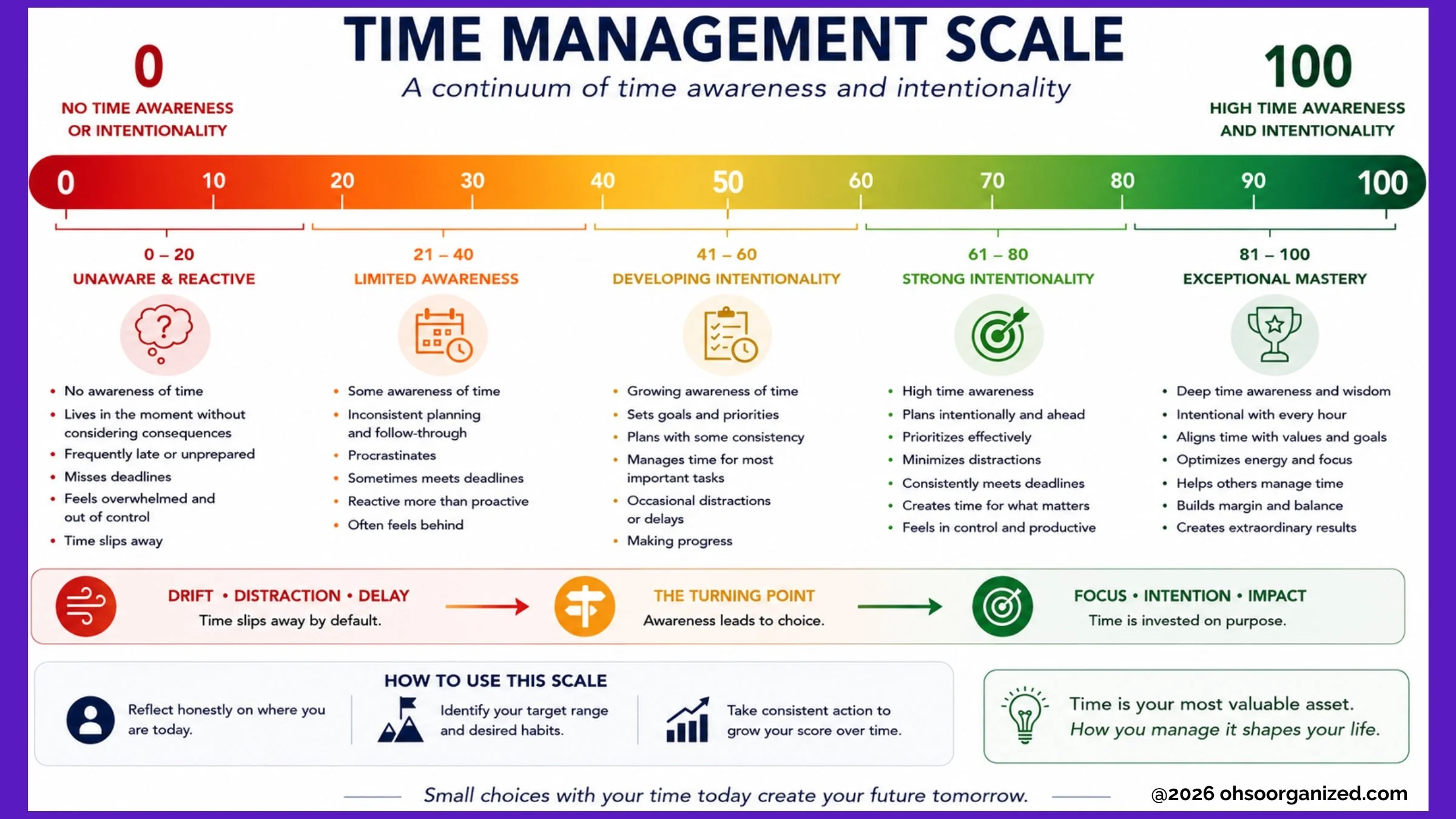
If you think of your relationship to time on a scale from zero to one hundred, with one end representing a total lack of time awareness and intentionality and the other representing high time awareness and intentionality, where would you place yourself? Whether your number is zero or one hundred, several concepts can improve your relationship with time and help you approach it more compassionately.


Time Management Scale

Before I share the strategies, review the Time Management Scale to get a sense of where you are right now. This isn’t an exact science, but the scale will help you identify your strengths and challenges. Understanding your relationship with time, combined with the concepts I’m about to share, can be a game-changer for you.

How to Use the Scale

  • Reflect honestly on where you are today

  • Identify your target range and desired habits

  • Take consistent action to improve your score over time

Remember that small choices about how you spend your time today shape your future.


3 Ideas to Encourage More Compassionate and Aligned Time Management

There are three ways to align your time in a more compassionate and powerful way. As I mentioned earlier, the time available each day is fixed. Your life and the time you have left are finite. None of us knows how many days remain. How you use this precious resource shapes your life.

1. Energy

Have you noticed how your energy ebbs and flows throughout the day? For example, I have more energy and mental clarity earlier in the day, and my energy lessens as the day goes on. Matching high-brain-demand tasks, such as planning or writing, with the time of day I’m ‘fully charged’ works better for me. Lower-brain-demand tasks, like resetting spaces or grocery shopping, can be done when my energy is less.

As you plan your available time and how you will spend it, factor in your energy. A while ago, Executive Coach Marcy Stoudt introduced me to the reframing of time management as energy management.

It’s helpful to consider how you’re planning and using your time. One thing I’ve learned is how much longer tasks take when my energy isn’t aligned. For example, when I’m tired and my energy is low, it takes me two to three times as long to do certain tasks as when I’m well-rested and in my high-energy, brain-power part of the day.

Aligning your energy management with how you use your time is a compassionate practice.

Small choices about how you spend your time today shape your future.
— Linda Samuels, CPO-CD®, CVOP™

2. Priorities

Have you noticed that some priorities, especially those tied to values, are fixed while others are flexible? For example, family might always be a top priority, so you’ll drop everything if someone in your family needs you. Or, when planning, family considerations drive your choices.

Flexible priorities are tasks, goals, and commitments that matter but don’t require immediate action or have a set deadline.

Flexible priorities could include:

  • Projects with open deadlines

  • Buy groceries sometime this week

  • Meet a friend for coffee in the next few months

  • Edit belongings to downsize

  • Plant flowers in the garden

  • Clean out the garage this season

  • Improve sleep habits

  • Try a meditation app

When considering your available time, aligning your priorities with your values and clarifying which tasks are fixed or flexible can lead to a more compassionate way forward.


3. Reality

Ah, yes! The old reality check. Here’s where time management can go sideways. Many people I know, including clients, struggle to align their available time with how long tasks take. This is where optimism needs to be balanced with a realistic understanding of time.

Has this happened to you? I see it most often on ambitious to-do lists. For example, you sit down to write your daily list. You have twenty or thirty items and expect to do them all today because they’re all “equally important.” Yet as the day goes on, you’ve only gotten to a few items. It’s clear you won’t finish everything. The day isn’t over, and you’re starting to feel stressed and defeated. Believe me, I get it. Reality and intention are two very different things.

  • Reality Check 1: Not everything is equally important.

  • Reality Check 2: Your list is too ambitious to complete in one day.

  • Reality Check 3: Optimism is great, but balance it with a realistic understanding of your available time and how long tasks take.

  • Reality Check 4: Reduce the size of your list. Curate a daily list of 1-5 items. Get those done, then review the time you have left before adding more to your day.

When you stop planning for an ideal day and start planning for the day you actually have, you gain a greater sense of control, accomplishment, and ease.


Are You Ready to Bring a More Compassionate Approach to Time Management?

The number is 24, as in the hours in a day. The number of days you have left is unknown. You have choices about how to spend your time. Use understanding and compassion as you plan and decide.

What will that look like for you? Which time management ideas resonate most with you? I’d love to hear your thoughts. I invite you to join the conversation.


How Can I Help?

Do you feel overwhelmed, disorganized, and time-stressed? Are you struggling to manage all your tasks, goals, and commitments? I’m here to help! You don’t have to do this alone. Virtual organizing is an extraordinary path forward – Local feel with a global reach.

Let’s connect! I’m easy to reach.

Managing your time, getting organized, and living with more ease are possible, especially with support.

 
 
3 Inspiring Time Questions That Will Help You Make Thoughtful Choices

The decisions you make relate to different points in time: the past, present, and future. Although you may not always view your choices this way, considering these time parameters can help reduce decision fatigue and create clarity surrounding decision-making.

Making thoughtful decisions can be challenging. Some common decision-making obstacles include:

  • Having too many choices

  • Lacking clarity

  • Feeling rushed

  • Asking unhelpful questions

  • Deciding when you’re exhausted

  • Being afraid to make the wrong choice

Any of these challenges can cause overwhelm, procrastination, or paralysis. However, when you ask questions based on time, it can cut through the noise, clarify your options, and motivate action.


1. Question to Let Go of the Past

What’s weighing down your backpack that needs to be released?
— James Clear

In a recent edition of James Clear’s 3-2-1 newsletter, he explained how “unfinished tasks” carried in your “invisible backpack” weigh you down. Many of these tasks are ones you will think you “should do,” but will probably never get around to.

Clear suggests two strategies. To “lighten the load: finish the task or let it go.” Applying a past timeframe to your decision about completing or releasing a task can help.

Consider these questions:

  • How long have you been worrying about and carrying these tasks with you?

  • Are past goals or commitments holding you back?

  • Which ones are no longer relevant, important, or necessary?


2. Question to Improve the Present

What small change could you make to your surroundings that would steer you toward good habits and away from distractions?
— James Clear

In another 3-2-1 newsletter, Clear encourages making tiny tweaks to your environment to support building better habits and reducing distractions. Only you know which habits you want to strengthen and which distractions are getting in your way.

Using the present timeframe idea to make proactive choices can be effective here. To do this, think about a current habit you want to build or improve. For example, let’s say you often run late to appointments. This is a source of stress for you and the people in your life. You want to be more punctual, yet find it challenging to get out of the house on time. Let’s say chronic lateness is caused by disorganization at home or your tendency to hyperfocus, which interrupts your sense of time.

Making a slight change in your environment to mitigate distractions and support a better habit could include things like:

  • Gather everything you need the night before

  • Wake up earlier to prepare

  • Use labeled timers to help with transitions and activation


3. Question to Imagine the Future

What will my future-self thank me for doing now?
— Stephanie Sarkis, PhD

In Ari Tuckman’s book The ADHD Productivity Manual, he shares one of his favorite questions posed by Stephanie Sarkis, PhD. She asks, “What will my future-self thank me for doing now?”

Let’s apply the future timeframe lens to this inquiry. While the question asks you to do something in the present, it’s in service of your future self.

Think about a goal you want to achieve. Maybe it’s organizing your legal and end-of-life papers, downsizing, or eating healthier. None of these will be realized in the future without taking action now.

Embrace the future construct. Visualize what ‘done’ will look and feel like. This will motivate you now to take action and accomplish the future results you desire.


How to Make More Thoughtful Choices?

Making wise decisions begins with asking good questions. Including a time perspective can clarify your choices. Do you consider the past, present, and future when making decisions? How does using a time construct affect you?

I’d love to hear your thoughts. I invite you to join the conversation.


How Can I Help?

Do you need support with organizing, letting go, or managing your time? I’d love to help! Virtual organizing is an extraordinary path forward – Local feel with a global reach.

Let’s talk. You can:

Organizing your time and space is possible, especially with support.

 
 
Here Are 5 Most Interesting and Best Time Management Discoveries - v50

Enjoy the latest release (v50) of the “What’s Interesting?” series, which features my most recent finds that inform, inspire, and relate to organizing and life balance. These unique time management discoveries reflect this month’s blog theme.

You are an engaged, vibrant, and generous group. I am deeply grateful for your ongoing presence, positive energy, and contributions to this community. I look forward to your participation and additional contributions to the collection I’ve sourced.

What do you find interesting?


What’s Interesting? – 5 Best Time Management Discoveries

1. Interesting Read – Productivity Time

Do you or someone you know have ADHD and struggle with productivity, consistency, and punctuality? If so, you’ll love the latest book by psychologist, author, presenter, and thought-leader, Ari Tuckman, PsyD, MBA.

He draws on his 40,000 hours of client work to share strategies and insights on how people with ADHD can get things done.

In The ADHD Productivity Manual, Ari explores thirty-six areas that affect productivity for individuals with ADHD. Topics include:

  • How ADHD makes it harder to see time

  • Essentials for making the most of your brain

  • Clarifying your goals

  • Minimizing distractions

  • Letting go of perfection

  • Navigating feelings of overwhelm

Ari says, “The obvious goal of this book is to help you get more done. The less obvious, but more important goal is that I want you to feel good about yourself.” He goes on to say that “ADHD is a disorder of converting intentions into actions. This book is all about action.”


2. Interesting Article – Timeboxing

Have you ever tried timeboxing? In Rebecca Muller’s Thrive Global article, “Try This Now: ‘Timebox’ Your Tasks at Work,” she makes the case for using this visualization exercise to help you prioritize and focus on which tasks to tackle first and which can wait. This approach can be especially beneficial when you feel overwhelmed and stressed by a lengthy to-do list.

Here is one method to timebox:

  • Grab a sheet of paper

  • Draw a column of boxes

  • Put each task in a box based on its priority level

You will quickly visualize which items require immediate attention and which are non-urgent. Muller quotes Marc Zao-Sanders in a Harvard Business Review piece. Zao-Sanders says about timeboxing, “It’s visual, intuitive, and obvious.”

In what ways could timeboxing be an effective strategy for you?


3. Interesting Product – Grounding Time

Busy schedules, excessive stress, and uncertainty can leave you feeling emotionally depleted and anxious. Does your day involve pushing yourself to the point of exhaustion? If so, it’s vital to restore your well-being by taking time to ground and calm yourself.

There are various ways to accomplish this, such as meditating, taking nature walks, journaling, talking with a loved one, slowly sipping a beverage, or gazing out the window.

Another idea is to use a time reminder for grounding. I found this adorable stress reliever made by Mindsight. The six-inch-tall Breathing Buddha helps you practice mindful breathing in short sprints. It features a simple visual soft light for guidance, pre-set breathing cycles, is rechargeable, and is portable.

What helps you feel relaxed and grounded?


It’s vital to restore your well-being by taking time to ground and calm yourself.
— Linda Samuels, CPO-CD®, CVOP™


4. Interesting Resource – Laugh Break Time

While life isn’t all puppies and rainbows, there’s something life-affirming about taking time for silly, joy-inducing moments. One way to do that is through laughter.

When was the last time you had a good laugh? I’m talking about full-body, uncontrollable, contagious laughter. Maybe you saw a comedian, heard a great joke, or watched a funny movie. Something tickled your giggle motor, and the laughter began.

By the way, if you haven’t seen the movie “Bad Shabbos,” I highly recommend it. I laughed so hard that my face hurt.

On a recent trip with my wonderful husband, Steve, we stopped at the Whispering Oaks Vineyard in Sunbury, PA. I gazed at the lush green landscape and sipped a delicious frozen wine slushy, which has become my new favorite drink. Then we shared this playful moment.

Steve started laughing, and I couldn’t help but join in. It makes me laugh every time I watch the video, and it reminds me of how essential laughter breaks are in life. While I recognize how personal humor can be, I hope this short clip brings a little lightness to your day.

What makes you laugh?


5. Interesting Thought – Progress Time

It’s easy to get discouraged when you are making changes or striving for a larger goal. The secret to moving forward and boosting motivation hinges on redefining progress.

Break large projects into smaller, manageable, and accomplishable parts. Celebrate the progress you are making with each action, even if that means simply acknowledging it. Keep going until you achieve the results you want.

A puzzle consists of many pieces. Each piece serves a role in creating the complete picture. Completion occurs by finding and placing one puzzle piece at a time. Likewise, achieving your goals happens through small actions that support progress.

What will you make progress on today?


Making the Most of Your Time

Each person receives the gift of 24 hours a day. It’s up to you to decide how you want to use your days, what you will prioritize, and what you will put on hold or release.

How can you manage your time better? What is one thing you could change that would make a significant and positive difference? Which of these discoveries resonates most with you? I’d love to hear your thoughts and invite you to join the conversation.


How Can I Help?

Do you want support to get unstuck, become organized, and utilize your time more effectively? I’m here to help. Virtual organizing is an extraordinary path forward – local feel with global reach.

Please email me at linda@ohsorganized.com, call 914-271-5673, or schedule a Discovery Call. Change is possible, especially with support.

 
 
How a Helpful Productivity Reframe Makes More Time for Fun

There’s nothing wrong with being productive. However, life can be stressful if your focus rests solely on to-do lists, getting things done, and making every minute count. You might find it surprising to hear this from a professional organizer. But guess what? Everyone needs time to relax, not be scheduled, and have fun.

Some time ago, one of my clients emailed me an article from The New York Times by Melissa Kirsch, titled “Satisfying vs. Productive.” In it, Kirsch made a distinction between the two concepts. She said that “A productive day implies a day in which you got some things done, a certain degree of industry. Whereas a satisfying day might be one in which you didn’t necessarily do very much at all, but the contents of the day seem totally appropriate given any number of factors…”

Kirsch presented the idea that instead of criticizing yourself for what didn’t get done, you should make time upfront to be more intentional. She suggested setting your day up for success by asking, “What would constitute a satisfying day today?” Think about how you want to feel by the end of the day. What needs to happen (to do or not do) to get there?


The “Satisfying” Perspective

As someone who enjoys being productive, I also value a day that isn’t solely focused on crossing items off my list. Using the “satisfying” lens to reframe the intent of certain days boosts my joy factor and removes the guilt and pressure to produce.

By letting go of my to-dos, I can fully embrace how a day unfolds. The day’s intent might be to have fun or relax. It could involve exploring or wandering. But what the day isn’t is being list or task-driven.


A Perspective Experiment

Recently, I had a chance to experiment with this idea. We took a few days off and put work on hold. During our trip, we did some planned and unplanned things.

One of the impromptu activities was visiting Knoebels, an amusement park. It was so much fun exploring a new place, going on rides, and indulging in good eats. Have you ever had a Belgian waffle ice cream sandwich filled with chocolate peanut butter ice cream? It was delicious!

I digress. My husband loves riding roller coasters, while I prefer the less thrilling rides. I happily waited while he enjoyed the scary attractions. Then he joined me on the gentler ones, like the Ferris wheel and carousel. I love the movement of the carousel—going up, down, round and round with no destination in sight. No worries, just pure delight.

Aside from unpacking, no productivity tasks or thoughts were on my mind when we returned home. Without a doubt, the day and our trip had been soul-nurturing, satisfying, and fun.

I was happy about my response to Kirsch’s question, “What would constitute a satisfying day today?” For me, it had been setting aside the list, doing something spontaneous, and having fun!

What would constitute a satisfying day today?
— Melissa Kirsch

What Does Your Day Look?

Productivity isn’t a dirty word. However, when you start to view productivity as satisfying, it can have a positive effect on your experience. What does a productive day look like for you? Is it the same as or different from a satisfying one?  

I’d love to hear your thoughts. I invite you to join the conversation.


How Can I Help?

Do you need support with organizing, editing, or managing your time? I’d love to help! Virtual organizing is an extraordinary path forward – Local feel with a global reach.

Making your days intentional and satisfying is possible, especially with support.