


Posts tagged garage
3 Useful Ways for Better and More Compassionate Time Management

You and I share at least two things in common. We both have 24 hours in a day, and our days are finite. Yet how we experience and use our time varies widely.

Perhaps you are time-aware. You know how much time you have and spend it intentionally. Or maybe you have difficulty keeping track of time, feel time-poor, are easily distracted, and never have enough hours to get things done.

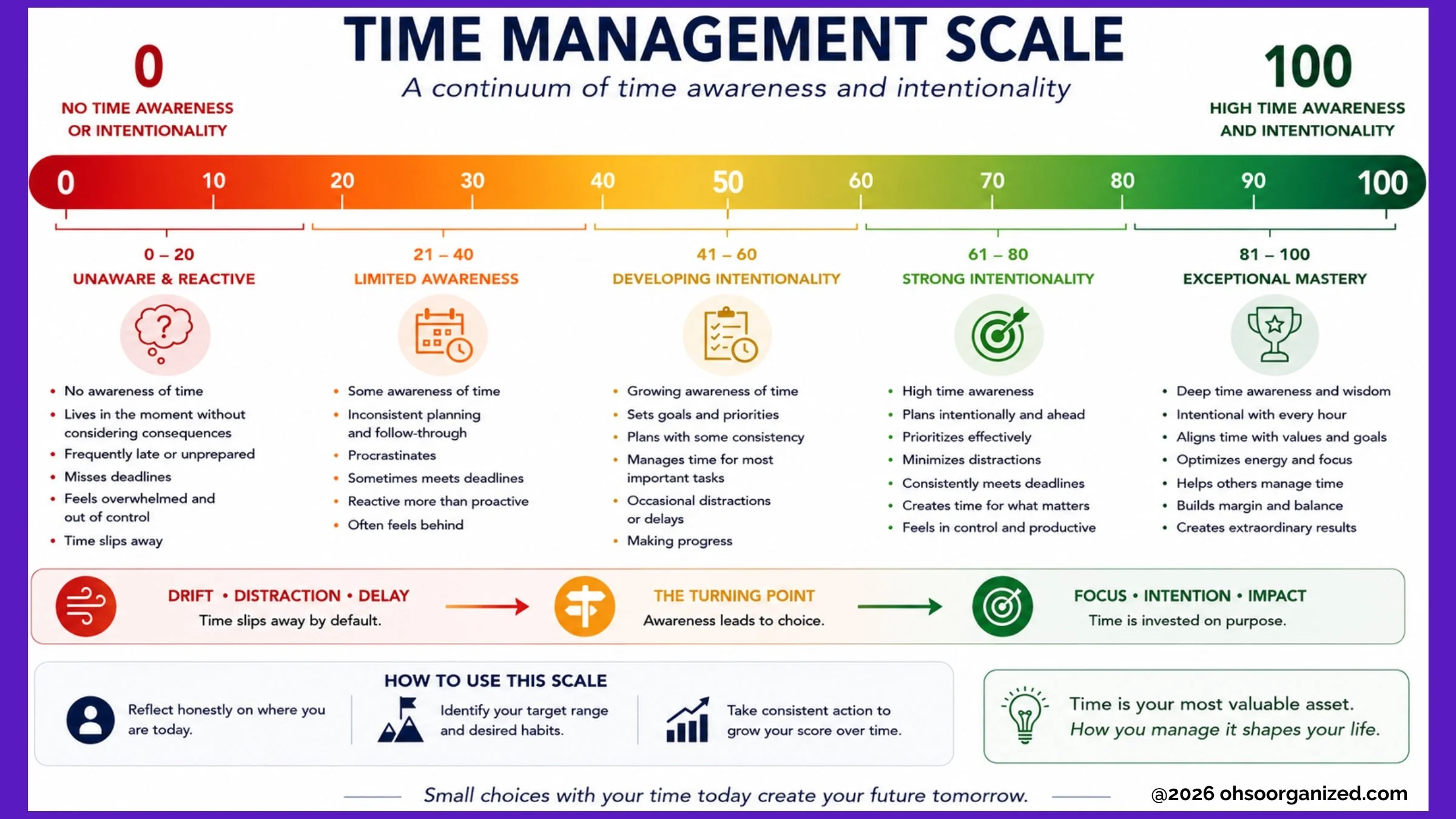
If you think of your relationship to time on a scale from zero to one hundred, with one end representing a total lack of time awareness and intentionality and the other representing high time awareness and intentionality, where would you place yourself? Whether your number is zero or one hundred, several concepts can improve your relationship with time and help you approach it more compassionately.


Time Management Scale

Before I share the strategies, review the Time Management Scale to get a sense of where you are right now. This isn’t an exact science, but the scale will help you identify your strengths and challenges. Understanding your relationship with time, combined with the concepts I’m about to share, can be a game-changer for you.

How to Use the Scale

  • Reflect honestly on where you are today

  • Identify your target range and desired habits

  • Take consistent action to improve your score over time

Remember that small choices about how you spend your time today shape your future.


3 Ideas to Encourage More Compassionate and Aligned Time Management

There are three ways to align your time in a more compassionate and powerful way. As I mentioned earlier, the time available each day is fixed. Your life and the time you have left are finite. None of us knows how many days remain. How you use this precious resource shapes your life.

1. Energy

Have you noticed how your energy ebbs and flows throughout the day? For example, I have more energy and mental clarity earlier in the day, and my energy lessens as the day goes on. Matching high-brain-demand tasks, such as planning or writing, with the time of day I’m ‘fully charged’ works better for me. Lower-brain-demand tasks, like resetting spaces or grocery shopping, can be done when my energy is less.

As you plan your available time and how you will spend it, factor in your energy. A while ago, Executive Coach Marcy Stoudt introduced me to the reframing of time management as energy management.

It’s helpful to consider how you’re planning and using your time. One thing I’ve learned is how much longer tasks take when my energy isn’t aligned. For example, when I’m tired and my energy is low, it takes me two to three times as long to do certain tasks as when I’m well-rested and in my high-energy, brain-power part of the day.

Aligning your energy management with how you use your time is a compassionate practice.

Small choices about how you spend your time today shape your future.
— Linda Samuels, CPO-CD®, CVOP™

2. Priorities

Have you noticed that some priorities, especially those tied to values, are fixed while others are flexible? For example, family might always be a top priority, so you’ll drop everything if someone in your family needs you. Or, when planning, family considerations drive your choices.

Flexible priorities are tasks, goals, and commitments that matter but don’t require immediate action or have a set deadline.

Flexible priorities could include:

  • Projects with open deadlines

  • Buy groceries sometime this week

  • Meet a friend for coffee in the next few months

  • Edit belongings to downsize

  • Plant flowers in the garden

  • Clean out the garage this season

  • Improve sleep habits

  • Try a meditation app

When considering your available time, aligning your priorities with your values and clarifying which tasks are fixed or flexible can lead to a more compassionate way forward.


3. Reality

Ah, yes! The old reality check. Here’s where time management can go sideways. Many people I know, including clients, struggle to align their available time with how long tasks take. This is where optimism needs to be balanced with a realistic understanding of time.

Has this happened to you? I see it most often on ambitious to-do lists. For example, you sit down to write your daily list. You have twenty or thirty items and expect to do them all today because they’re all “equally important.” Yet as the day goes on, you’ve only gotten to a few items. It’s clear you won’t finish everything. The day isn’t over, and you’re starting to feel stressed and defeated. Believe me, I get it. Reality and intention are two very different things.

  • Reality Check 1: Not everything is equally important.

  • Reality Check 2: Your list is too ambitious to complete in one day.

  • Reality Check 3: Optimism is great, but balance it with a realistic understanding of your available time and how long tasks take.

  • Reality Check 4: Reduce the size of your list. Curate a daily list of 1-5 items. Get those done, then review the time you have left before adding more to your day.

When you stop planning for an ideal day and start planning for the day you actually have, you gain a greater sense of control, accomplishment, and ease.


Are You Ready to Bring a More Compassionate Approach to Time Management?

The number is 24, as in the hours in a day. The number of days you have left is unknown. You have choices about how to spend your time. Use understanding and compassion as you plan and decide.

What will that look like for you? Which time management ideas resonate most with you? I’d love to hear your thoughts. I invite you to join the conversation.


How Can I Help?

Do you feel overwhelmed, disorganized, and time-stressed? Are you struggling to manage all your tasks, goals, and commitments? I’m here to help! You don’t have to do this alone. Virtual organizing is an extraordinary path forward – Local feel with a global reach.

Let’s connect! I’m easy to reach.

Managing your time, getting organized, and living with more ease are possible, especially with support.


One Effective Strategy to Easily Calm Your Mind Clutter

Does this sound familiar? Your mind is filled with a running list of tasks, places to visit, and projects to start (or finish). The thoughts swirling in your brain feel like one giant, cluttered mess.

It can be more challenging to concentrate, take action, or make progress because your ponderings are caught in thought loops. Simply thinking about the possibilities can leave you feeling anxious, exhausted, or demotivated.

Guess what? I’ve been there, too. It’s not that I don’t have task lists to manage, because I do. However, those tasks and events have already been prioritized, planned, and accounted for. They aren’t the issue, but the unaccounted-for ones are. Many of those items require coordination with my husband, Steve.

To clear my mind clutter, I engaged in a helpful process that I will share with you. If your cluttered thoughts have nowhere to go, I encourage you to experiment with this strategy.


The Process to Calm Mind Clutter

Step 1: Activate the Process

  • This may seem obvious, but the first step is to schedule a time to actively work on clearing your mind clutter. This intentional act will help you move in a productive direction.

  • Choose a time when you’re at your best. Steve and I decided to meet on a weekend morning after breakfast when we felt alert and well-rested.


Step 2: Do a Brain Download

  • Release your thoughts, which will immediately clear your mind clutter. This clearing is analogous to decluttering a kitchen counter or editing an overflowing basket of magazines. Relief is felt as space opens up.

  • The brain download can take many forms. Your capture tool can be analog, digital, or auditory. I used a blank piece of paper, which I titled “Planning with Steve.”

  • Create categories if it’s helpful. I separated the page into four columns, each representing a different category: Papers/Logging, Fun, Home, and Financial.

  • Populate your capture tool. As soon as a thought surfaced, we categorized and added it to the corresponding column. For example, “Visit the New York Botanical Garden went into the Fun category. “Clear out the garage” was added to the Home column.


Step 3: Prioritize

  • Your capture tool is probably quite full now. You might feel overwhelmed, as in, “How am I going to get it all done?” You can accomplish everything, but not all at once.

  • Prioritizing comes next. Instead of planning every single thing you captured, select the top three or four things you want to focus on first.

  • There is no right or wrong way to prioritize. For example, your priorities could be time-based if something has a specific deadline, or preference-based, as in what you’d like to accomplish or do first. We opted to prioritize several things from the Fun and Home categories.


Step 4: Commit

  • Commitment is the powerhouse of the mind decluttering strategy. It is essential and is often neglected. Overlooking this aspect can make Steps 1-3 ineffective.

  • Have your calendar ready.

  • Choose one of the priorities you identified.

  • Schedule a time block or blocks for that priority. We began by scheduling dates from the Fun category and then added a few projects from the Home category.

  • Repeat choosing and scheduling until those three or four top priorities are blocked out on your calendar.

  • We found it less overwhelming to focus on and schedule only the top few priorities. We will revisit this process and repeat Steps 3 and 4 once we have made progress on our initial priorities.

  • As an alternate approach, you may prefer to schedule everything from your brain download list in one sitting.

Commitment is the powerhouse of the mind decluttering strategy.
— Linda Samuels, CPO-CD®, CVOP™

The Benefits of Mind Decluttering

There are many benefits to clearing mind clutter. Here are some of the positives I experienced using this process:

  • My mind feels clearer.

  • While we utilized a team approach for mind decluttering, I also see value in using this strategy individually.

  • The unproductive thought loops have ceased.

  • That anxious feeling has dissipated.

  • I feel less burdened by the projects and events because they now have a designated slot for attending to them.

  • I am excited because we have set aside time to focus on things that are important to us.

  • I feel confident that we will complete the tasks we prioritized.

  • I am glad that projects that have been incomplete for a long time will now be brought to completion.

  • I have happy anticipation about the fun things we’ve scheduled.


What Helps You Release Mind Clutter?

There are many ways to ease mind clutter, including the strategy I shared. What helps you declutter your mind? In what ways could the process I described be beneficial to you?

I’d love to hear your thoughts. I invite you to join the conversation.


How Can I Help?

Do you need support with organizing, editing, or decluttering your thoughts? I’d love to help! Virtual organizing is an extraordinary path forward – Local feel with a global reach.

Please schedule a Discovery Call, email me at linda@ohsorganized.com, or call 914-271-5673. Living clutter-free is possible, especially with support.


3 Reasons for Lack of Motivation and How to Get Motivated

Have you ever experienced that intense, inner push that propels you towards your desired goal? Or perhaps, you’ve felt the opposite and lacked the energy and motivation to move forward. In Kendra Cherry’s article, What Is Motivation? she explains,

“Motivation is the process that initiates, guides, and maintains goal-oriented behaviors. It is what causes you to act, whether it is getting a glass of water to reduce thirst or reading a book to gain knowledge.

Motivation involves the biological, emotional, social, and cognitive forces that activate behavior. In everyday usage, the term ‘motivation’ is frequently used to describe why a person does something. It is the driving force behind human actions.”

There are many reasons why we become motivationally challenged, including fear of failure, comparison, and drudgery. In one of my most popular posts, 10 Most Common Motivation Challenges & Easy Solutions, I explore these and other ideas. Since motivation concerns is a topic many of us are currently struggling with, I decided to expand on the original post to give you some other relevant motivation challenges and solutions.


3 Reasons for Lack of Motivation and How to Get Motivated

1. “Fuzzy brain.”

With the hundreds of Zoom calls and conversations I’ve had in these past months, there have been countless times when someone connected feeling unmotivated to “fuzzy brain,” “brain fog,” “bunker brain,” or “COVID brain.” Lack of motivation is understandable since we live with intense uncertainty and stress caused by the pandemic and the current political, social, and economic climate. Neuroscientists Hilke Plassmann and Benjamin Kessler, describe this mentally fuzzy phenomenon. They explain that “the combination of impaired analytical thinking and heightened external sensitivity creates what can be called ‘Covid-19 brain’ – a fragile, frazzled state that keeps our thoughts simultaneously on edge and unfocused.”

Solution:  To heal the brain fog, Plassmann suggests using music to restore your equilibrium, regulate your emotions, and increase your focus. She also suggests engaging in mindfulness meditation, especially breathing focused practices, that regulate brain activity.


2. Emergency, emergency!

As if the pandemic isn’t enough, many of us are also experiencing life emergencies such as loss of loved ones, medical challenges, or loss of jobs, income, or housing. When these events happen, it’s hard enough. But when they occur in this extreme environment, it is even more likely your motivation will get disrupted. When your days are spent putting out the emergency fires, and there are underlying stress and anxiety because of the pandemic, there might not be much oomph remaining to expend energy on your goals.

Two weeks ago, my 91-year old mom, who has dementia, broke her hip. She ended up in the hospital, had surgery, and is now in rehab. As if that weren't enough, she had two additional emergencies and ER visits during this time. Talk about being on high alert! Let’s just say that while I have been doing my best to work on my goals and stay motivated, there were moments when I felt like I was walking through molasses, as in slow in going.  One of my weekly goals is writing my blog post. While I am motivated to write, with the mom stuff happening, it has been challenging to focus. So when I sat to write what was going to be a ten-point post, I gave myself some slack and reduced it to three.

When life’s emergencies occur in this extreme environment, it is even more likely your motivation will get disrupted.
— Linda Samuels, CPO-CD®

Solution: Life emergencies are the time to be especially kind to you. Acknowledge how your high alert state is depleting your reserves. The crisis will eventually pass. Make sure that you increase your self-care with enough sleep, hydration, nutrition, and movement. Minimize your self-expectations. What can you let go of? Focus on what’s most important now. Reach out to your friends and family for support. As your emergency passes, you will have more energy and motivation to work on your goals.


3. Can’t take the heat.

Yes. I know it is summer. And with this season comes hot weather. I don’t know about you, but it’s harder for me to activate when it’s hot. I remember the many summer vacations spent with our daughters in The Outer Banks. It was sweltering in North Carolina. The heat was tolerable when we were at the beach or in the air conditioning. However, when we explored the local towns, it felt like we were walking in an oven. Our energy and motivation to do anything were compromised. It seemed like a significant achievement just to choose and eat an ice cream cone. Even though New York (where I live) isn’t North Carolina hot, the temperature can still affect my motivation. Are you climate-sensitive?

Solution:  If you are affected by the warm weather, notice and acknowledge that. Consider some workarounds that will help increase your motivation. Things as simple as changing your clothing to lighter fabrics and colors, adding a fan to your workspace, or taking your brisk walk in the early morning or late evening, can help. Remember to hydrate, hydrate, and hydrate some more. Plan projects like garage or attic organizing for the colder weather. 


Take a moment to recognize that motivation can wane. It doesn’t mean it will be gone forever. It does mean you might need to experiment and make a few adjustments in behavior or perspective to nurture its return. What motivation challenges are you experiencing? What helps you get motivated when you are struggling? I’d love to hear your thoughts. I invite you to join the conversation!


Dream Possibilities
Fall+Leaves.jpg

Organizing isn’t just about sorting papers, editing closets, and decluttering junk drawers. It’s also about having the level of order that’s comfortable for you. Getting organized will reduce the stress of life’s details, enable you to accomplish larger goals, and give you more time to embrace your passions.

Dreaming is an essential part of the organizing process. There are several ways to encourage the dream juices to flow.

Dream small. How would you use that time if you had an extra 30 minutes free each day? Would you read a book, walk, or have coffee with a friend? If 30 additional minutes a day seems like a tremendous gift, begin here.

Once you’ve secured those minutes, think about moving on to bigger goals. Life can be overwhelming. Sometimes, we need time to re-energize so that we can be present throughout the rest of our days. I regularly have to remind myself to stop and take that needed break.

Dream moderately. If there are 52 weekends per year and you reserved just four of them to complete a short-term project, what would it be? Sometimes we think about “projects” we’d like to do, but never schedule the time to complete them. With some planning and commitment, it is possible to accomplish some of these dreams.

I don’t know how it happened again, but our garage needs to be organized. Since I’m not excited to get in there and do it, I know it won’t get done unless my husband and I block out the time to do so. Guess what I’ll be doing one of these fall or spring weekends?

Dream big. What would you want to accomplish if time, money, or circumstance weren’t challenges? Let your mind dream without criticism or judgment. Often, we tend to discourage ourselves before even taking our first steps forward. Try to suspend all negativity; there is no harm in dreaming and wishing. Identifying what you’d like comes before any action can occur.

Each New Year’s Eve, our family reflects on the past year and future thinks about goals and wishes for the coming year. We know that not all of our dreams will be accomplished, but we also realize how important it is to record them. The act of taking that one step puts these ideas into motion. When we return the following year to review, we are amazed by how many of our hopes have been realized.

The possibilities are there for you. Whether you need time to rejuvenate, accomplish projects, or push the boundaries of your comfort zone, setting aside time to bring some of these dreams into reality through thought and action can make all the difference in the life balance and satisfaction you seek.

Join in the conversation. What dream phase are you in? What are you thinking about? If you join the conversation and leave a comment on this post, you will be automatically entered to win a very cool "To-Do Tattoo" by Fred and Friends. One lucky winner will be chosen on Sunday, October 16, 2011.
