

Posts tagged reality
3 Useful Ways for Better and More Compassionate Time Management

You and I share at least two things in common. We both have 24 hours in a day, and our days are finite. Yet how we experience and use our time varies widely.

Perhaps you are time-aware. You know how much time you have and spend it intentionally. Or maybe you have difficulty keeping track of time, feel time-poor, are easily distracted, and never have enough hours to get things done.

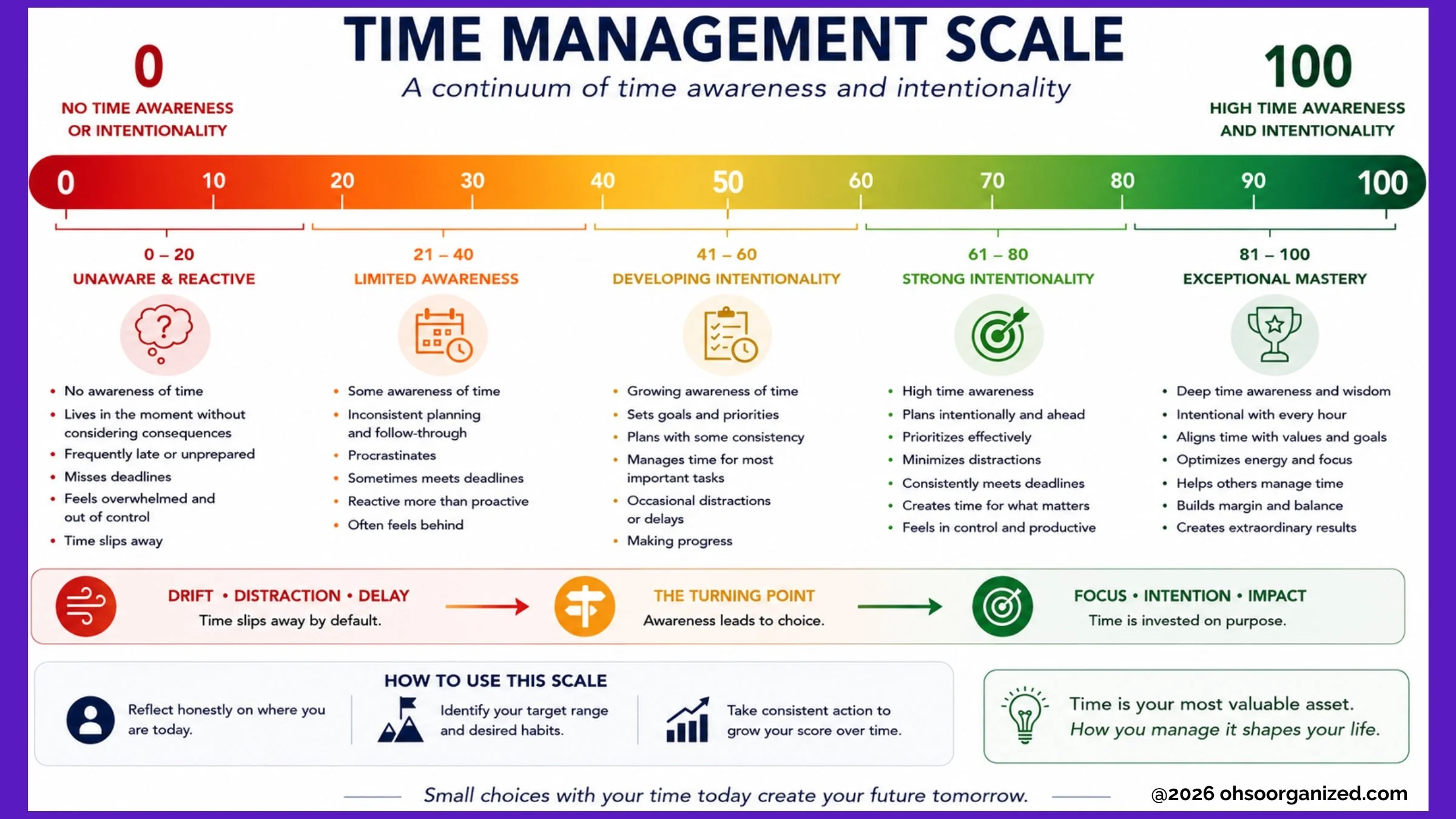
If you think of your relationship to time on a scale from zero to one hundred, with one end representing a total lack of time awareness and intentionality and the other representing high time awareness and intentionality, where would you place yourself? Whether your number is zero or one hundred, several concepts can improve your relationship with time and help you approach it more compassionately.


Time Management Scale

Before I share the strategies, review the Time Management Scale to get a sense of where you are right now. This isn’t an exact science, but the scale will help you identify your strengths and challenges. Understanding your relationship with time, combined with the concepts I’m about to share, can be a game-changer for you.

How to Use the Scale

  • Reflect honestly on where you are today

  • Identify your target range and desired habits

  • Take consistent action to improve your score over time

Remember that small choices about how you spend your time today shape your future.


3 Ideas to Encourage More Compassionate and Aligned Time Management

There are three ways to align your time in a more compassionate and powerful way. As I mentioned earlier, the time available each day is fixed. Your life and the time you have left are finite. None of us knows how many days remain. How you use this precious resource shapes your life.

1. Energy

Have you noticed how your energy ebbs and flows throughout the day? For example, I have more energy and mental clarity earlier in the day, and my energy lessens as the day goes on. Matching high-brain-demand tasks, such as planning or writing, with the time of day I’m ‘fully charged’ works better for me. Lower-brain-demand tasks, like resetting spaces or grocery shopping, can be done when my energy is less.

As you plan your available time and how you will spend it, factor in your energy. A while ago, Executive Coach Marcy Stoudt introduced me to the reframing of time management as energy management.

It’s helpful to consider how you’re planning and using your time. One thing I’ve learned is how much longer tasks take when my energy isn’t aligned. For example, when I’m tired and my energy is low, it takes me two to three times as long to do certain tasks as when I’m well-rested and in my high-energy, brain-power part of the day.

Aligning your energy management with how you use your time is a compassionate practice.

Small choices about how you spend your time today shape your future.
— Linda Samuels, CPO-CD®, CVOP™

2. Priorities

Have you noticed that some priorities, especially those tied to values, are fixed while others are flexible? For example, family might always be a top priority, so you’ll drop everything if someone in your family needs you. Or, when planning, family considerations drive your choices.

Flexible priorities are tasks, goals, and commitments that matter but don’t require immediate action or have a set deadline.

Flexible priorities could include:

  • Projects with open deadlines

  • Buy groceries sometime this week

  • Meet a friend for coffee in the next few months

  • Edit belongings to downsize

  • Plant flowers in the garden

  • Clean out the garage this season

  • Improve sleep habits

  • Try a meditation app

When considering your available time, aligning your priorities with your values and clarifying which tasks are fixed or flexible can lead to a more compassionate way forward.


3. Reality

Ah, yes! The old reality check. Here’s where time management can go sideways. Many people I know, including clients, struggle to align their available time with how long tasks take. This is where optimism needs to be balanced with a realistic understanding of time.

Has this happened to you? I see it most often on ambitious to-do lists. For example, you sit down to write your daily list. You have twenty or thirty items and expect to do them all today because they’re all “equally important.” Yet as the day goes on, you’ve only gotten to a few items. It’s clear you won’t finish everything. The day isn’t over, and you’re starting to feel stressed and defeated. Believe me, I get it. Reality and intention are two very different things.

  • Reality Check 1: Not everything is equally important.

  • Reality Check 2: Your list is too ambitious to complete in one day.

  • Reality Check 3: Optimism is great, but balance it with a realistic understanding of your available time and how long tasks take.

  • Reality Check 4: Reduce the size of your list. Curate a daily list of 1-5 items. Get those done, then review the time you have left before adding more to your day.

When you stop planning for an ideal day and start planning for the day you actually have, you gain a greater sense of control, accomplishment, and ease.


Are You Ready to Bring a More Compassionate Approach to Time Management?

The number is 24, as in the hours in a day. The number of days you have left is unknown. You have choices about how to spend your time. Use understanding and compassion as you plan and decide.

What will that look like for you? Which time management ideas resonate most with you? I’d love to hear your thoughts. I invite you to join the conversation.


How Can I Help?

Do you feel overwhelmed, disorganized, and time-stressed? Are you struggling to manage all your tasks, goals, and commitments? I’m here to help! You don’t have to do this alone. Virtual organizing is an extraordinary path forward – Local feel with a global reach.

Let’s connect! I’m easy to reach.

Managing your time, getting organized, and living with more ease are possible, especially with support.


How to Embrace Possibilities and Create More Ease and Joy in Your Life

Inspiration abounds. The fall season in the northeast profoundly influences my thoughts about possibilities. Seeing the bold color shift to saturated yellows, oranges, and reds encourages me to seek change.

Last week, I wrote about my guest bedroom makeover. I considered what was possible, turned those ideas into reality, and was motivated to make more changes.

I made additional unplanned tweaks and changes that were outgrowths influenced by the bedroom project. When you disrupt an area, physical space, and objects are moved. This spatial churning also affects thoughts. Undoing what was in one room opened my mind to seeing and experimenting in other areas.

Sometimes, you feel set and don’t have the need or desire to change anything. Those times can last for brief periods, months, or years. At a point, though, something will interrupt that state. You are ready to try something different, reorganize systems, or make significant life shifts.

Possibilities infiltrate your thoughts. When possibilities are paired with action, change occurs.


3 Unexpected Outcomes from Possibility Thinking

1. Discover Giddy, Joyful Ease

I’ll admit this openly: I love decorative pillows. They’re textural and colorful and instantly change the look of a room. Typically, I have no less than five pillows adorning the sofa or beds.

As you might imagine, keeping the pillows fluffed and arranged can be a pain. Plus, you need extra time to undo and make the beds—pillows off, pillows on. However, I was happy to do the pillow maintenance dance because I loved how they looked and felt. I was willing until recently.

When I transformed the guest bedroom, I rethought the decorative pillow arrangement on that bed. That encouraged me to reconsider the pillow situation in our bedroom. I’m almost embarrassed to say, but we had ten pillows, only two of which we used for sleep. As I write this, I’m laughing out loud. I never counted them up before. Ten pillows are ridiculous.

My supportive husband has always accepted my pillow obsession but recently started questioning their necessity. Between his input and my desire to reimagine other areas of our home, I felt emboldened to change things.

Our bed now has only four sleep pillows and one decorative pillow. I feel giddy, even joyful, when I undo the bed at night or make it in the morning. It’s so easy that it almost feels wrong. I love it!

It took a change in one room to open my mind to possibilities in other areas. The wheels continue to turn.


When you release what is unnecessary, you clear the path for possibilities.
— Linda Samuels, CPO-CD®, CVOP™

2. Create Organization and Accessibility

One of the most fabulous products I discovered during the bedroom renovation was the Elfa® drawer dividers. We redid the guest bedroom closet with an Elfa® system from The Container Store. The designer suggested using the drawer dividers. I loved them so much that I purchased more for other areas where I have Elfa® drawers.

I showcased them in the tea bag overflow drawer a few weeks ago. Since then, I decided to reorganize the gift wrap supply drawers using the dividers. Instead of the gift bags, tags, ribbons, and other supplies moving around each time I opened a drawer, the dividers keep items better organized and securely in place.

Since the drawer organization upgrade, I’ve wrapped a few gifts. It was so easy and fun! The supplies are more visible, accessible, and visually pleasing.

Enjoy this fun video, which demonstrates how easy the drawer dividers are to install.


3. Right-Size Your Stuff

I often discuss how letting go of things that have overstayed their welcome makes space for more of what you want in your life. Clutter or extra stuff you never use takes up physical and emotional space. When you release what is unnecessary, you clear the path for possibilities.

When we emptied the guest bedroom, it gave me pause to assess the removed items and make decisions about their future. I did ‘the edit’ and engaged in various questions to help me evaluate what to keep or let go. I asked letting go questions, including:

  • Does this fit or belong in the newly reimagined space?

  • Will I use it?

  • Do I still like it?

  • Could it go somewhere else?

  • Is it time to let it go?

  • Has it served its purpose and is no longer necessary?

I made decisions. Cardboard storage boxes were recycled and replaced with new containers. Some furniture, art, home goods, boxes, and decorative pillows (yes, those!) will be sold or donated.

Currently, I still have a pile of items waiting to be gone. Getting them out requires my time and attention. Using Facebook Marketplace, GreenDrop, or the Buy Nothing Group, things will exit. I am confident in my decisions and ready to release things.

This process began with thinking about possibilities in one space and resulted in letting go of things that are no longer needed. It feels good and will feel even better when the pile is gone.


What Possibilities Are Ahead?

What no longer works for you? What becomes possible with a slight tweak? What possibility will inspire more organization and ease into your life? How can letting go create a path for new opportunities? I’d love to hear your thoughts. I invite you to join the conversation.

Are you ready to move forward, get organized, and live with more ease? If so, I’m here to help. Please email me at linda@ohsoorganized.com or call 914-271-5673. Turning possibilities into reality is achievable, especially with support.


New Exciting Bedroom Fun Look Transformation: From Possibility to Reality

It’s a funny thing about possibilities. Dreaming and imagining are part of a possibility-thinking process. Simultaneously, angst, ambivalence, or uncertainty can also be present. Why is that?

You understand and live your current reality. It may not be how you want it, but it’s familiar. Thinking about alternatives can be thrilling, anxiety-producing, or scary. Change requires time, attention, and resources, which you might or might not have.

Something happened to me recently. Who knew a seemingly simple guest bedroom renovation and organizing project would be such an emotional, satisfying, liberating, and poignant experience?

For years, I wanted to reimagine our guest bedroom. Initially, the room was my art studio and office. After our first daughter, Allison, was born, it became her bedroom. When her sister, Cassie, was born, it became their shared space, “the girls’ room.” Fast-forward to them leaving for college, and it turned into a guest room. However, while I made a few minor changes after they left, I never altered the wall colors, window treatments, or closet.

The girls said, “Mom, you can change the room any way you want. It’s OK.” They repeated this message to me for years. The kids had moved on and kept encouraging me to, too. However, part of me wasn’t ready to let go of certain remnants of their living-at-home years. How could I paint over Allison’s murals or cover up the pencil growth chart markings? Also, I didn’t have the mental bandwidth to figure out how I wanted the room to be until now.


Possibilities Meet the Moment

What shifted? We had other home improvement projects happening, and I knew that the guest room’s time had come. My motivation to make this change was heightened. I didn’t want another year to pass without completing this goal. I was finally ready to turn possibilities into reality.


9 Phases of the Guest Bedroom Project

  • Imagine – Envision the possibilities. What do I want the room to look and feel like? How can I make it comfortable for guests and also include functional storage? What will the color scheme be? Can I refer to old vision boards or other visual inspiration sources?

  • Plan – Think through the process. How much time do I need to complete this project? Where can we (my husband, Steve, and I) carve out time in our schedule to work on this? How much of this project can we do ourselves? How much outside help do we need? Should we rip out and install a new closet interior or only paint the existing one?

  • Gather Resources – Identify vendors and resources. Which vendors can I use for painting and construction, purchasing blinds, framing, buying furniture, and redoing the closet? Which vendors are best for buying organizing containers and other products?

  • Budget – Determine the costs. What estimates do I need to get? What will different parts of the project cost (painting, furniture, headboard, bedding, blinds, closet, bins)? What is our overall budget?

  • Empty – Prepare the space for transformation. What must be removed from the room to prepare for painting and construction, and when can we empty it? How can I prepare emotionally for the temporary chaos and disruption?

  • Renovate – Do the work. How many days will the painter need to prepare, demo the closet, patch, and paint? After the room is painted and before we return the contents, when can Steve install the new Elfa® closet? When can Steve install the new window blinds?

  • Edit – Make decisions about room contents. Which items can I let go of by selling, donating, tossing, or giving away? Which things will return to the room? Which items need to be replaced? Which items belong elsewhere?

  • Organize – Return ‘keepers’ in an organized way. How will the contents be organized back into the room? Which items will need new storage containers? Do they need labels?

  • Finish – Complete the final touches. When will all furniture, lights, books, memorabilia, and games be returned to the room? Which bedding will I use? When can we hang the pictures, mount the wall hooks, and add the door stop? When will I consider the room done?


Emotional Surprises

When we emptied the room to prepare for the painter, I was surprised by how emotional I felt. I was physically handling boxes of the kiddos’ memorabilia, photo albums, books, games, and art. Touching, moving, and looking at objects from the past stirred up many emotions. I felt a powerful combination of gratitude, sadness, joy, and love.

I saw photos and objects from the past. Some images were of loved ones who are no longer alive. I looked at the kids’ art, writings, and school projects. I marveled at our detailed records of the milestones and everyday experiences. It was a journey of emotions as I reflected and remembered the beautiful years we spent raising our daughters.

Even when the room was empty, I could feel the love reverberating within its walls. Cherished memories traveled through time and space, which filled my heart and mind.

Bringing possibilities to fruition is gratifying.
— Linda Samuels, CPO-CD®, CVOP™

Practicing Flexibility

During the project, I remained flexible about my options, which was helpful. When a room's contents are removed, many unanticipated things can happen. Gifting yourself the flexibility to make new or different choices is beneficial.

  • Closet – The closet required some thought. Do we paint the existing closet or rip it out to install a new one? It would cost more to have a new closet interior. However, time-wise, it seemed most practical to redo it now. Plus, we would gain more storage space.

  • Furniture – After emptying the room, we liked how spacious it felt with less. While we intended to return the desk, we realized it was unnecessary and took up too much space. I’m letting go of the desk.

  • Art – After emptying the room and painting the interior, Allison’s murals and other framed art were no longer visible. With blank walls, I reimagined the space. We decided to have more blank wall space and only hang a few pieces, including a new one. I printed and framed one of the landscape photos I had taken in the Finger Lakes.

  • Memorabilia – I texted the kiddos photos and asked what they wanted to keep. I respected their responses and either let go or kept things accordingly. I also shared several pictures of their projects, writings, and other memorabilia I thought they’d get a kick out of seeing.


9 Lessons Learned

  • Imagining possibilities is fun and creative.

  • Bringing possibilities to fruition is gratifying.

  • Change is refreshing.

  • Change encourages more change.

  • Emptying one room sparked a reimagining, tweaking, and reorganizing of other areas, such as the pantry and our bedroom.

  • Letting go of things that have overstayed their welcome is liberating.

  • Life has stages. Organizing your space for the phase you’re in is affirming.

  • Embrace gratitude for what was and what is.


The Bedroom Transformation Video


What’s Possible for You?

How does possibility thinking show up for you? What changes have you made or want to make? I’d love to hear your thoughts. I invite you to join the conversation.

Are you ready to get unstuck, plan a new project, or create new organizing systems? If so, I’m here to help. Please email me at linda@ohsoorganized.com, call 914-271-5673, or schedule a Discovery Call. Moving forward is possible, especially with support.