

Posts tagged commitments
Goldilocks Inspires Useful Clues for How to Really Let Go

Do you remember the story of Goldilocks and the Three Bears? One of the main themes is Goldilocks’ search for what felt “just right.” One chair was too big, and another too small. She rejected both. However, when she found the one that fit, she knew it was the one for her and used it. The chair was right-sized and “just right” for her.

At the core of the Goldilocks philosophy is finding the sweet spot, the optimal place where things feel balanced, comfortable, and supportive. Who knew Goldilocks could help with letting go?

Are you struggling to let go of things, ideas, habits, or commitments? If so, a Goldilocks approach could help. Her decision tree went like this:

“This bed is too hard.”

“This bed is too soft.”

“This bed is just right.”

What will “just right” look and feel like for you?


Why is Letting Go Overwhelming?

There can be a lot to sort through, which can make letting go feel overwhelming. Clutter can accumulate from:

  • years of acquiring

  • gifts and inherited items from others

  • postponed decisions

  • emotional attachments

  • unclear or nonexistent organizational systems

  • being overscheduled

  • unclear boundaries

  • not following through on closure loops

Time is part of the equation, too. You need time to make decisions and to align what you own with who you are and what you need now. This can be tricky if you feel stuck in the past or are holding onto things for an aspirational future or self.

However, when you start making decisions based on who you are now and your current needs, it brings greater clarity as you let go.


Are You Sacrificing the Present?

Many years ago, I attended an ICD class on consumerism, minimalism, and experimentalism, presented by my friend and colleague, Lynne Johnson. She shared a quote about letting go.

How much of your present are you willing to sacrifice in order to save remembrances of your past to ponder in your future?
— Anonymous

The question aligns with the Goldilocks philosophy of the three-point decision tree, but from a time-based perspective. Consider what you are holding onto in relation to the:

  • Past - Are you willing to hold on to things from your past that keep you stuck and no longer serve you? Can you release them and move on?

  • Present - Are you willing to let those things take up physical space and mental energy, distracting you from the present? Can you let go and be more aligned with the present?

  • Future - Are you holding onto things with a glimmer of hope that you will revisit, use, or need them someday? Can you say goodbye to them in service of an unencumbered future?


What DOES Letting GO Look Like?

When you release what you no longer need, you invite more ease, better life alignment, joy, and growth. Even releasing one thing makes room for what’s most important, essential, and valued by you.

Letting go can look like this:

  • Donate the never-used pots and pans to make the ones used regularly more accessible.

  • Release rarely-used purses to make room for the ones you do use.

  • Recycle the papers that ‘time took care of’ so you can focus on what’s current.

  • Skip the to-do list to enjoy a beautiful spring weekend day.

What does letting go look like for you?


The Goldilocks of Letting Go

What happens when you begin to align your life so it feels “just right?” Will you release what no longer belongs, brings you joy, or is useful? Will letting go bring you closer to living your best life now? When you release what's blocking your energy, space, and thoughts, you create room for calm, growth, and happiness.

Which ideas resonate with you most? I’d love to hear your thoughts. I invite you to join the conversation.


How Can I Help?

Do you feel overwhelmed or disorganized? Do you want to let go of the unnecessary but feel stuck or unsure where to start? I’m here to help! You don’t have to do this alone. Virtual organizing is an extraordinary path forward – Local feel with a global reach.

Let’s connect! I’m easy to reach.

Letting go and getting organized are possible, especially with support.


5 Simple Practices to Joyfully Reduce Stress and Restore Balance Now

It’s the holiday season. Lights twinkle, gifts get wrapped, and plans are in flux. You’re doing your best to keep up with your daily commitments and the extra effort it takes to navigate this season of celebration, gatherings, and giving. It can be a lot, both wonderful and overwhelming.

On one hand, you have extra time to be with your loved ones and take a break from your normal routines. However, there can also be pressure to say “yes” to all invitations, buy gifts beyond your budget, or overindulge in holiday treats. There are more delicious cookies around than usual. Oh, no!

While the holiday season can be joyful, it can also be stressful, making you feel anxious and out of balance. The good news is that it doesn’t have to be that way.

Recently, I discovered some wonderful grounding practices in “Are You Made at Me? – How to Stop Focusing on What Others Think and Start Living for You” by Meg Josephson, LSCW. These strategies help break the cycle of chronic stress, which negatively affects the mind and body.


Stress: “A Flirty Little Loop”

What is the stress cycle all about? Josephson explains, “The body naturally responds to stress – whether it’s real, remembered, or perceived– with tension, and this response keeps stress and tension going in a flirty little loop.” She describes the four-step cycle:

  • Stressful Happening – This could be internal or external, such as “an anxious thought spiral or someone doing something to make you feel unsafe, whether or not you actually are.”

  • Body Reacts – Your body responds by tensing up.

  • Message Perceived – Tensed muscles send signals to the body indicating that “Something bad is happening! This is stressful.”

  • Cycle Continues – “The tense muscles cue more anxious thoughts, more muscular tension, and more panic.” These reactions perpetuate the stress-and-tension loop.

Josephson says, “When the mind is tense, so is the body. When the body is tense, so is the mind. By first noticing that we’re tensing up, feeling stressed, we can immediately insert a pause into this automatic process and begin to soften our bodies. Being aware of the stress is what allows us to start to break the cycle.”

I will highlight my top five favorite grounding practices from the 14 that Josephson shared. These will help you reduce stress, feel more balanced, present, and calm.

When the mind is tense, so is the body. When the body is tense, so is the mind.
— Meg Josephson, LCSW

5 Simple Grounding Practices to Reduce Stress and Nurture Balance

These techniques can be used at any time during your day when you feel stressed. It all starts with awareness—paying attention to body signals like tense muscles.

1. Increasing Exhale

Elongate your exhale by doing a few cycles where you exhale longer than you inhale. For example, inhale for a count of 4 and exhale for a count of 6. This technique stimulates the vagus nerve, which immediately activates the parasympathetic nervous system, or “rest and digest” mode.


2. Humming

Keep your mouth closed, relax your jaw, and breathe in and out through your nose while making a sound with your vocal cords. The gentle buzzing sound creates vibrations that stimulate your vagus nerve. Singing or chanting can also work because the larynx (the voice box) is connected to the vagus nerve.


3. Sensing with 5, 4, 3, 2, 1

Use your senses to ground yourself by noticing the environment around you right now. Observe what’s nearby, and “Name five things you can see, four things you can feel, three things you can hear, two things you can smell, and one thing you can taste.”


4. Using Your Hands

Research shows that “effective touch” is a stress reliever. This can include self-touch. Notice where you feel tension. Place your hand or palm on that area and breathe deeply. For example, if you’re feeling tension in your chest, put your hand there and breathe several times. This practice is calming and reduces stress.


5. Dancing

This practice feels especially fun during the holiday season. Of course, you can do it anytime. Dancing helps integrate movement and breath. It connects you to your body and takes you out of your head. Play your favorite tune and dance away.


How Do You Manage Stress and Invite More Balance?

It’s the season for joy and delight. But when you’re feeling stressed and off balance, accessing that joy can be difficult. Which of these five grounding practices resonates most with you? What else helps you feel grounded, calm, and balanced?

I’d love to hear your thoughts. I invite you to join the conversation.


How Can I Help?

Do you feel overwhelmed, disorganized, stressed, or out of balance? Would you like to make progress? I’m here to help! Virtual organizing is an extraordinary path forward – Local feel with a global reach.

Let’s connect! I’m easy to reach.

Getting organized is possible, especially with support.


One Insightful Question to Bring a Joyful Balance into Your Life

The holidays are quite the time of year. The twinkling lights decorating the landscape cue us to this season of giving, celebrating, and reflecting.

You might be finishing this year’s projects or beginning new ones to continue in the new year. While joy-inducing opportunities are abundant, balancing the holidays, work life, personal plans, and life maintenance responsibilities can be stressful.

There are many ways to bring calm and balance into your life, and I’ve written extensively about them.

Recently, I read something valuable and relevant from James Clear, which I’ll share with you. I hope you find it helpful as you navigate your balance this season.


First, The Back Story

Are you familiar with James Clear’s “3-2-1 Thursday” newsletter? Each issue includes three of his short ideas, two quotes from others, and one question to consider. One of my clients told me about it, and I signed up immediately. I enjoy receiving his weekly wisdom in its easily digestible format.


Two Simple Rules

In a recent newsletter, Clear shared this:

“Two simple rules:

  1. You get better at what you practice.

  2. Everything is practice.”

He encourages observing yourself and others to notice what we’re practicing. He reminds us that where you focus is a choice. For example, are you practicing…

  • “Getting mad on social media?”

  • “The fine art of noticing how they have been wronged?”

  • Stressing over being stressed?

  • Saying “yes” to the point of being overscheduled?

  • Not following through on commitments?

  • Engaging in negative self-talk?

  • Not sleeping enough?

  • Accumulating more stuff?


One Insightful Question

Bringing awareness to your practices is essential for changing where your time and energy go. Clear asks, “What are you practicing?”

Do you want to “get better” at nourishing practices? If so, focus on those while reducing harmful ones.

What are you practicing?
— James Clear

Here are several of my recent practices:


Which Practices Will Bring You More Balance?

You have an opportunity to create a better balance this season. What will you focus on during the last few weeks of the year? Which practices can you let go of that no longer serve you? Which ones do you want to invite in?

You have choices. I’m excited to see how this idea can shift your balance. I’d love to hear your thoughts. I invite you to join the conversation.


How Can I Help?

Do you want support decluttering, organizing, planning, or creating more balance? I’d love to help! Virtual organizing is an extraordinary path forward – A local feel with a global reach.

Please schedule a Discovery Call, email me at linda@ohsorganized.com, or call 914-271-5673. Organization, balance, and ease are possible, especially with support.
 
 
How to Let Go of What’s Not Working to Joyfully Make Way for What Does

Are there things in your life that just aren’t working? Maybe you have organizing systems, but they are cumbersome or impossible to maintain. Perhaps your spaces include what you use but aren’t set up in accessible ways. Or maybe your calendars are so packed with appointments and commitments that you don’t have time to rest and recharge. These are significant. Figuring them out and letting go can feel challenging.

Not all challenges are tricky. You might experience less complex issues that aren’t working. For example, you often:

  • Misplace your eyeglasses or keys

  • Can’t find a working pen when you need one

  • Search for the flashlight you had just the other day

  • Run out of milk

  • Move the same pile of papers from your desk to the floor.

Because these seem like insignificant challenges, you ignore them. You experience a slight annoyance here and feel bothered by something there. It’s enough to notice but not enough to do anything about it.


Enough Already

Doing something to remedy the situation can take months, years, or decades. You tolerate the inconvenience until one day, you say, “Enough is enough!” When that day comes, you are ready to let go of what’s not working to make way for what does.

Here’s the funny thing. When you get to the it’s-enough-already-point, that’s when the magic happens. You are ready to:

  • Let go of being irritated

  • Be mindful of what’s going on

  • Have room in your brain to problem-solve

  • Change the status quo


The Lamp

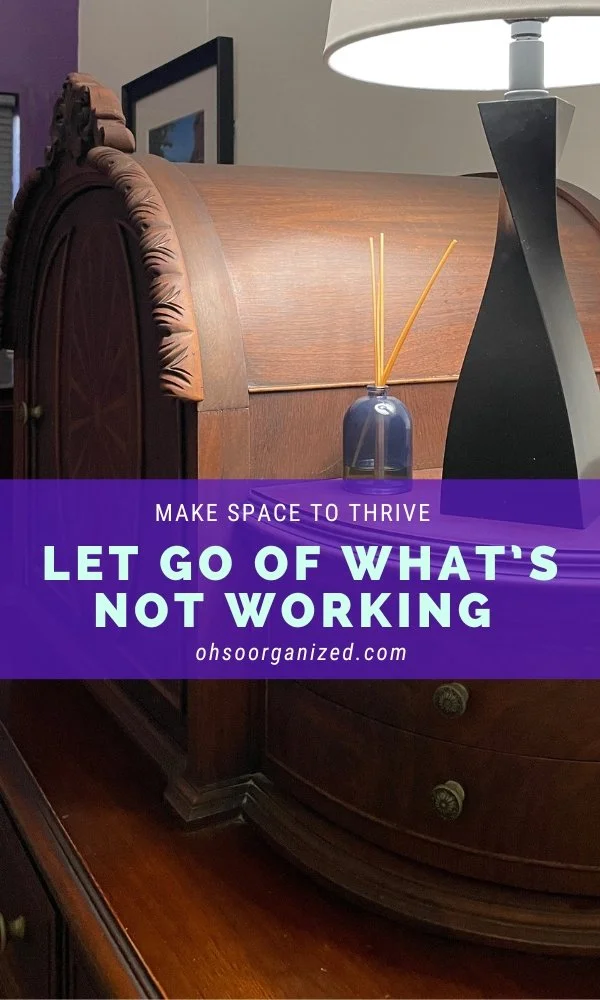
Some of you may know I’m short, under five feet tall. We had a lamp in our bedroom that sat on the dresser for years. It was a colorful glass lamp with a purple shade. I liked it except for one thing. Because of the tall dresser, the placement of the switch high up on the lamp, and my height, it was difficult for me to turn the light on and off.

Each time I pushed the switch, I would stretch by standing on my tippy toes to reach it. Was it awkward and slightly annoying? Yes! Did I do this for a lot of years? Yes! Why? Because I ignored the irritation and my agency to change what wasn’t working.

As we were preparing our house for guests, my husband and I worked on various projects. Something about working on those projects activated my thoughts. I had an “Enough is enough” moment. An idea popped into my head. Why not replace the lamp with one that isn’t as tall? Or, more specifically, change it to one I could easily reach. What a simple solution!

Within a few days, I bought a new lamp, a black base with a white shade. While I like how it looks, I love that I can reach it…easily! No more tippy toes are required. And each time I turn the switch, I can’t help but smile. Honestly, a few times, I’ve squealed with delight.


Are you ready to let go of what’s not working to make way for what does?
— Linda Samuels, CPO-CD®, CVOP™

Why Let Go?

It’s easy to keep doing what you’ve always done, even if it’s annoying. But when you’re willing to let go of what’s not working, you make room for what is. And when that happens, joy and happiness will follow.

I don’t have to stretch anymore to reach the lamp. Instead, I will learn to ‘stretch’ in other ways. What else is possible? What else can I improve?

How about you? Are you ready to thrive? What becomes possible when you let go of what’s not working? I’d love to hear your thoughts and invite you to join the conversation.

Do you want help letting go of those things, habits, or situations that no longer serve you? If so, reach out anytime. Please email me, Linda, at linda@ohsorganized.com, call 914-271-5673, or schedule a Discovery Call. Letting go is possible, especially with support.