Posts tagged clothing
How One Small Change Can Help Reduce Overwhelm and Boost Task Activation

There are two challenges related to change that many of my clients face. The most common reason is overwhelm, often because the changes they seek are significant. Overwhelm can happen when you:

  • Have difficulty deciding where to start

  • Want to make multiple changes

  • Are unsure whether what you want to accomplish is possible

  • Engage in negative self-talk or unhelpful loops and scripts

  • Are uncertain how you’ll have time to make the changes you seek

The second most common challenge is task activation. My clients often know what to do, yet struggle to take action. They may experience low mood, boredom with the task, self-doubt, exhaustion, or difficulty managing their time.

The good news is that even when you’re feeling overwhelmed and having difficulty activating, things can shift quickly in a positive direction. I’ve seen this happen consistently with my clients, and it’s inspiring to be part of.

Are you curious about how to shift from overwhelm to hope and from stuckness to action? If so, keep reading to learn a few helpful strategies.


Change Strategies That Work When You’re Feeling Overwhelmed and Stuck

Strategy 1: Go Small

You know the phrase, “Think big?” For the first strategy, do the exact opposite. Instead of focusing on all the changes you want to make, go small, really small. This shift creates a boundary.

Let’s say you want to edit and organize all the rooms in your home. The goal is doable, but the enormity of those tasks feels overwhelming. For now, set aside thinking about the big picture and focus on a single, small piece.

For example, you want to edit and organize your clothes, which are stored in many rooms, dressers, and closets. Select one small area to begin, such as a drawer, a shelf, a closet rod, or a bag stuffed in the basement. Anywhere is OK as long as the area is small.

You’ll notice almost immediately that your mood begins to regulate because you’ve contained the organizing task to something more manageable. Overwhelm and anxiety subside when you set boundaries around your area of focus.


Strategy 2: Engage in What’s Doable

Combine the first strategy, going small, with this next one. As you can imagine, it’s not enough to create a tinier boundary and shift your mindset. It must be paired with an action or task. By reducing stress and cortisol surges, activation becomes possible. You can calmly face your task.

Here’s the magic. Making progress on that one small thing has a wonderfully positive effect. Your thoughts transform from “I can’t do this” to “I’m getting it done!” Your mood shifts from blocked and negative to lighter, more energetic, and more excited about taking on more.


Overwhelm and anxiety subside when you set boundaries around your area of focus.
— Linda Samuels. CPO-CD®, CVOP™


Strategy 3: Enlist Help

The first two strategies are effective. However, if you’re ready for change and still feel unable to move forward, it’s time for the third option: Ask for help. This can come from a nonjudgmental friend, family member, or professional organizer like me. You don’t have to do this alone.

My clients recognize that having a partner on their organizing journey is the secret sauce. They appreciate ongoing support, discussions of solutions and challenges, help with decision-making, a thought partner, and encouragement.

Some recent client organizing tasks included:

  • Decluttering the dining room table

  • Refining a project management system

  • Editing several bags of shirts

  • Sorting and releasing old business files from a shelf

  • Editing and letting go of a box of electronic material

For all of these projects, my clients’ starting point was feeling overwhelmed and unable to act. However, by narrowing the scope, focusing on one small part at a time, and enlisting external support, they improved their mood, accomplished a specific task, boosted their confidence, and were motivated to do more.


Why Does a Tiny Change Matter?

Small shifts are doable and sustainable. When you think about change, it can feel overwhelming, especially when the changes are big. However, by adjusting your mindset, narrowing the scope, and enlisting help, you can make progress. What helps you when you feel overwhelmed? How do you work with task activation? What resonates with you?

I’d love to hear your thoughts. I invite you to join the conversation.


How Can I Help?

Do you feel overwhelmed, disorganized, or paralyzed? Do you seek change, yet feel stuck? I’m here to help! Virtual organizing is an extraordinary path forward – Local feel with a global reach.

Let’s connect! I’m easy to reach.

Embracing change and getting organized are possible, especially with support.


Here Are Today's Most Interesting and Best Clutter Discoveries - v45

This is the newest release (v45) of the “What’s Interesting?” feature, with my latest finds that inform, educate, and relate to organizing and life balance. These unique, inspiring clutter discoveries reflect this month’s blog theme.

You are an intelligent, generous, and engaged group. I am deeply grateful for your ongoing presence, positive energy, and contributions to this community. I look forward to your participation and additions to the collection I’ve sourced.

What do you find interesting?


What’s Interesting? – 5 Best Clutter Discoveries

1. Interesting Workshop – Overwhelming Clutter

Do you feel stuck and overwhelmed by emotional and physical clutter? If you answered “yes,” you’re not alone. Help is here!

Join me, Linda Samuels, Professional Organizer, for an empowering workshop – How to Let That Sh*t Go on Thursday, June 6th, from 7:00-8:00 pm EDT.

Together, we’ll unleash your superpower and learn to let go of thoughts, time, and things that no longer serve you.

This one-hour Zoom workshop will teach you transformative strategies to spark immediate positive changes. Release the clutter holding you back and say hello to a happier, more organized you. Reserve your spot now!


2. Interesting Product – Card Clutter

One of the questions clients frequently ask me is,

“What should I do with all the cards I have received?”

Card recipients often feel guilty for letting them go, so they hold onto them for years or decades. However, they feel distressed by card clutter and the space they take.

Some cards aren’t as treasured. However, many are sentimental and meaningful, received by loved ones here and gone. So, how do you decide what to do?

Card Decluttering Process: 

  • Gather your cards

  • Keep your favorites, which include cherished hand-written messages or ones you especially enjoy

  • Recycle the rest

What can you do with the keepers? You can contain them in a box. Or, there’s another fun way to make them a usable keepsake. Transform them into an 8” x 8” custom hardcover book with Cards by Artkive.

Check out the video describing their process.


3. Interesting Read – Communication Clutter

Are you overwhelmed by email, text, and other communication clutter? This deluge creates mind clutter, too. There have never been this many ways to communicate, and it’s a lot to sift through.

Smart Brevity–The Power of Saying More with Less by the co-creators of Axios and Politico said, “Never in the history of humanity have we vomited more words in more places with more velocity.”

As a verbal processor, I am guilty of using lots of words. However, this book inspires me to think about the impact and stress this has on others. It includes specific techniques for creating shorter, more robust communication for email, meetings, speeches, presentations, social media, and more. “Smart Brevity is a new way to think about creating, sharing, and consuming information in our cluttered, clanging digital world.”

Authors Jim VandeHei, Mike Allen, and Roy Schwartz created a nifty AI-powered Smart Brevity® test. Enter your text, and the tool scores how “smart, clear, and effective it is.”

Declutter your communication. Stop overexplaining. “We make people deduce what we’re trying to say instead of just blurting it out. Don’t be fancy-be effective.”


Remove clutter that’s distracting you.
— Linda Samuels, CPO-CD®, CVOP@


4. Interesting Resource – Textile Clutter

Do you have textile clutter and want to keep it out of the landfill? If so, you’re in luck. Retold Recycling has a solution for you. To date, they’ve diverted 150 tons of textiles from landfills.

Easy Recycling (Decluttering) Process:

  • Gather your unwanted textiles, including fabric scraps, rags, stained, ripped, or unwanted clothing, linens, single socks, cotton face masks, and more.

  • Do not include pillows or cushions.

  • Order your Retold bag with a pre-paid label.

  • Fill your bag and bring it to the post office.

  • Retold will sort your goods and send them to thrift stores, donation centers, recyclers, resellers, and up-cyclers.


5. Interesting Thought – ‘Noise’ Clutter


When your spaces, calendars, and thoughts are filled with too much noise, it’s impossible to focus on what matters most. This is an excellent time of year to quiet things down. Remove clutter that’s distracting you. Let go of the unnecessary, and create space to invite in what you truly value.

Can you share one interesting, clutter-related discovery? Which of these resonates with you? I’d love to hear your thoughts and invite you to join the conversation.

Do you want help decluttering? If so, reach out anytime. Please email me, Linda, at linda@ohsorganized.com, call 914-271-5673, or schedule a Discovery Call. Letting go of clutter is possible, especially with support.


Here Are Today's Most Interesting and Best Next Step Discoveries - v44

This is the newest release (v44) of the “What’s Interesting?” feature, with my latest finds that inform, educate, and relate to organizing and life balance. These unique, inspiring, next step discoveries reflect this month’s blog theme.

You are a passionate, generous, and engaged group. I am deeply grateful for your ongoing presence, positive energy, and contributions to this community. I look forward to your participation and additions to the collection I’ve sourced.

What do you find interesting?


What’s Interesting? – 5 Best Next Step Discoveries

1. Interesting Read – Brave Next Step

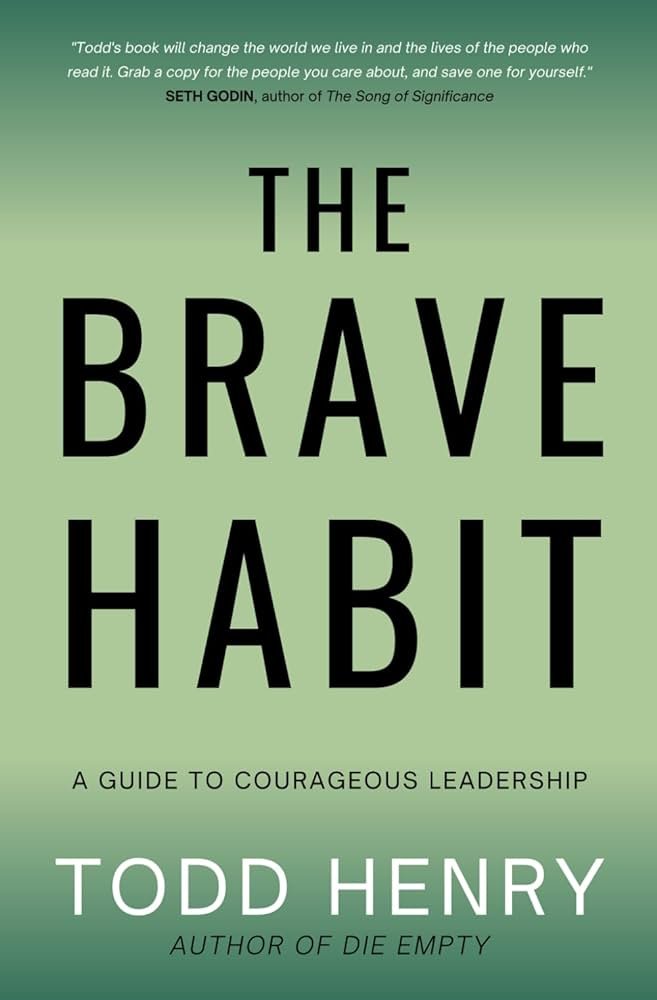
Fear can color your choices and how you experience your life. In Todd Henry’s new work, The Brave Habit – A Guide to Courageous Leadership, his goal is “to inspire an epidemic of everyday brave action.” He says, “Bravery exists when we have a vision for a better possible future, and we trust that we have agency to help bring it about.” These ideas are further explored by examining what happens when low to high perceived agency is paired with optimistic or pessimistic visions.

When thinking about the next steps and the consequences of your actions, Todd says, “…almost every action you take, or choice you make has a lingering impact on the world around you, and over time, the impacts of those actions are exponential.”

Todd created The Brave Index to accompany the book. It’s a quick survey that helps you identify areas to develop your capacity for brave work and leadership. Based on your responses, you will receive a customized action plan. Todd says, “Don’t fear wrong action, fear inaction … One small step in the face of fear is enough to dispel its hold on you.”


2. Interesting Workshop – Clutter-Free Next Step

Does your next step include reducing clutter, overwhelm, and disorganization? One in four people struggle with clutter, which can affect their anxiety levels, relationships, sleep, and focus.

If you’re in the Westchester area near Croton on Hudson, New York, join me, Linda Samuels, Professional Organizer, for a live in-person workshop on How to Conquer Clutter. On Thursday, March 21st, from 5:30-7:30 pm Eastern, I’ll present at Design Lab’s monthly speaker series, sponsored by Denise Wenacur of DW Design & Décor. Come say “hi,” network with local professionals, enjoy yummy beverages and treats, and learn empowering clutter insights and solutions.


3. Interesting Article – Unplugged Next Step

March 1st was the Global Day of Unplugging. For 24 hours, we were encouraged to unplug, unwind, relax, and engage in activities that did not involve technology, electronics, or social media.

Did you miss it? That’s OK. You can create your own “unplugged” day or a part of a day at any time. Several of my colleagues wrote terrific articles about the benefits, history, and ideas for unplugging. Is stepping away from your devices next on your agenda? Find inspiration here:


One small step in the face of fear is enough to dispel its hold on you.
— Todd Henry


4. Interesting Resource – Beneficial Next Step

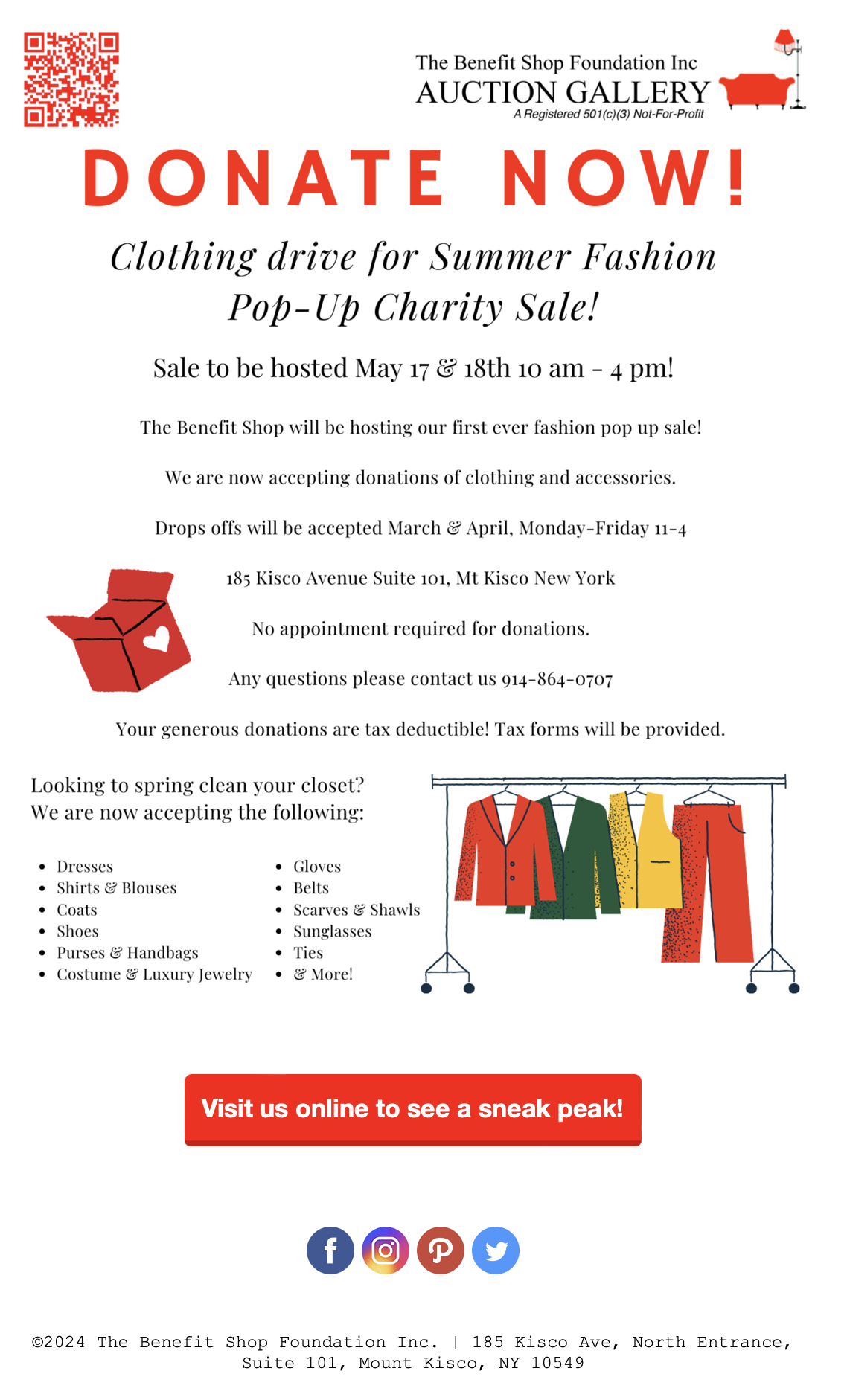
Spring is next. This is an excellent time for editing, letting go, and decluttering your closets and drawers. Do you have clothing and accessories you no longer need, want, or fit? If so, you can clear space and help others.

Consider donating your clothing to The Benefit Shop Foundation Inc. You can drop off things at 185 Kisco Avenue, Suite 101, Mount Kisco, New York. Items will be accepted in March and April, Monday through Friday, from 11 am to 4 pm. Donations are tax-deductible, and tax forms will be available.

The Benefit Shop Foundation will host a fashion pop-up sale on May 17th and May 18th from 10 am to 4 pm. Proceeds will go to various local community-based organizations that help people who live and work in the area.


5. Interesting Thought – Small Next Step


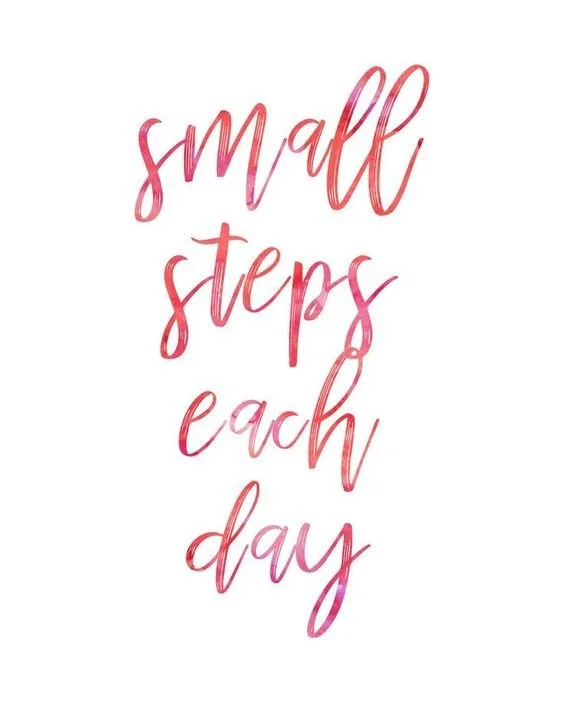
Figuring out what to do next can feel overwhelming. When unsure what to do next or feeling the enormity of a project’s scope, next seems elusive. Instead, focus on making consistent, tiny movements forward.

Each small step lets you experience progress, boosts your motivation, and moves you closer to your goal. Make your next step small and manageable. Do and repeat. Action is your key to progress.

Do you have an interesting, next-step-related discovery? Which of these resonates with you? I’d love to hear your thoughts and invite you to join the conversation.

If you need help deciding on your next step, I’m here to help. Please email me at linda@ohsorganized.com, call 914-271-5673, or schedule a Discovery Call. Figuring out next is doable, especially with support.


9 Marvelous Ways Virtual Professional Organizers Can Help With Transitions

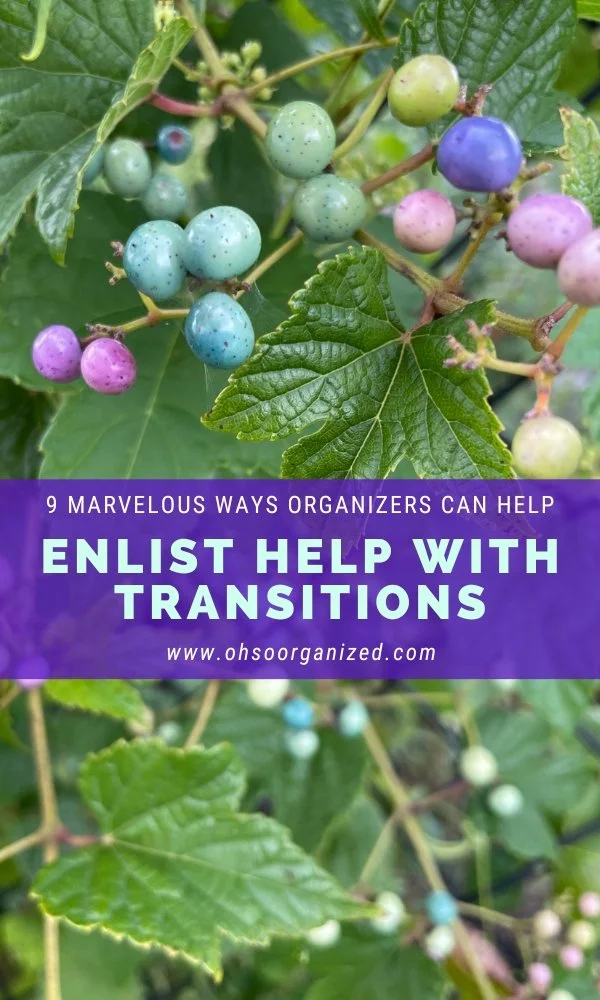
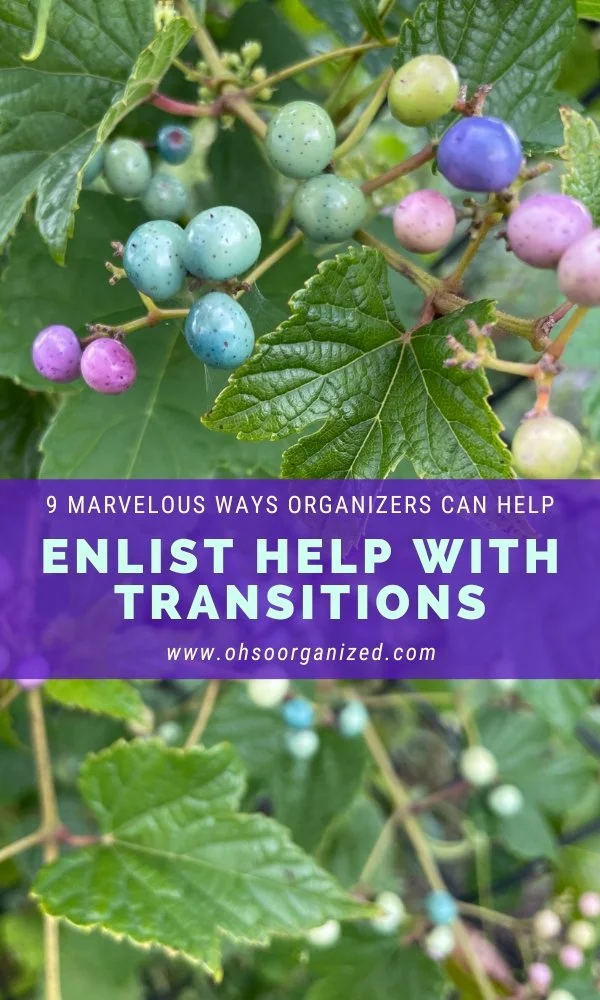
Can you feel it? Transitions are in the air. The summer is coming to a close. Fall is around the corner, and change is on its way. One transition signal I noticed on a recent walk was the appearance of these beautiful berries that start white and turn to blue and purple hues. Oh, yes. Fall is coming. The transition is happening.

How do you feel about transitions? Are you excited, optimistic, empowered, sad, scared, apprehensive, or overwhelmed? Change can be challenging. You let go or say goodbye to what was and move forward to something different. The ‘different’ could be an unknown, a new stage of life, or a smaller, seemingly insignificant change. Navigating transitions can be much easier when you get planning, implementing, and supporting help.

Here's the good news. Many people can provide support, including friends, family members, colleagues, or virtual professional organizers like me. Much of my work centers around helping people of all ages and stages during their life transitions.


9 Ways Organizers Can Help With Transitions

1. Resetting for the New Season

Can you enlist the help of an organizer to do a clothing edit and organization? As you store your spring/summer clothes and bring out your fall/winter ones, choose the items you will no longer wear and can release. Could you hire an organizer to support your decision-making and organizational ideas? Your seasonal clothing transition will go more smoothly.


2. Going Back to School

You had one pattern for the summer, but now it’s time for the kiddos to return to school. This is a transition time where habits and schedules change. An organizer can help you create great organizational systems that work for your family.


3. Becoming an Empty Nester

Perhaps going back to school means you’re now an empty nester. This is an enormous transition for both you and your kiddo. If you need help getting your college-bound kid organized to leave the nest or need help reorganizing your home and schedule now that your kid is out, enlist help from a professional organizer.


4. Becoming a Parent

When a new life arrives, everything changes. You will prepare emotionally and physically during this transition. You can use the services of an organizer to help create an organized space for your little one.


5. Changing a Relationship

Whether you are moving in with your partner, getting married, or divorced, these transitions can be stressful and complicated. There are emotional aspects to navigate. There are also scheduling and space transitions, which an organizer can be especially helpful with. Whether merging two households into one or dividing one home into two, it’s beneficial to have a non-judgmental, compassionate person to plan, organize, and navigate this transition.


Transitions are an opportunity for growth, renewal, and possibilities.
— Linda Samuels, CPO-CD®, CVOP™

6. Moving and Downsizing

Moving and downsizing are significant transitions. This can be anxiety-producing, especially if you work with a tight deadline or do not want to move. There are many things to handle, even when your deadline is flexible, or you’ve purposely chosen the change. Hiring an organizer to help you plan, support your decisions, and share resources can ease the stress of these complex transitions.


7. Retiring

You worked a lifetime, and now you’re ready to stop. You’re used to being highly scheduled with less free time to pursue hobbies and friendships. As you transition into this new stage of life, consider what you want and no longer need. What can you let go of? What do you want to make space for? You can work with an organizer to figure out what ‘belongs’ now.


8. Experiencing Health Challenges

While you have your medical health professionals’ support team, an organizer can help with health-related transitions in many ways. Perhaps you need a system for documenting doctor visits, instructions, or medications. Maybe you need to reorganize space in your home, declutter, or create an unobstructed flow. Especially when you’re not feeling your best, having another person to support your transition and organizational needs can be helpful.


9. Losing a Loved One

When someone we love dies, life changes instantly. It doesn’t matter if it is expected or not. Loss is loss. Everyone grieves in their way. At a point when the grief fog lifts, you might feel ready to make changes, like rethinking the use of rooms or letting go of some of your loved one's belongings. This is a highly emotional time. Having an organizer to work with can help you honor your loved one’s possessions as you organize, let go, and move forward.


As Tom Stoppard said, “Every exit is an entry somewhere.” As you travel from where you are to where you are heading, don’t go it alone. Gather your team who will help, support, and be there as you navigate. Transitions are an opportunity for growth, renewal, and possibilities.

Are you going through a transition? Who is on your team? Do you want additional help? I’d love to hear your thoughts. I invite you to join the conversation.