Posts tagged clothes
3 Fantastic Reasons to Declutter Now Instead of One Day

Is your life overflowing with stuff? Even if your belongings have ‘homes’ and you know where to find them, does the sheer volume feel overwhelming? Drawing on more than thirty years of working with clients and my own life experience, I’ve seen how the accumulation of stuff happens. It’s a slow (and sometimes not-so-slow) creep of collecting. 

One day, you look around and wonder:

  • Where did all this stuff come from?

  • Do I still need these things?

  • Are they taking up too much space, management time, and mental energy?

  • Is all this stuff necessary for the life I’m living now?

  • What will happen to my belongings when I’m gone?

  • What would life feel like with less?

  • What would it feel like to align what I own with the life I’m living?

There are many ways to think about clutter and the physical items that accompany your life. Let’s look at three reasons why decluttering sooner rather than later could benefit you. If even one idea resonates with you, it could be the cue and motivation you need to begin the decluttering process.


3 Compelling Reasons to Declutter Now Instead of Waiting

1. 300,000!

A frequently cited statistic in the organizing industry and media is the number of things we accumulate. Estimates suggest that the average American household may contain hundreds of thousands of items. The number often cited is 300,000. That’s a lot of stuff!

Whether that’s your number is a separate question. I don’t know what our household number is. Out of curiosity, I counted some objects in a few areas, and I was surprised by what I found:

  • 778 – Number of items in the bedroom clothing closet, including clothes, hangers, shoes, shoe boxes, and some accessories. We have additional clothes and shoes in the dressers and other areas.

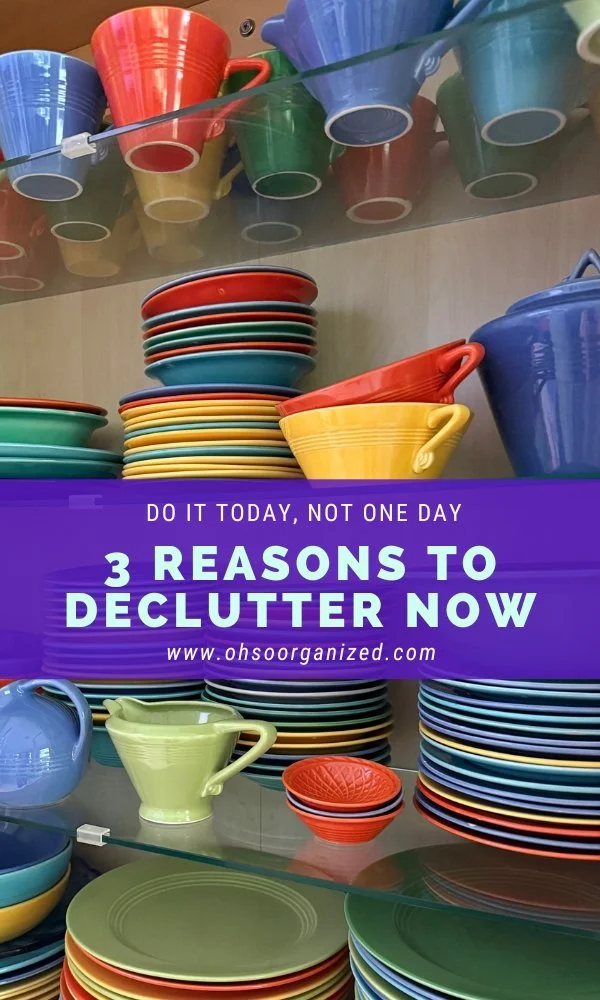
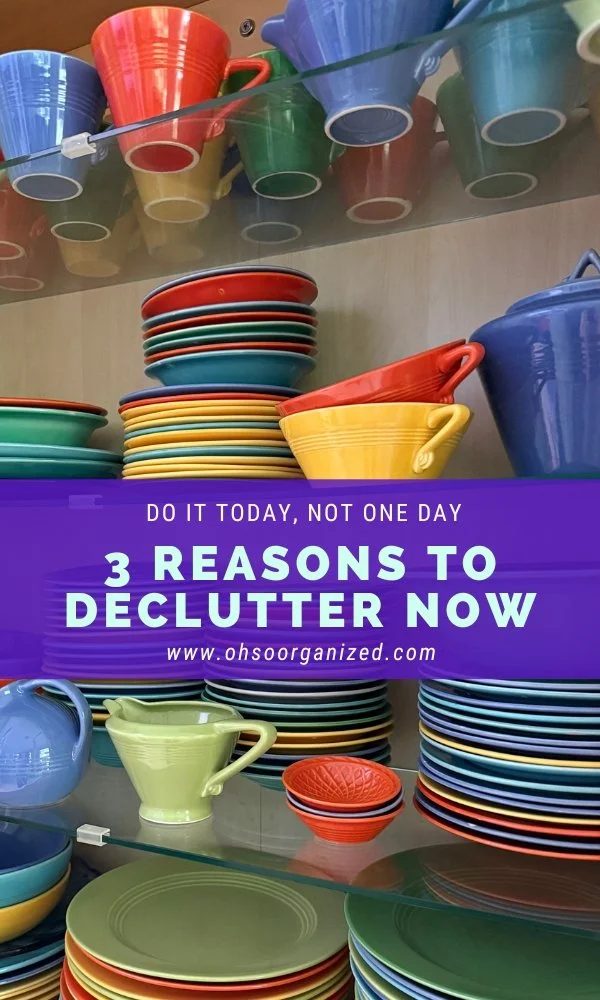
  • 289 – Number of items in the dining room china cabinet. We have more dishes in the kitchen.

  • 49 – Number of items in the desk pen cup. I have many more writing instruments in other areas and in the supply cabinet.

The 1,116 items counted so far represent only a tiny portion of what we have in our household. I'm not sure whether we actually own 300,000 items. The idea is to recognize what you have and align it with what you want, need, and use.

By focusing on specific areas and doing a quick count, I spotted several things that could go. For instance, I don’t like all the pens that have landed in the pen cup—time to declutter. Even in the china cabinet, there are several dishes I don’t want that could go. While I regularly go through my clothing closet, more could be edited out.

Being aware of how much you have will help you declutter the things that no longer matter or are not useful to you.


2. Yikes!

Clutter can cause stress and affect your ability to focus. My clients have described how clutter affects them as,

  • “I have so much clutter I can’t even think.”

  • “I don’t want to feel overwhelmed by my stuff.”

  • “The clutter is distracting, and I can’t focus.”

  • “Clutter makes me feel agitated and angry.”

  • “I don’t want to feel clutter-related stress and anxiety.”

Research backs up the experience my clients describe. UCLA Center on Everyday Lives of Families (CELF) conducted research and discovered that “cluttered home environments were associated with elevated cortisol levels – especially among women who described their homes as chaotic or stressful.” Cortisol is the hormone produced as part of the body’s stress response.

Neuroscience research on cognitive overload and attention, including Princeton University’s work, shows that visual clutter, or “competing visual stimuli,” reduces the brain’s ability to focus and process information efficiently.

Knowing how clutter can affect your stress, attention, and functioning makes a compelling case for decluttering sooner rather than later.

Clutter can cause stress and affect your ability to focus.
— Linda Samuels, CPO-CD®, CVOP™

3. For love.

Recently, I came across an Instagram video featuring Alice D’Antoni Phillips, a psychologist-turned-chef. She discussed the emotional struggle of letting go of sentimental items while downsizing. Alice also described letting go as “an act of care.” She didn’t want to burden her loved ones with decisions about her stuff after she’s gone.

Then she said a beautiful phrase that stuck with me. It’s so gentle, compassionate, and loving. Alice said, “Easing the path of life for the people you love.” In that, she acknowledged that we’re all going to be gone at some point. We are born. We live. We die. That’s the reality.

The other part was about making it easier for the people you love by handling your stuff before you go. Making decisions and decluttering now are expressions of love.

It’s never too soon to start decluttering. Your loved ones will thank you.


Why Declutter Now?

There are countless reasons to declutter now, without delay. Some might be:

  • Your clutter is causing undue stress.

  • You have more things than you use, need, or want.

  • You want to make decisions about your belongings so your loved ones don’t have to after you’re gone.

  • You want to downsize and prepare to move.

  • You’re fed up with all the stuff.

  • You want greater clarity of mind and in your space.

What are your compelling reasons to declutter? What is motivating you? Which ideas resonate most? I’d love to hear your thoughts. I invite you to join the conversation.


How Can I Help?

Do you feel overwhelmed or disorganized? Is the clutter in your life causing stress and keeping you from living the life you want? I’m here to help! You don’t have to do this alone. Virtual organizing is an extraordinary path forward – Local feel with a global reach.

Let’s connect! I’m easy to reach.

Decluttering, getting organized, and living with more ease are possible, especially with support.


How to Joyfully Make Discovering "Small Awe" Your Next Step

What are your days like? Is life moving along smoothly? Or are your days filled with overwhelm, ups and downs, and challenges? There are times when finding your next step flows easily. At other points, the next step feels elusive. What if next included embracing “small awe” moments? How would that change the mood for your day and your experience of next?

Have you ever seen or experienced something that evoked such a sense of awe that you could barely find words to describe it? I remember visiting the Grand Canyon decades ago. My husband and I stood on the edge, looking at the magnificent expanse and feeling that deep awe. We were speechless.

Experiencing big awe because of natural wonders, cosmic events, encounters with wildlife, moments of surprise, spiritual experiences, human achievement, art, scientific discoveries, or personal transformation is amazing yet rare.

Small Awe Concept

The idea of small awe is more readily accessible. I was introduced to the concept when I visited the Dinner Gallery in New York City with my daughter, Allison. We saw the Time Is A Fire exhibit by artist Langdon Graves, who gave a talk about her work. Langdon used the phrase “small awe” to describe the intent behind some of her pieces. I’ve been thinking about that idea ever since. She said these tiny moments of awe are always available to us. However, we often don’t stop long enough to recognize them.


a Small Awe Next Step

What if your next step was discovering and enjoying a small awe moment? That might be . . .

  • Seeing the first purple crocus of the season emerge from the earth

  • Hearing your client declare confidently the progress they are making

  • Crossing off the last task on your to-do list for the day

  • Feeling the sun warm your body after days of gray, gloomy weather

  • Going to the post office to mail your tax packet to your accountant

  • Basking in the post-mindfulness meditation calm

  • Taking in the coffee aroma and flavor from your favorite mug

  • Sensing the warm water cover you as you shower or soak luxuriously in a tub

  • Enjoying the open space you have in your closet after decluttering, organizing, and donating some clothes

  • Hearing the sound of your loved one’s voice on the other end of the phone

  • Climbing into your cozy bed after a long day

  • Making progress on that big project, you were procrastinating about

  • Having a great conversation with dear friends

Be on the lookout for a ‘small awe’ moment.
— Linda Samuels, CPO-CD®, CVOP™

Next can be a grand gesture or something smaller. It can be infused with awe. Are you stuck and unsure about what to do next? Be on the lookout for small awe moments. It might be just what you need to help you joyfully move forward. What moments are available to you? What will be your next step? I’d love to hear your thoughts.

If you want guidance with your next step, I’m here to help. Please email me at linda@ohsoorganized.com, call 914-271-5673, or click here to schedule a Discovery Call. Next is doable, especially with support.


9 Marvelous Ways Virtual Professional Organizers Can Help With Transitions

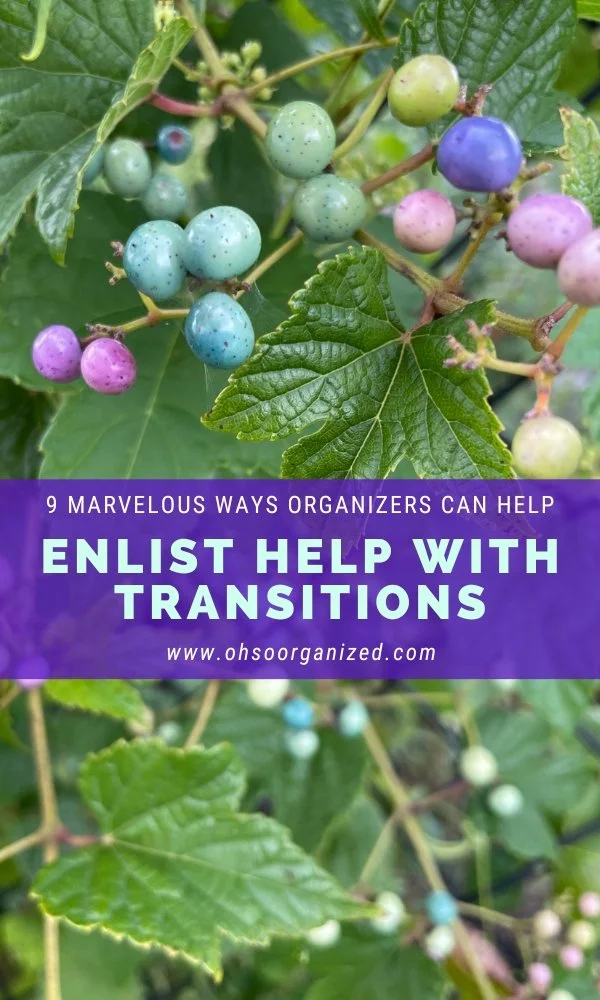
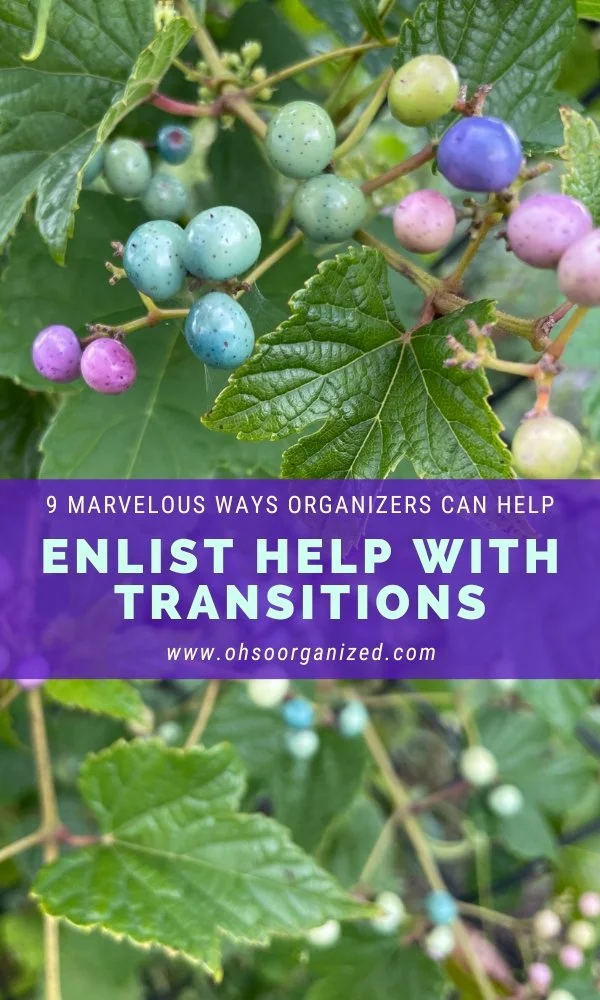
Can you feel it? Transitions are in the air. The summer is coming to a close. Fall is around the corner, and change is on its way. One transition signal I noticed on a recent walk was the appearance of these beautiful berries that start white and turn to blue and purple hues. Oh, yes. Fall is coming. The transition is happening.

How do you feel about transitions? Are you excited, optimistic, empowered, sad, scared, apprehensive, or overwhelmed? Change can be challenging. You let go or say goodbye to what was and move forward to something different. The ‘different’ could be an unknown, a new stage of life, or a smaller, seemingly insignificant change. Navigating transitions can be much easier when you get planning, implementing, and supporting help.

Here's the good news. Many people can provide support, including friends, family members, colleagues, or virtual professional organizers like me. Much of my work centers around helping people of all ages and stages during their life transitions.


9 Ways Organizers Can Help With Transitions

1. Resetting for the New Season

Can you enlist the help of an organizer to do a clothing edit and organization? As you store your spring/summer clothes and bring out your fall/winter ones, choose the items you will no longer wear and can release. Could you hire an organizer to support your decision-making and organizational ideas? Your seasonal clothing transition will go more smoothly.


2. Going Back to School

You had one pattern for the summer, but now it’s time for the kiddos to return to school. This is a transition time where habits and schedules change. An organizer can help you create great organizational systems that work for your family.


3. Becoming an Empty Nester

Perhaps going back to school means you’re now an empty nester. This is an enormous transition for both you and your kiddo. If you need help getting your college-bound kid organized to leave the nest or need help reorganizing your home and schedule now that your kid is out, enlist help from a professional organizer.


4. Becoming a Parent

When a new life arrives, everything changes. You will prepare emotionally and physically during this transition. You can use the services of an organizer to help create an organized space for your little one.


5. Changing a Relationship

Whether you are moving in with your partner, getting married, or divorced, these transitions can be stressful and complicated. There are emotional aspects to navigate. There are also scheduling and space transitions, which an organizer can be especially helpful with. Whether merging two households into one or dividing one home into two, it’s beneficial to have a non-judgmental, compassionate person to plan, organize, and navigate this transition.


Transitions are an opportunity for growth, renewal, and possibilities.
— Linda Samuels, CPO-CD®, CVOP™

6. Moving and Downsizing

Moving and downsizing are significant transitions. This can be anxiety-producing, especially if you work with a tight deadline or do not want to move. There are many things to handle, even when your deadline is flexible, or you’ve purposely chosen the change. Hiring an organizer to help you plan, support your decisions, and share resources can ease the stress of these complex transitions.


7. Retiring

You worked a lifetime, and now you’re ready to stop. You’re used to being highly scheduled with less free time to pursue hobbies and friendships. As you transition into this new stage of life, consider what you want and no longer need. What can you let go of? What do you want to make space for? You can work with an organizer to figure out what ‘belongs’ now.


8. Experiencing Health Challenges

While you have your medical health professionals’ support team, an organizer can help with health-related transitions in many ways. Perhaps you need a system for documenting doctor visits, instructions, or medications. Maybe you need to reorganize space in your home, declutter, or create an unobstructed flow. Especially when you’re not feeling your best, having another person to support your transition and organizational needs can be helpful.


9. Losing a Loved One

When someone we love dies, life changes instantly. It doesn’t matter if it is expected or not. Loss is loss. Everyone grieves in their way. At a point when the grief fog lifts, you might feel ready to make changes, like rethinking the use of rooms or letting go of some of your loved one's belongings. This is a highly emotional time. Having an organizer to work with can help you honor your loved one’s possessions as you organize, let go, and move forward.


As Tom Stoppard said, “Every exit is an entry somewhere.” As you travel from where you are to where you are heading, don’t go it alone. Gather your team who will help, support, and be there as you navigate. Transitions are an opportunity for growth, renewal, and possibilities.

Are you going through a transition? Who is on your team? Do you want additional help? I’d love to hear your thoughts. I invite you to join the conversation.


How Change Becomes Something Desirable When Your Full Mind is Suddenly Aware

Have you ever ignored the signs that it’s time to make a change? Then something significant happens. What was invisible moments ago becomes something you can no longer ignore. You might wonder, “How did I not see this before?”

It’s often the case that we conveniently ignore the signs. Why is that? Change can be scary. Its pursuit can require you to do uncomfortable things, like creating new habits or stepping outside your expertise or comfort zone. Instead of embracing change as a positive, proactive choice, we meet it with hesitation or fear.

Recently, I had an experience that made me think, “How did I not see this before?” I was going about my morning routine. I just applied my face moisturizer, looked in the makeup mirror, and was about to tweeze my eyebrows. Then I saw it. In the middle of my forehead, sticking out, was one long, white coarse hair. What? It wasn’t there yesterday or the day before. Did it grow overnight? How did that happen? Or had it been there for days, and I hadn’t noticed it? Well, I saw it that morning and quickly plucked it out.

Are you wondering how this relates to change? Once I saw the hair, I couldn’t unsee it, and I felt compelled to do something. Yes. Pulling it out was making a change of sorts. While my story might seem silly, it highlights how awareness drives change.

Are these scenarios more familiar?

  • Papers are piling up on the coffee table. You walk by them every day without giving them much thought. One evening, you wonder how the piles got so big. You can no longer pass them by, so you edit, let go and regain your surface. Your awareness drove change.

  • Clothes are overflowing in your closet. You navigate each morning irritably as you get dressed. One day, you recognize how much stress this causes you. You can no longer ignore it, so you edit and organize, which creates a smoother morning routine. Your awareness drove change.

  • Your computer is slow. It crashes, takes time to respond, and doesn’t function well. Each day you continue to work with a slow, unpredictable computer. At a point, you recognize this isn’t a tolerable way forward. You spend countless hours with tech support, hire a tech person for more help, and ultimately purchase a new computer because your hard drive is failing. Why did you ignore the signs for so long? Finally, awareness drove change. If you’re curious, that was me and I love my new computer.


Awareness drives change.
— Linda Samuels, CPO-CD®, CVOP™

The other side of change is a wonderful place to be. But getting there can be slow when we ignore the cues. Once you ‘see’ and acknowledge the challenge, your mind creates space for finding solutions and taking action. While the initial noticing and awareness can be painful, as in “How did I not see this before?” don’t let that derail what happens next. Use your awareness as the impetus to embrace change. Once you see clearly, you have an opportunity for improvement.

Have you ever experienced a sudden awareness of a challenge that helped you make a change? Or do you have the understanding but are stuck moving forward? I’d love to hear your thoughts. I invite you to join the conversation.