Posts tagged mental energy
3 Fantastic Reasons to Declutter Now Instead of One Day

Is your life overflowing with stuff? Even if your belongings have ‘homes’ and you know where to find them, does the sheer volume feel overwhelming? Drawing on more than thirty years of working with clients and my own life experience, I’ve seen how the accumulation of stuff happens. It’s a slow (and sometimes not-so-slow) creep of collecting. 

One day, you look around and wonder:

  • Where did all this stuff come from?

  • Do I still need these things?

  • Are they taking up too much space, management time, and mental energy?

  • Is all this stuff necessary for the life I’m living now?

  • What will happen to my belongings when I’m gone?

  • What would life feel like with less?

  • What would it feel like to align what I own with the life I’m living?

There are many ways to think about clutter and the physical items that accompany your life. Let’s look at three reasons why decluttering sooner rather than later could benefit you. If even one idea resonates with you, it could be the cue and motivation you need to begin the decluttering process.


3 Compelling Reasons to Declutter Now Instead of Waiting

1. 300,000!

A frequently cited statistic in the organizing industry and media is the number of things we accumulate. Estimates suggest that the average American household may contain hundreds of thousands of items. The number often cited is 300,000. That’s a lot of stuff!

Whether that’s your number is a separate question. I don’t know what our household number is. Out of curiosity, I counted some objects in a few areas, and I was surprised by what I found:

  • 778 – Number of items in the bedroom clothing closet, including clothes, hangers, shoes, shoe boxes, and some accessories. We have additional clothes and shoes in the dressers and other areas.

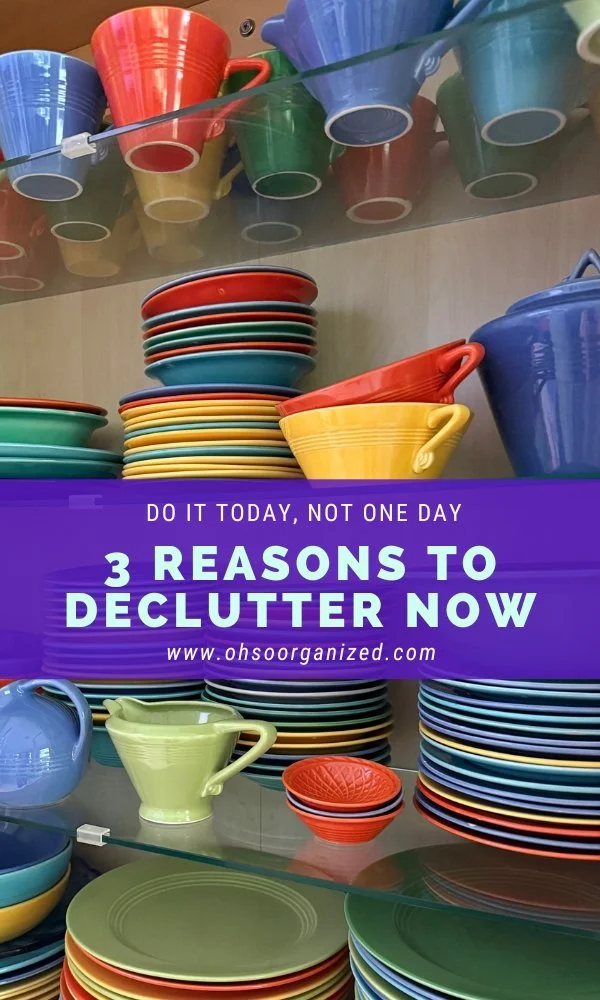
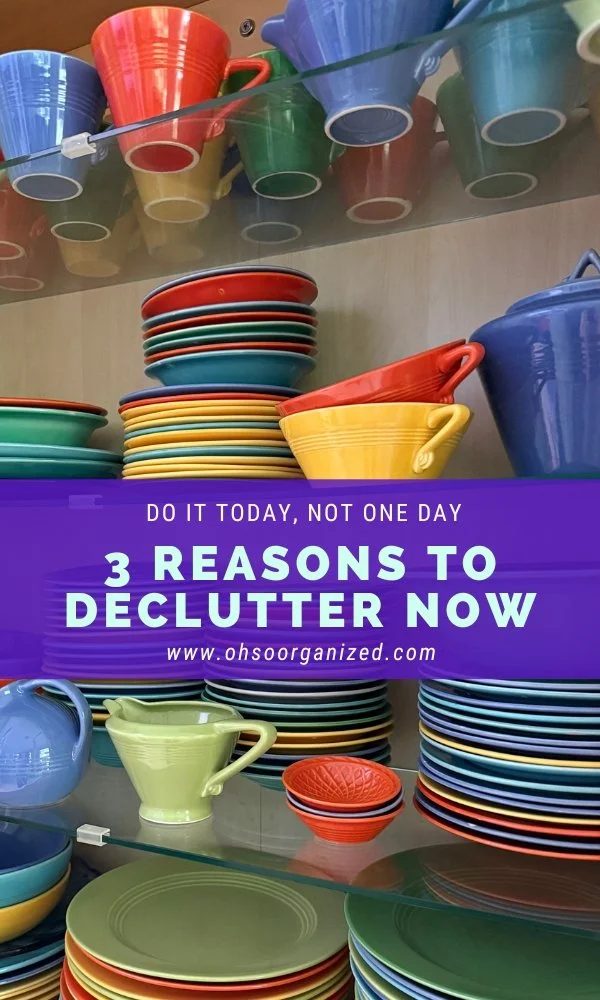
  • 289 – Number of items in the dining room china cabinet. We have more dishes in the kitchen.

  • 49 – Number of items in the desk pen cup. I have many more writing instruments in other areas and in the supply cabinet.

The 1,116 items counted so far represent only a tiny portion of what we have in our household. I'm not sure whether we actually own 300,000 items. The idea is to recognize what you have and align it with what you want, need, and use.

By focusing on specific areas and doing a quick count, I spotted several things that could go. For instance, I don’t like all the pens that have landed in the pen cup—time to declutter. Even in the china cabinet, there are several dishes I don’t want that could go. While I regularly go through my clothing closet, more could be edited out.

Being aware of how much you have will help you declutter the things that no longer matter or are not useful to you.


2. Yikes!

Clutter can cause stress and affect your ability to focus. My clients have described how clutter affects them as,

  • “I have so much clutter I can’t even think.”

  • “I don’t want to feel overwhelmed by my stuff.”

  • “The clutter is distracting, and I can’t focus.”

  • “Clutter makes me feel agitated and angry.”

  • “I don’t want to feel clutter-related stress and anxiety.”

Research backs up the experience my clients describe. UCLA Center on Everyday Lives of Families (CELF) conducted research and discovered that “cluttered home environments were associated with elevated cortisol levels – especially among women who described their homes as chaotic or stressful.” Cortisol is the hormone produced as part of the body’s stress response.

Neuroscience research on cognitive overload and attention, including Princeton University’s work, shows that visual clutter, or “competing visual stimuli,” reduces the brain’s ability to focus and process information efficiently.

Knowing how clutter can affect your stress, attention, and functioning makes a compelling case for decluttering sooner rather than later.

Clutter can cause stress and affect your ability to focus.
— Linda Samuels, CPO-CD®, CVOP™

3. For love.

Recently, I came across an Instagram video featuring Alice D’Antoni Phillips, a psychologist-turned-chef. She discussed the emotional struggle of letting go of sentimental items while downsizing. Alice also described letting go as “an act of care.” She didn’t want to burden her loved ones with decisions about her stuff after she’s gone.

Then she said a beautiful phrase that stuck with me. It’s so gentle, compassionate, and loving. Alice said, “Easing the path of life for the people you love.” In that, she acknowledged that we’re all going to be gone at some point. We are born. We live. We die. That’s the reality.

The other part was about making it easier for the people you love by handling your stuff before you go. Making decisions and decluttering now are expressions of love.

It’s never too soon to start decluttering. Your loved ones will thank you.


Why Declutter Now?

There are countless reasons to declutter now, without delay. Some might be:

  • Your clutter is causing undue stress.

  • You have more things than you use, need, or want.

  • You want to make decisions about your belongings so your loved ones don’t have to after you’re gone.

  • You want to downsize and prepare to move.

  • You’re fed up with all the stuff.

  • You want greater clarity of mind and in your space.

What are your compelling reasons to declutter? What is motivating you? Which ideas resonate most? I’d love to hear your thoughts. I invite you to join the conversation.


How Can I Help?

Do you feel overwhelmed or disorganized? Is the clutter in your life causing stress and keeping you from living the life you want? I’m here to help! You don’t have to do this alone. Virtual organizing is an extraordinary path forward – Local feel with a global reach.

Let’s connect! I’m easy to reach.

Decluttering, getting organized, and living with more ease are possible, especially with support.


What’s Possible When You Focus Energy on One Useful Next Step?

Life requires energy. How much effort do you spend on aspects of your life you have little or no control over? Are distractions and worry preventing you from moving forward?

Focusing your energy and choosing productive actions within your control will guide you toward more fruitful next steps. You may wonder how you can do that.

One option is to do an informal personal energy audit. This evaluation will help you understand where your time and energy go. Once completed, prioritizing next will become more evident.


What is a Personal Energy Audit?

In James Clear’s recent 3-2-1 Thursday newsletter, his idea influenced my thoughts about creating a personal energy audit. To do this, notice where you spend your time and mental energy on a typical day.

Once you have made a quick assessment, you’ll be able to:

Clear says,

“Take all the energy you spend on…

  • worrying about the past

  • worrying about the future

  • worrying about what others think

  • worrying about if you might fail

…and channel that energy into one useful action within your control.”

What a fantastic and powerful call to action!


Notice where you spend your time and mental energy on a typical day.
— Linda Samuels, CPO-CD®, CVOP™


What Will Be Your Essential Next Step?

Clear encourages harnessing those energy gains into just “one useful action.” Select one next small, doable step “within your control” that will result in a positive outcome. Doing that will help reduce overwhelm and increase laser focus.

What will your “useful action” be?


Is Your Energy Aligned with Useful Action?

You will expend energy each day. It is vital to notice where that energy is going. Do you focus on those things that aren’t in your control? Or are you aligning your energy with positive action?

I’d love to hear your thoughts. I invite you to join the conversation.


How Can I Help?

Do you want support organizing, editing, planning, or focusing energy on useful next steps? I’d love to help! Virtual organizing is an extraordinary path forward – local feel with a global reach.

Please schedule a Discovery Call, email me at linda@ohsorganized.com, or call 914-271-5673. Focusing on what’s next is possible, especially with support.


What Great Question to Immediately Ask Now If You're Struggling to Let Something Go?

With new flowers and buds appearing daily, spring brings hope and encouragement. My clients are letting go and lightening up. However, they sometimes place obstacles that make the process more challenging. Those roadblocks appear as unhelpful thoughts.

Have you noticed the power of the words you say and think? Your messages can inspire action or inaction, trigger motivation or discouragement, and help or hinder the letting go process.

Suppose you have decades of old bills in filing cabinets, piled on shelves, or stored in boxes. You’re questioning whether to keep or release them. The internal struggle begins. They aren’t bothering anyone and have an established ‘home,’ but they are taking up space. You haven’t looked at them in years and will unlikely ever refer to them. They have no financial value or record-keeping significance, yet they sit. You remain undecided about their fate.


The debate about the documents will continue until you make a decision. You might choose to keep or shred them. But until you decide, the papers will occupy physical and emotional space. Their weight is felt. Sometimes, you hold on because you anticipate the potential effort required to edit and let go. Yet, it also takes energy not to decide.

Deciding to hold on instead of letting go is a valid action. You can stop investing your mental energy once you choose to keep or release. Remember that choosing to hold on is not the same as ignoring to make a decision.

Your messages can help or hinder the letting go process.
— Linda Samuels, CPO-CD®, CVOP™

A Great Question When You’re Struggling to Let Go

I promised to share a great question when you’re struggling with decision-making. Your words have power, and semantics are potent. A slight tweak to how you pose a question can significantly affect the outcome. Inquiring in a particular way can make it more purposeful, encouraging, gentler, or less guilt-inducing.

A great question is the one that works best for you. The options below have similar meanings yet are phrased differently.

  • Is it time to let it go?

  • Is it time to put it down?

  • Is it time to release it?

  • Is it time to edit it?

  • Is it time to reduce it?

  • Is it time to move on?

  • Is it time to let it be?

Which one resonates most with you? Which one will help you choose and act? I’d love to hear your thoughts and invite you to join the conversation.

If you need help letting go, I’m here to help. Please email me at linda@ohsorganized.com, call 914-271-5673, or schedule a Discovery Call. Letting go is possible, especially with support.


3 Hopeful Ideas Motivated Big Changes in My Life Which Can Really Help You Too

It’s fascinating how big changes are made. They start with small, almost unnoticeable habit shifts. On your journey to be free of clutter, you donate a bag of rarely worn clothes or edit and clear the pile of unsorted mail from your kitchen counter. These tiny, single actions can bring about significant changes when consistency and support are added to your effort. 

The other aspect of making meaningful changes is the need for time and mental energy to make them happen. When you’re preoccupied, running as fast as you can to keep up, or emotionally exhausted, change is the last thing on your mind. You can’t stop your life to make a change. Instead, to integrate new habits, it’s essential to create space in your life for prioritizing the change you desire

In the last several years, I’ve experienced many emotional energy pulls. These included taking care of my mom with dementia, saying my final good-byes to her last March, grieving, navigating the pandemic’s effects on my organizing business, and preparing for and having our youngest daughter’s wedding at our home during the pandemic. Despite these emotional highs and lows, I’ve found focused intervals to bring about changes in my life. Admittedly, many of these changes came into being when I had more mental energy to give them.

Coincidentally, the three anchors/words, which rhyme, kept me motivated and focused on my desired changes. They are Zoom, Noom, and Room.

While these specific ideas might not be on your change radar, I encourage you to consider which words are. Which anchors will help you pursue the changes you seek? How will you make the space and time for change to flourish?


3 Hopeful Ideas Motivated Big Changes in My Life Which Can Help You Too

1. Zoom

Communication, relationships, and community are some of my treasured values. When the pandemic arrived, many communication networks halted. Most in-person contact was suspended. I couldn’t visit with family, friends, colleagues, or clients. Sure I still had the phone, text, and email, but physical contact was limited and non-existent for extended periods.

Using Zoom became an incredible go-to tool that helped me slowly change and think about how I interacted, did business, and stayed socially active. I’m guessing that many of you are Zoomed-out, but for me, Zoom continues to be a viable way for navigating life and keeping connected with people. 

I embraced communication changes and used Zoom to-

Zoom provided a channel to nurture and develop relationships, shift my organizing business, learn, and teach. While most in-person activities are now possible as many pandemic restrictions lift, Zoom still remains a viable way for me to stay connected. The platform allowed me to be flexible during these last few years, quickly embrace change, and support what I value most.


2.  Noom

Being healthy is a top priority for me. While I had some healthy practices like meditating daily and eating lots of fruits and vegetables, I wanted to change other habits. For what seems like a bazillion years, one of my goals has been to ‘lose 10 pounds.’ I’ve never been a dieter and didn’t like the idea of going on a diet. Instead, about five years ago, I saw a tremendously helpful nutritionist. She gave me a better understanding of what foods and portions were best for me. Over eight months, I lost 15 pounds. But then, in time, I gained it back and more.  The ongoing support was vital, and the difference was noticeable when I stopped seeing her.

Do you remember how I spoke about having the time and mental energy to bring about change? It takes focused effort to make eating and other lifestyle changes. When my mom died, I was emotionally exhausted. It took me months to get my energy back. When it returned, I felt ready to refocus on my health and make some changes.

In September, I signed up for Noom. It’s a weight loss app with a psychology-based approach to “help you change not just how you eat, but how you think.” It’s well-designed and simple to use. The app with built-in accountability helps me keep daily food logs, understand my calorie budget, track water intake, daily exercise, and weight. You are assigned a personal Coach and receive short articles every day, which encourage, motivate, and explain the psychology of habits.

While I’m still working towards my target goal, in five months, I have lost 18.5 pounds, I’m drinking 9 glasses of water a day, and walking an average of 10,000 steps a day. There have been other changes such as losing many inches around my body, clothing fitting better, feeling more energetic, learning new skills, and knowing I have a doable life-changing plan that’s working.

A bonus surprise was my husband signed up for Noom with me. He’s made incredible changes, and I’m so proud of him. We support one another, which is invaluable.

With any significant life change, it’s essential to have ongoing support, whether an app, person, Coach or all of those. If you’re curious about Noom, click here to learn more.

What do you need to bring about the habit changes you desire?


Big changes start with small actions.
— Linda Samuels, CPO-CD®, CVPO™


3. Room

This last idea is about creating both physical and mental space in your life to feel calm, have room to think, and live with less stress. These changes were worth pursuing, and I have worked years to get there. For me, there is the physical manifestation, which comes in the form of an uncluttered home filled with colors, textures, and scents that soothe and delight. 

One of the goals I worked on last summer into fall, inspired by our vacation staying in a tiny house, was my ‘live with less’ project. While I had lots of stuff, I recognized I didn’t need or want it all. I started randomly going through drawers, closets, and files to let go of unnecessary things. It was cathartic and surprising how much stuff exited. I don’t miss anything.

The other part of ‘room’ is making space for your mental well-being. For me, that’s having quiet time, finding cozy spots to write, journal, or read, spending time in nature, exploring and photographing, meditating, or doing yoga. It’s making room for self-care and carving out time to feed my soul.

Especially with all that has happened in the world and the ongoing challenges, making time to replenish yourself is critical. It’s all too easy to get derailed by a crisis near or far. Our bodies are not designed to sustain continual stress.

What would it take to make room for you? What changes will help make room and space for your physical and emotional well-being?

Big changes start with small actions. What will be your anchors for change? What will provide motivation and support for the changes you desire? I’d love to hear your thoughts. I invite you to join the conversation.