
Is your life overflowing with stuff? Even if your belongings have ‘homes’ and you know where to find them, does the sheer volume feel overwhelming? Drawing on more than thirty years of working with clients and my own life experience, I’ve seen how the accumulation of stuff happens. It’s a slow (and sometimes not-so-slow) creep of collecting.
One day, you look around and wonder:
Where did all this stuff come from?
Do I still need these things?
Are they taking up too much space, management time, and mental energy?
Is all this stuff necessary for the life I’m living now?
What will happen to my belongings when I’m gone?
What would life feel like with less?
What would it feel like to align what I own with the life I’m living?
There are many ways to think about clutter and the physical items that accompany your life. Let’s look at three reasons why decluttering sooner rather than later could benefit you. If even one idea resonates with you, it could be the cue and motivation you need to begin the decluttering process.
3 Compelling Reasons to Declutter Now Instead of Waiting
1. 300,000!
A frequently cited statistic in the organizing industry and media is the number of things we accumulate. Estimates suggest that the average American household may contain hundreds of thousands of items. The number often cited is 300,000. That’s a lot of stuff!
Whether that’s your number is a separate question. I don’t know what our household number is. Out of curiosity, I counted some objects in a few areas, and I was surprised by what I found:
778 – Number of items in the bedroom clothing closet, including clothes, hangers, shoes, shoe boxes, and some accessories. We have additional clothes and shoes in the dressers and other areas.
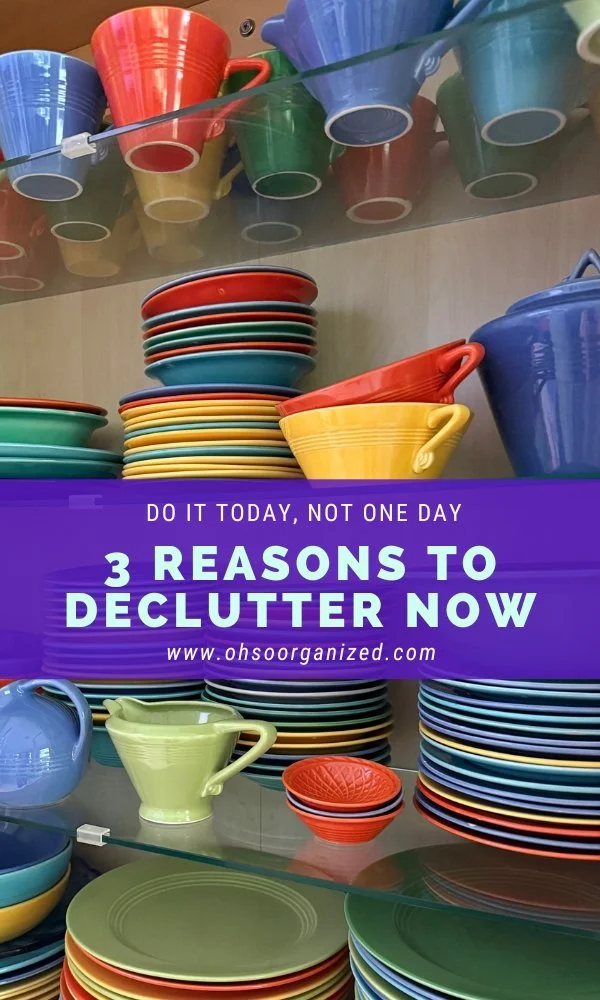
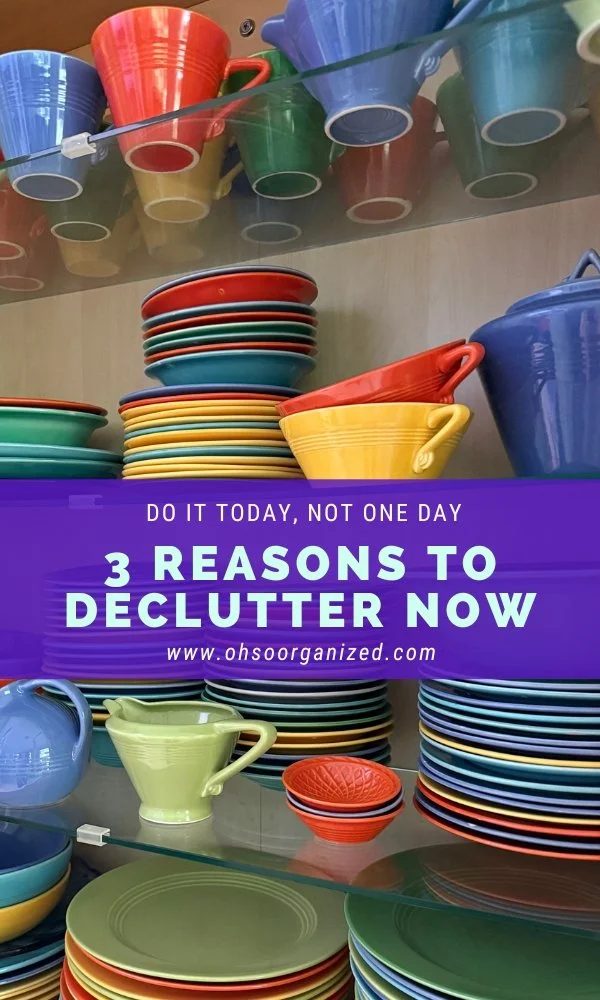
289 – Number of items in the dining room china cabinet. We have more dishes in the kitchen.
49 – Number of items in the desk pen cup. I have many more writing instruments in other areas and in the supply cabinet.
The 1,116 items counted so far represent only a tiny portion of what we have in our household. I'm not sure whether we actually own 300,000 items. The idea is to recognize what you have and align it with what you want, need, and use.
By focusing on specific areas and doing a quick count, I spotted several things that could go. For instance, I don’t like all the pens that have landed in the pen cup—time to declutter. Even in the china cabinet, there are several dishes I don’t want that could go. While I regularly go through my clothing closet, more could be edited out.
Being aware of how much you have will help you declutter the things that no longer matter or are not useful to you.
2. Yikes!
Clutter can cause stress and affect your ability to focus. My clients have described how clutter affects them as,
“I have so much clutter I can’t even think.”
“I don’t want to feel overwhelmed by my stuff.”
“The clutter is distracting, and I can’t focus.”
“Clutter makes me feel agitated and angry.”
“I don’t want to feel clutter-related stress and anxiety.”
Research backs up the experience my clients describe. UCLA Center on Everyday Lives of Families (CELF) conducted research and discovered that “cluttered home environments were associated with elevated cortisol levels – especially among women who described their homes as chaotic or stressful.” Cortisol is the hormone produced as part of the body’s stress response.
Neuroscience research on cognitive overload and attention, including Princeton University’s work, shows that visual clutter, or “competing visual stimuli,” reduces the brain’s ability to focus and process information efficiently.
Knowing how clutter can affect your stress, attention, and functioning makes a compelling case for decluttering sooner rather than later.
“Clutter can cause stress and affect your ability to focus.”
3. For love.
Recently, I came across an Instagram video featuring Alice D’Antoni Phillips, a psychologist-turned-chef. She discussed the emotional struggle of letting go of sentimental items while downsizing. Alice also described letting go as “an act of care.” She didn’t want to burden her loved ones with decisions about her stuff after she’s gone.
Then she said a beautiful phrase that stuck with me. It’s so gentle, compassionate, and loving. Alice said, “Easing the path of life for the people you love.” In that, she acknowledged that we’re all going to be gone at some point. We are born. We live. We die. That’s the reality.
The other part was about making it easier for the people you love by handling your stuff before you go. Making decisions and decluttering now are expressions of love.
It’s never too soon to start decluttering. Your loved ones will thank you.
Why Declutter Now?
There are countless reasons to declutter now, without delay. Some might be:
Your clutter is causing undue stress.
You have more things than you use, need, or want.
You want to make decisions about your belongings so your loved ones don’t have to after you’re gone.
You want to downsize and prepare to move.
You’re fed up with all the stuff.
You want greater clarity of mind and in your space.
What are your compelling reasons to declutter? What is motivating you? Which ideas resonate most? I’d love to hear your thoughts. I invite you to join the conversation.
How Can I Help?
Do you feel overwhelmed or disorganized? Is the clutter in your life causing stress and keeping you from living the life you want? I’m here to help! You don’t have to do this alone. Virtual organizing is an extraordinary path forward – Local feel with a global reach.
Let’s connect! I’m easy to reach.
Schedule a Discovery Call
Fill out the Contact Form
Email me at linda@ohsoorganized.com or
Call 914-271-5673
Decluttering, getting organized, and living with more ease are possible, especially with support.


