Posts tagged collecting
3 Fantastic Reasons to Declutter Now Instead of One Day

Is your life overflowing with stuff? Even if your belongings have ‘homes’ and you know where to find them, does the sheer volume feel overwhelming? Drawing on more than thirty years of working with clients and my own life experience, I’ve seen how the accumulation of stuff happens. It’s a slow (and sometimes not-so-slow) creep of collecting. 

One day, you look around and wonder:

  • Where did all this stuff come from?

  • Do I still need these things?

  • Are they taking up too much space, management time, and mental energy?

  • Is all this stuff necessary for the life I’m living now?

  • What will happen to my belongings when I’m gone?

  • What would life feel like with less?

  • What would it feel like to align what I own with the life I’m living?

There are many ways to think about clutter and the physical items that accompany your life. Let’s look at three reasons why decluttering sooner rather than later could benefit you. If even one idea resonates with you, it could be the cue and motivation you need to begin the decluttering process.


3 Compelling Reasons to Declutter Now Instead of Waiting

1. 300,000!

A frequently cited statistic in the organizing industry and media is the number of things we accumulate. Estimates suggest that the average American household may contain hundreds of thousands of items. The number often cited is 300,000. That’s a lot of stuff!

Whether that’s your number is a separate question. I don’t know what our household number is. Out of curiosity, I counted some objects in a few areas, and I was surprised by what I found:

  • 778 – Number of items in the bedroom clothing closet, including clothes, hangers, shoes, shoe boxes, and some accessories. We have additional clothes and shoes in the dressers and other areas.

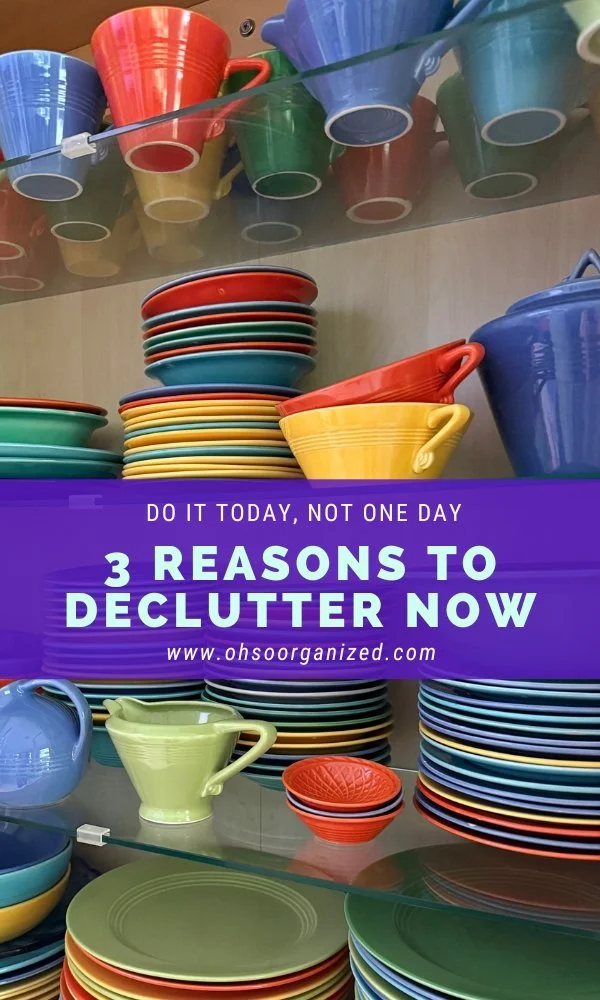
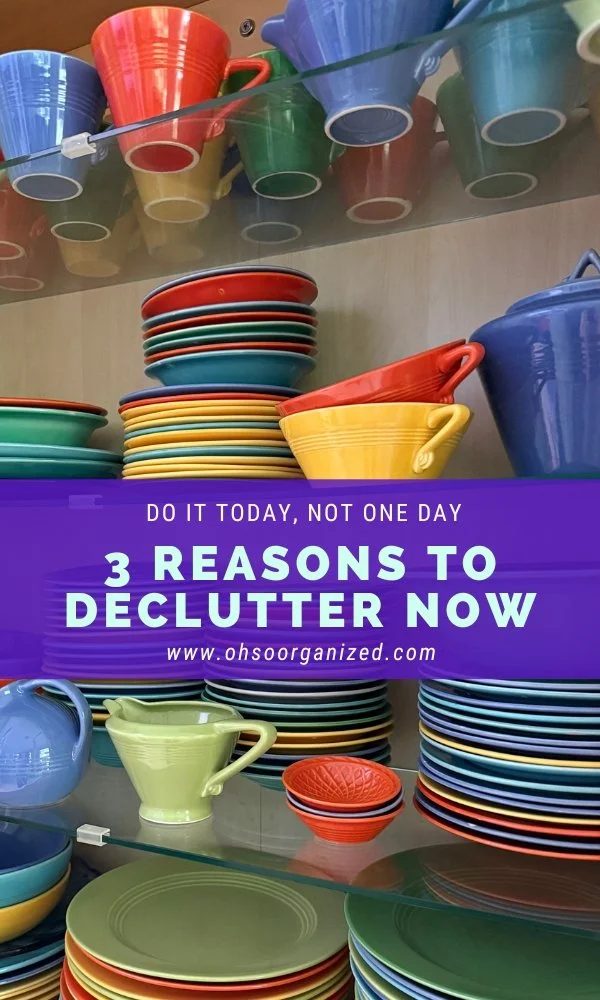
  • 289 – Number of items in the dining room china cabinet. We have more dishes in the kitchen.

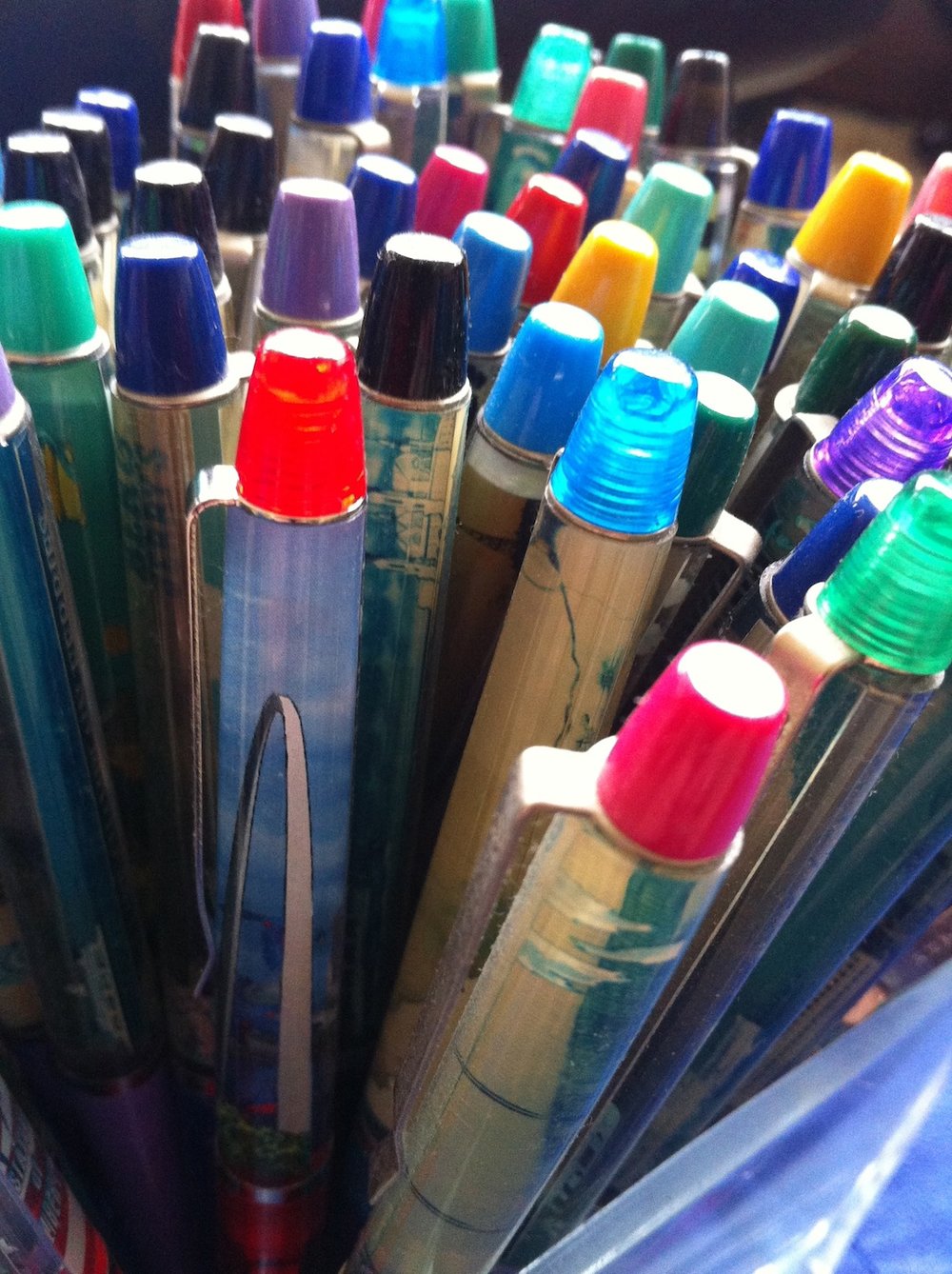
  • 49 – Number of items in the desk pen cup. I have many more writing instruments in other areas and in the supply cabinet.

The 1,116 items counted so far represent only a tiny portion of what we have in our household. I'm not sure whether we actually own 300,000 items. The idea is to recognize what you have and align it with what you want, need, and use.

By focusing on specific areas and doing a quick count, I spotted several things that could go. For instance, I don’t like all the pens that have landed in the pen cup—time to declutter. Even in the china cabinet, there are several dishes I don’t want that could go. While I regularly go through my clothing closet, more could be edited out.

Being aware of how much you have will help you declutter the things that no longer matter or are not useful to you.


2. Yikes!

Clutter can cause stress and affect your ability to focus. My clients have described how clutter affects them as,

  • “I have so much clutter I can’t even think.”

  • “I don’t want to feel overwhelmed by my stuff.”

  • “The clutter is distracting, and I can’t focus.”

  • “Clutter makes me feel agitated and angry.”

  • “I don’t want to feel clutter-related stress and anxiety.”

Research backs up the experience my clients describe. UCLA Center on Everyday Lives of Families (CELF) conducted research and discovered that “cluttered home environments were associated with elevated cortisol levels – especially among women who described their homes as chaotic or stressful.” Cortisol is the hormone produced as part of the body’s stress response.

Neuroscience research on cognitive overload and attention, including Princeton University’s work, shows that visual clutter, or “competing visual stimuli,” reduces the brain’s ability to focus and process information efficiently.

Knowing how clutter can affect your stress, attention, and functioning makes a compelling case for decluttering sooner rather than later.

Clutter can cause stress and affect your ability to focus.
— Linda Samuels, CPO-CD®, CVOP™

3. For love.

Recently, I came across an Instagram video featuring Alice D’Antoni Phillips, a psychologist-turned-chef. She discussed the emotional struggle of letting go of sentimental items while downsizing. Alice also described letting go as “an act of care.” She didn’t want to burden her loved ones with decisions about her stuff after she’s gone.

Then she said a beautiful phrase that stuck with me. It’s so gentle, compassionate, and loving. Alice said, “Easing the path of life for the people you love.” In that, she acknowledged that we’re all going to be gone at some point. We are born. We live. We die. That’s the reality.

The other part was about making it easier for the people you love by handling your stuff before you go. Making decisions and decluttering now are expressions of love.

It’s never too soon to start decluttering. Your loved ones will thank you.


Why Declutter Now?

There are countless reasons to declutter now, without delay. Some might be:

  • Your clutter is causing undue stress.

  • You have more things than you use, need, or want.

  • You want to make decisions about your belongings so your loved ones don’t have to after you’re gone.

  • You want to downsize and prepare to move.

  • You’re fed up with all the stuff.

  • You want greater clarity of mind and in your space.

What are your compelling reasons to declutter? What is motivating you? Which ideas resonate most? I’d love to hear your thoughts. I invite you to join the conversation.


How Can I Help?

Do you feel overwhelmed or disorganized? Is the clutter in your life causing stress and keeping you from living the life you want? I’m here to help! You don’t have to do this alone. Virtual organizing is an extraordinary path forward – Local feel with a global reach.

Let’s connect! I’m easy to reach.

Decluttering, getting organized, and living with more ease are possible, especially with support.


Why Do We Hold On to Treasures, Clutter, and Stuff?
Why Do We Hold On to Treasures, Clutter, and Stuff? by Linda Samuels

It’s the month of books, lots of new books! Most of my latest acquisitions are about clutter. I don’t know about you, but I love books, as does the family I come from. I grew up in a house of books. There were books in every room. Family excursions would often include hours spent “browsing” at bookstores like Rizzoli in New York City. Every time my mom returned from a trip, she’d bring back more books filled with places she traveled or art she’d seen. Sundays were often spent sitting around reading The New York Times, listening to music and reading books.

I’ll admit that when I was younger, I wasn’t as avid a reader. I preferred drawing, painting and dancing. But over the years, I have turned into my mother. What can I say? I have a lot of reading to catch up on.

While the books in our home are neatly stacked and stored on shelves, we have a lot of them. To visitors they might seem like clutter or too much stuff. To us, they are treasures. There are periods when I’ll scour the rooms with a bag in hand, hunting for books that can be released and donated. As I look, I rediscover some great “old friends,” which I can’t part with. However, there are some that I’m ready to let go of and put into the “donate” bag. Each book released represents a small success.

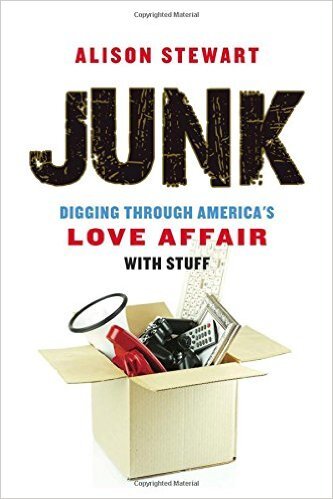
Junk by Alison Stewart

The newly published book, Junk – Digging Through America’s Love Affair With Stuff  by journalist and author Alison Stewart, is one of the books that recently joined my collection. About a year and a half ago, I had the pleasure of meeting and talking with Alison. The inspiration for her book came from her experience emptying her parents’ home after they passed away. She became fascinated with why we hold on to things. This led her to a three-year journey investigating all about our culture’s obsession with stuff: collecting it, releasing it, and upcycling it.

Alison cites resources like the Institute for Challenging Disorganization and interviewed many people including junk removers, some of my colleagues and me. She used part of my interview in her book and quoted me saying,

“I don’t think it is so odd that we define ourselves by certain objects. If you think about your space, you have things around, colors you like. What you see is the variation in the volume. And whether the stuff is enhancing your daily experience or it is causing stress. That’s the dividing line. Is it preventing you from living the life you want, doing what you want, causing problems with your family? That’s the slippery slope.”

The need to hold on and collect is a common phenomenon. As Alison asks, “Why do smart, successful people hold on to old Christmas bows, chipped knickknacks, VHS tapes, and books they would likely never reread?”

Why do smart, successful people hold on to old Christmas bows, chipped knickknacks, VHS tapes, and books they would likely never reread?
— Alison Stewart

Junk has many great stories, facts and connections with our shared experiences. It’s well worth adding this book to your collection or borrowing it from a friend.

Is your home filled with things that are too good to let go of, yet they no longer are serving a purpose? Have they become clutter? Do they represent postponed decisions? How do you decide if something is a treasure or clutter? I’d love to hear your thoughts.  Come join the conversation.


How to Fill Your Time With Amazing Moments

During a local errand run, I came across a luggage tag that grabbed my attention. Written in bold, clear lettering it said,

“Collect moments NOT things.” 

I’ll be the first to admit that I’m a collector of things. I derive pleasure in looking at and playing with fun, colorful objects like my floating pens, Pez dispensers and miniatures. But what I am a deeply appreciative of are the brilliant moments that life offers us at every turn.

The key is allowing the time to pause and acknowledge what we’re seeing, hearing, feeling, or noticing. Maybe the moment is the slight breeze cooling you off on a hot day, the scent of the rich, brown earth after a heavy rain, hearing the soothing voice of a loved one, the taste of that first morning sip of coffee, or sensation of your body exhaling as you lay down to relax after a long day. The list of wonderful moments goes on. Which moments fill your time? Which moments are there to appreciate?

While some moments are solitary, we also have shared ones with our friends, family, colleagues, acquaintances, and strangers. Who are the people that you share your time with?

Linda Goldfarb and Linda Samuels - ICD 2009

Linda Goldfarb and Linda Samuels - ICD 2009

Our time is limited. This was made all too clear as I mourn the recent loss of my friend and colleague, Linda Goldfarb. She passed away this week and will be deeply missed. Over the last fifteen years, our paths crossed many times at NAPO-NY, NAPO National and ICD events. I had the great pleasure of working with her on several projects for ICD. She was a woman of her word, creative, patient, focused, and always delivered on her promises. Linda was passionate about traveling, spending time with her husband, Bob and being a foster parent to dogs waiting to be adopted. She was a giver. Her moments counted.

While I’ll continue to collect a Pez dispenser here or a miniature there, the larger focus will be on collecting and appreciating amazing moments both simple and deep, solo and shared, because life is made up of those tiny instances. Time goes all too quickly. These moments are waiting for us to embrace.

Amazing moments are the ones we notice. Which moments fill your time? I’d love to hear your thoughts. Come join the conversation. 

 
5 Big Surprises About Professional Organizers & The Things They Collect

It may surprise you that many organizers are also collectors. I’m one of them. I collect many things, including Pez dispensers, cobalt blue glass, trinkets, floating pens, sparkly things, and beautiful Pinterest images. I no longer collect rocks, cat-related objects, pins, or leotards. Tastes change. Focus changes. Letting go happens.

I was interested in learning more about organizers’ collections, the influence they had on their organizing work, and issues related to letting go. To gain a deeper understanding, I reached out to several of my colleagues, including Janine Adams, Ruthann Betz-Essinger, Nancy Borg, and Karen Fulks. They shared a range of perspectives on the “stuff” of life, including collecting, managing, and letting go of it.

My deepest gratitude goes to each of them for sharing their experiences of collecting and letting go with us. Keep reading for some insights about the path of our possessions.

I asked my colleagues . . . 

  • What do you collect?

  • How has your organizing work influenced your collecting habits?

  • What letting go challenges have you experienced with your collections?

Contained Collections

“When I was in my twenties, I traveled internationally for my work, and I started collecting fountain pens, which were abundant and affordable in other countries. I added to the collection for a few years, and when I stopped traveling so much, I stopped collecting.

The collection lives in a fishing tackle box in the basement. Today, I literally had to dust off the box before opening it (for the first time in probably 20 years), and inside I found 43 neatly stored fountain pens. 

The organizer in me just had to consider letting go of the collection: I certainly don’t use these pens. Heck, I don’t even think about the collection. But looking at the pens, they bring back memories of my travels and, yes, of my youth. Should I let them go? Perhaps. Are they worth enough to sell? I have no idea, but it’s conceivable. Will I sell them? I sincerely doubt it, unless I find myself with a whole lot of time on my hands.

For now, I have plenty of room to store this small, contained collection. Perhaps I’ll give the pens away to a fountain-pen-loving young person one day. In the meantime, I appreciate the opportunity to reacquaint myself with these lovely pens!”

Janine Adams, CPO®, CPO-CD® – Professional Organizer, Blogger, Speaker & Blogger

Useful Collections

“I collect books and anything with Vera Bradley’s name on it.  Since becoming an organizer I have learned that the best collections need to be visible and/or useful. What is the point of something that is unseen or not used? Today, I give away any fiction books I have read, either to a friend or a library. I have also started buying more e-books.  My Vera Bradley collection is a little trickier, but I do rotate my purses and totes on a monthly basis. If I don’t use something within the year, it’s gone. I limit the number of Vera items to the volume of the storage container in which they are kept. Letting go is hard but the more you practice, the easier it gets. Also, knowing that another person might get the same thrill over an item that once thrilled you, makes it easier to give up.”

Ruthann Betz-Essinger, CPO®, MBA – Business & Residential Organizer & Speaker

Memories-Inspired Collections

“When my parents retired and downsized their “giraffe” figurines (both large & small), it was with great sadness that I watched them ‘let go’ of their lifelong collection. It was storytelling at its best. It signified wonderful days gone by and so it felt very heavy-hearted to bid them farewell.

When I married, while I loved the ‘idea’ of starting a collection of something, I understood that interests change and so too would our collections of ‘things.’  I recalled that my parent’s passion had faded though the years, and that those great long-necked treasures had eventually become even greater dust collectors.

35 years later, it is artwork, home décor, and treasured photo albums that fill our home and rekindle memories. We used to collect matchbooks from every restaurant, near and far. Although no longer an active (nor displayed) collection, I still delight in digging into a Ziploc and discover the favorite places that retell our stories.”

Nancy Borg – Professional Organizer & Blogger

Organized Collections

“Fact:  In our house, there are 40+ collections and 10,000 books. Working for years with ‘collectors,’ the easiest way to start with collections is to use the motto of Organizers worldwide: Like with like. And break it down again. For my/our obsessions: alphabetize books, put found money in by date, vintage knit potholders on kitchen walls, group cigar boxes by size, etc. But...snowglobes, the largest collection? After building narrow shelf units, groups formed – states, countries, animals, strange. The collection grew, as did the groups. We moved recently, (ok, 7 years ago), were undecided as to location, so all went to the attic and haven’t been looked at until…today, writing this – yep, still in attic, still undecided, and most fairly intact. I pretend I’m my client. I loved these unique snowglobes. Ha! Past tense & there’s my answer. Easy? No, but if I take pictures, I won’t have to dust them.”

Karen Fulks – Professional Organizer since 1984 & Collector since 1951

Passion, control, loss, and inquisitiveness reside in these stories. We experience unusual relationships to our objects and collections. How do we decide what to keep and what to let go of? Our “things” can have a unique hold on us, and therefore, we create parameters and boundaries around them. These come in both physical and emotional forms, such as fitting them into a specific container or questioning the value of our emotional attachments.

What resonates with you? Are you a collector, or do you know one? How do your attachments to “collected” objects influence your letting go habits? I invite you to share your thoughts about collecting, letting go, and boundaries. Join the conversation!