Posts tagged visual clutter
3 Fantastic Reasons to Declutter Now Instead of One Day

Is your life overflowing with stuff? Even if your belongings have ‘homes’ and you know where to find them, does the sheer volume feel overwhelming? Drawing on more than thirty years of working with clients and my own life experience, I’ve seen how the accumulation of stuff happens. It’s a slow (and sometimes not-so-slow) creep of collecting. 

One day, you look around and wonder:

  • Where did all this stuff come from?

  • Do I still need these things?

  • Are they taking up too much space, management time, and mental energy?

  • Is all this stuff necessary for the life I’m living now?

  • What will happen to my belongings when I’m gone?

  • What would life feel like with less?

  • What would it feel like to align what I own with the life I’m living?

There are many ways to think about clutter and the physical items that accompany your life. Let’s look at three reasons why decluttering sooner rather than later could benefit you. If even one idea resonates with you, it could be the cue and motivation you need to begin the decluttering process.


3 Compelling Reasons to Declutter Now Instead of Waiting

1. 300,000!

A frequently cited statistic in the organizing industry and media is the number of things we accumulate. Estimates suggest that the average American household may contain hundreds of thousands of items. The number often cited is 300,000. That’s a lot of stuff!

Whether that’s your number is a separate question. I don’t know what our household number is. Out of curiosity, I counted some objects in a few areas, and I was surprised by what I found:

  • 778 – Number of items in the bedroom clothing closet, including clothes, hangers, shoes, shoe boxes, and some accessories. We have additional clothes and shoes in the dressers and other areas.

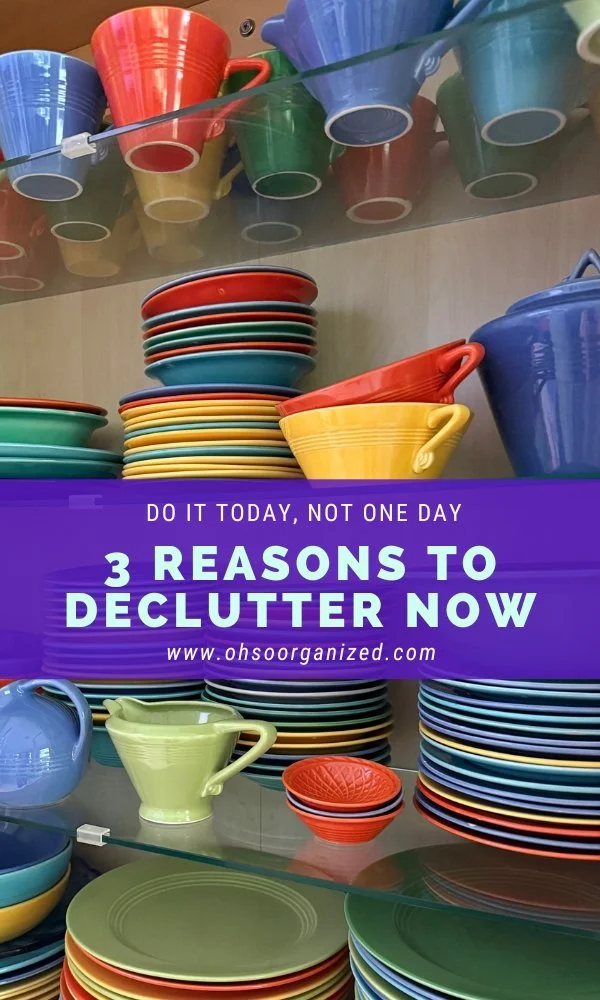
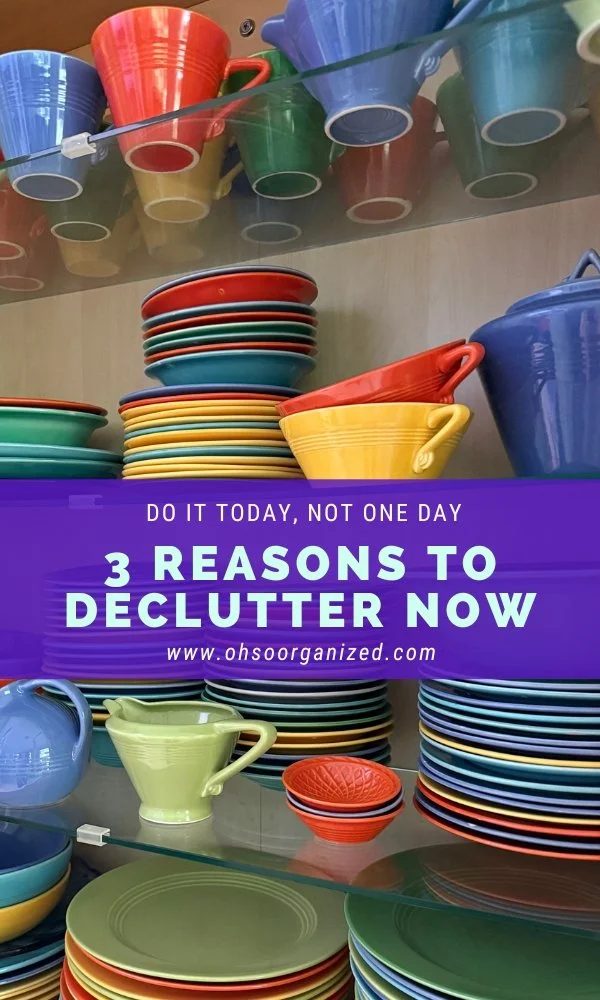
  • 289 – Number of items in the dining room china cabinet. We have more dishes in the kitchen.

  • 49 – Number of items in the desk pen cup. I have many more writing instruments in other areas and in the supply cabinet.

The 1,116 items counted so far represent only a tiny portion of what we have in our household. I'm not sure whether we actually own 300,000 items. The idea is to recognize what you have and align it with what you want, need, and use.

By focusing on specific areas and doing a quick count, I spotted several things that could go. For instance, I don’t like all the pens that have landed in the pen cup—time to declutter. Even in the china cabinet, there are several dishes I don’t want that could go. While I regularly go through my clothing closet, more could be edited out.

Being aware of how much you have will help you declutter the things that no longer matter or are not useful to you.


2. Yikes!

Clutter can cause stress and affect your ability to focus. My clients have described how clutter affects them as,

  • “I have so much clutter I can’t even think.”

  • “I don’t want to feel overwhelmed by my stuff.”

  • “The clutter is distracting, and I can’t focus.”

  • “Clutter makes me feel agitated and angry.”

  • “I don’t want to feel clutter-related stress and anxiety.”

Research backs up the experience my clients describe. UCLA Center on Everyday Lives of Families (CELF) conducted research and discovered that “cluttered home environments were associated with elevated cortisol levels – especially among women who described their homes as chaotic or stressful.” Cortisol is the hormone produced as part of the body’s stress response.

Neuroscience research on cognitive overload and attention, including Princeton University’s work, shows that visual clutter, or “competing visual stimuli,” reduces the brain’s ability to focus and process information efficiently.

Knowing how clutter can affect your stress, attention, and functioning makes a compelling case for decluttering sooner rather than later.

Clutter can cause stress and affect your ability to focus.
— Linda Samuels, CPO-CD®, CVOP™

3. For love.

Recently, I came across an Instagram video featuring Alice D’Antoni Phillips, a psychologist-turned-chef. She discussed the emotional struggle of letting go of sentimental items while downsizing. Alice also described letting go as “an act of care.” She didn’t want to burden her loved ones with decisions about her stuff after she’s gone.

Then she said a beautiful phrase that stuck with me. It’s so gentle, compassionate, and loving. Alice said, “Easing the path of life for the people you love.” In that, she acknowledged that we’re all going to be gone at some point. We are born. We live. We die. That’s the reality.

The other part was about making it easier for the people you love by handling your stuff before you go. Making decisions and decluttering now are expressions of love.

It’s never too soon to start decluttering. Your loved ones will thank you.


Why Declutter Now?

There are countless reasons to declutter now, without delay. Some might be:

  • Your clutter is causing undue stress.

  • You have more things than you use, need, or want.

  • You want to make decisions about your belongings so your loved ones don’t have to after you’re gone.

  • You want to downsize and prepare to move.

  • You’re fed up with all the stuff.

  • You want greater clarity of mind and in your space.

What are your compelling reasons to declutter? What is motivating you? Which ideas resonate most? I’d love to hear your thoughts. I invite you to join the conversation.


How Can I Help?

Do you feel overwhelmed or disorganized? Is the clutter in your life causing stress and keeping you from living the life you want? I’m here to help! You don’t have to do this alone. Virtual organizing is an extraordinary path forward – Local feel with a global reach.

Let’s connect! I’m easy to reach.

Decluttering, getting organized, and living with more ease are possible, especially with support.


 
 
Here Are 5 Most Interesting and Best Fresh Start Discoveries – v53

Enjoy the latest release (v53) of the “What’s Interesting?” series, which features my most recent finds that inspire, spark curiosity, and connect to organizing and life balance. These unique, fresh start discoveries reflect this month’s blog theme.

You are an engaged, vibrant, and generous group. I am deeply grateful for your ongoing presence, positive energy, and contributions to this community.

I look forward to your participation and further contributions to the collection I curated.

What do you find interesting?


What’s Interesting? – 5 Best Fresh Start Discoveries

1. Interesting Read – Fresh Start Goals

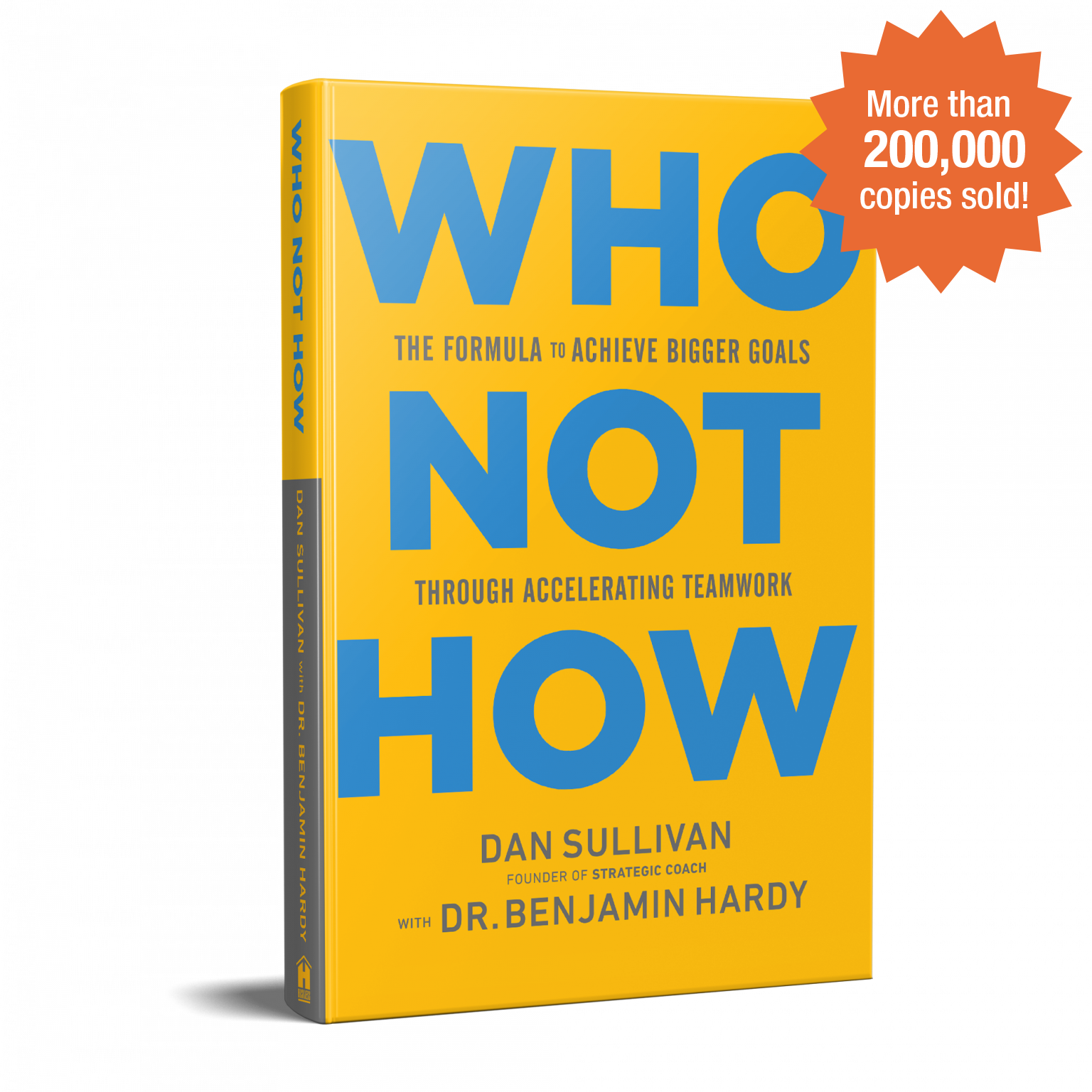
Bigger isn’t always better. Yet if you want to strive for an audacious goal this year, Dan Sullivan, coach and author of Who Not How – The Formula to Achieve Bigger Goals Through Accelerating Teamwork, has a way to get there.

This philosophy hinges on changing the questions you ask. Stop asking, “How can I do this?” Forget working in isolation and doing everything yourself. Instead, Sullivan teaches you to ask, “Who can do this for me?”

He advocates focusing on the “whos in your life that give you the perspectives, resources, and ability to go beyond what you could do alone.” Replace “How can I accomplish this?” with “Who can help me achieve this?”

If you’re feeling frustrated and stuck, it could be the ideal time to build your ‘who’ team.


2. Interesting Experience – Fresh Start ‘Party’

Do you have any “boring tasks” you’re procrastinating on? If so, you are not alone. Thanks to one of my clients, I learned about a Business Insider article that describes a new trend offering a fun solution to this challenge.

Instead of staying stuck and alone while trying to get things done, consider hosting an “admin night” party, as Business Insider editor Tess Martinelli did. She invited her friends over to work on their to-do lists or anything that was causing mind clutter, while also having time to socialize.

She kept things casual and as “low effort” as possible. While there were few rules, Marinelli set several parameters to help make the evening flow better, including:

  • Dress comfortably.

  • Bring your own snacks.
    Provide a beverage (optional).

  • Give some structure, such as working for 30 minutes and socializing or resting for 10 minutes. Repeat that cycle two or three times.

  • After each “round,” talk about what you accomplished.


3. Interesting Article – Fresh Start Decluttering

One of the top ten New Year’s resolutions is to be more organized. An essential part of getting organized is decluttering. This involves letting go of:

  • things that have overstayed their welcome

  • no longer support your current reality, or

  • don’t want or need.

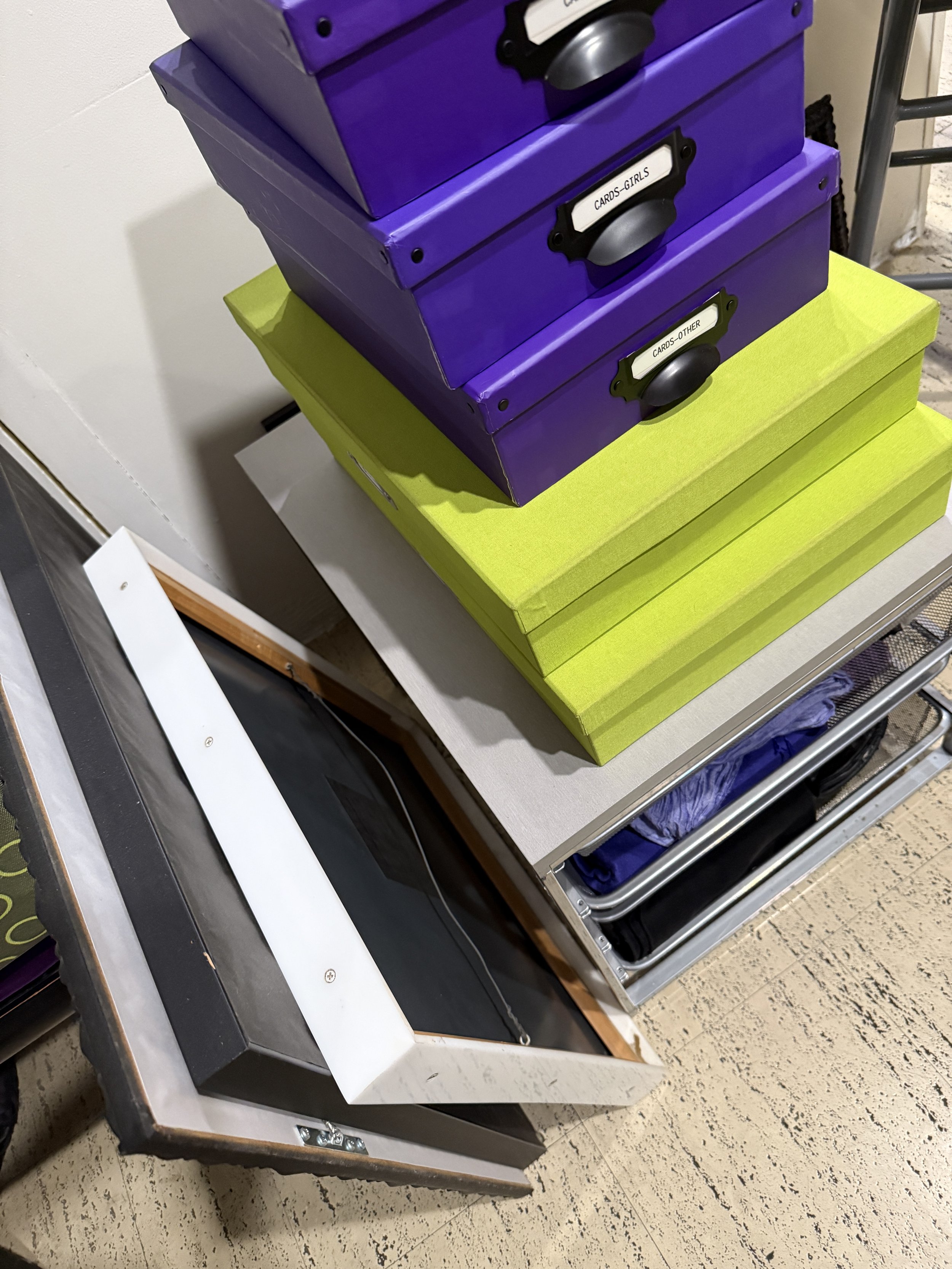
In The Washington Post article “How to reduce visual clutter for a calmer, more functional home,” the case is made for how taxing visual clutter can be on the brain. My clients often describe their clutter (physical or visual) as paralyzing or overwhelming their thoughts and actions.

Corey Pence from The Container Store defines visual clutter as an “overwhelming or excessive amount of visual elements in a space that make it difficult to focus on important information or executing tasks.” Clutter can also make it hard to feel calm and relaxed. Imagine a bedroom with clothing piled everywhere, or a living room with books, toys, and dishes strewn about.

The article suggests many ways to eliminate visual clutter, such as:

  • choosing furniture that encloses objects, such as a nightstand with a drawer instead of an open shelf

  • editing routinely

  • designating a home for objects

  • using coordinated bins on open shelves

  • carefully curating decorative objects, with an emphasis on having fewer

For a great fresh start, declutter until you find that sweet spot for the level of visual clutter your brain can handle.


4. Interesting Product – Fresh Start Planning

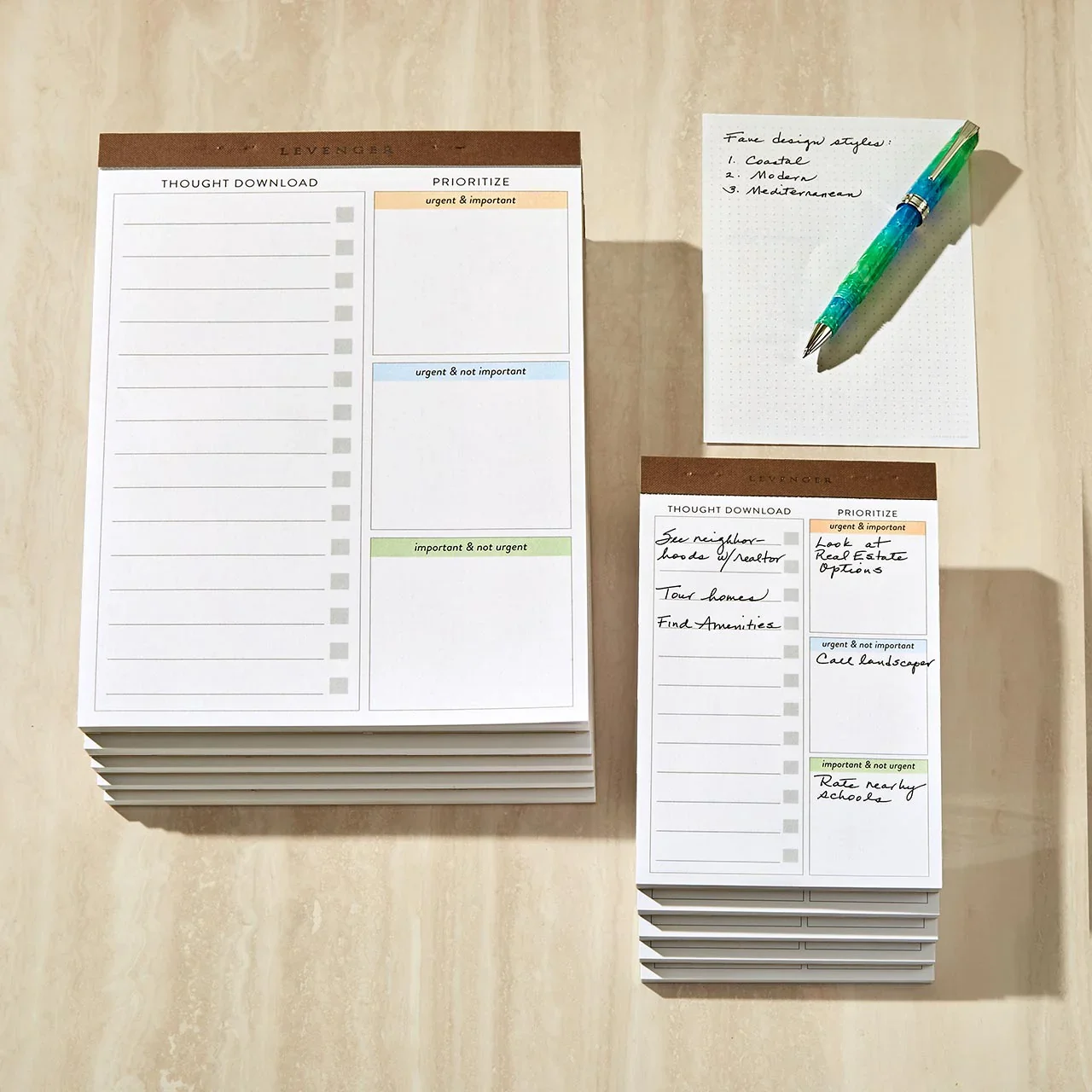
My go-to source for paper pads is Levenger. Their designs are streamlined, and the paper is smooth and easy to write on. If you’re looking for a new way to capture and prioritize your thoughts, check out Levenger’s Think and Plan Priority Manager Pad.

The pad comes in two sizes with two columns and four sections. The left column is great for brainstorming and list-making. It includes:

  • A ruled checklist

The right column is for prioritizing tasks using the Eisenhower method. It has three boxed sections for tasks:

  • Urgent and important

  • Urgent and not important

  • Important and not urgent

Download your brain, sort your to-dos, and give yourself an organized way to focus on your new beginning.


For a great fresh start, declutter until you find that sweet spot for the level of visual clutter your brain can handle.
— Linda Samuels, CPO-CD®, CVOP™


5. Interesting Thought – Fresh Start Magic

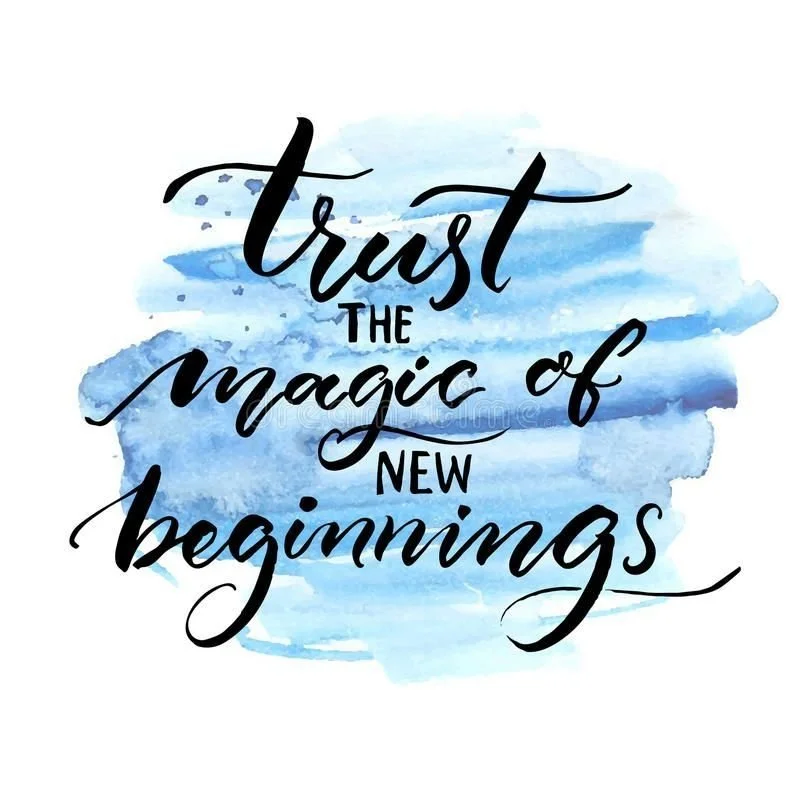
There’s something magical about fresh starts and new beginnings. You might feel hopeful, curious, excited, eager, joyful, empowered, or inspired. However, I’ve heard from many people recently that they’re having a very different experience. With the fresh start of the new year, they’re feeling anxious, apprehensive, pressured, disoriented, overwhelmed, or stuck.

Believe me, I get it. I’ve felt all of these ways at different points. On the one hand, I embrace and love a clean slate. It’s an opportunity for a reset and reimagining. Some years, like this past year, I just wasn’t ready to do ‘new.’ Instead, I was in the thick of finishing projects from the year, which overlapped with the time I typically review and plan.

Wherever you are right now, consider these possibilities:

  • If you’re ready, let the wonder of a new year help you move forward.

  • If you’re not ready, be gentle with yourself and ease the pressure to make big new plans for now.

Stay open to activating a fresh start (and its magical powers) at any time: a new day, month, or season.


The Fresh Start Advantage

There’s still time to make this first month of the new year work for you. Lean into the energy and newness of this season. Use the clean slate to your advantage.

Which of these discoveries resonates most with you? Which would you like to add? I’d love to hear your thoughts and invite you to join the conversation.


How Can I Help?

Do you feel overwhelmed, stuck, or disorganized? I’m here to help. Virtual organizing is an extraordinary path forward – Local feel with a global reach.

Let’s talk. I’m easy to reach.

Getting organized is possible, especially with a fresh start and compassionate support.


11 Delightful Pros Share Best Cues for When It's Time to Declutter

There are tons of cues that shout, “It’s time to declutter!” However, sometimes life gets so busy that you don’t see or feel the indicators. You can quickly become clutter blind and ignore the signs. The challenge, however, is when clutter creates overwhelm, procrastination, lack of direction, or anxiety.

For me, physical clutter is less problematic than mind clutter. When I notice myself aimlessly wandering from room to room and lacking focus, I know it’s time to declutter my thoughts. Depending on the situation, I might take a walk in nature, which helps me feel grounded and clear. Or, I might pull out my journal and free write to release the thoughts swirling around in my head. As a verbal processor, another helpful strategy is talking aloud with a trusted friend or loved one who is an excellent listener.

Does any of this sound familiar? If so, you’re going to love what comes next. There is power and relief in noticing, reflecting, and taking action as you’re about to learn.

I invited a stellar group of colleagues to share some of their personal discoveries with you. They explain their decluttering cues and the actions they take to get uncluttered. These generous friends include Julie Bestry, Christine Li, Seana Turner, Leslie Josel, Diane Quintana, Marcy Stoudt, Ellen Delap, Jonda Beattie, Geralin Thomas, Janet Barclay, and Yota Schneider. I asked them to respond to and elaborate on this prompt-

How do you know when to declutter your things, thoughts, space, or schedule?

Their diverse responses encompass various decluttering cues, from feeling tired to mentally blocked. My deepest gratitude goes to this inspiring group for sharing their time, hearts, and wisdom with us.


11 Pros Share Best Cues for When It’s Time to Declutter

1. Feel Pressured

“My catalyst for decluttering is pressure. I might recognize it as stress, inconvenience, irritation, or even physical friction.

If I lack buffer time between tasks, too many lower priority items squeeze against higher priority obligations, leaving no room to breathe, think, or re-set. When items in my desk, bathroom, or kitchen drawers lack margin to move smoothly or for me to retrieve them easily, the friction is a trigger to declutter. A closet packed so tightly that clothes rub against one another, causing wrinkles, means there's too much pressure in my space.

Sorting and reducing relieves the pressure!”

Julie Bestry, CPO® – Certified Professional Organizer, Author, Blogger, Speaker


2. Feel Fatigued

“I know I need to declutter when I am feeling drained or fatigued. It’s a bodily response informing me that there are too many things going on or too much to focus on accurately and well. When I have that realization, I do my best to spring into decluttering mode so that I free myself up for smooth action again.” 

Christine Li, Ph.D.Procrastination Coach, Clinical Psychologist, Make Time for Success podcast Host


3. Feel Over-Scheduled

“I am quick to declutter my spaces, but I have a tendency to over-program my schedule. I know I am in trouble when I have no chance during the week to ‘catch my breath.’ While any given day may be heavy-laden, if looking at the week ahead leaves me feeling anxious about my ability to meet my commitments or anticipating insufficient sleep, I know I’ve taken on too much. 

For me, the ‘fix’ is to intentionally block out some white space’ each week, including one day of rest and at least an hour each day to relax.”

Seana Turner – Professional Organizer, Blogger, Speaker


4. Feel Mentally Blocked

“We all define clutter differently. For me, clutter isn’t about my physical stuff, as my environment is well organized and consistently edited. However, my clutter is mental blockage, time robbers, emotional demands, and digital or electronic dependency. And the list goes on and on! In essence, it’s anything taking up viable space – in my head and life. So as soon as I can’t see what direction I’m heading as too much ‘clutter’ is blocking the view, it’s time to brain dump on paper. Clear my head and edit! That’s my no-fail method for feeling less overwhelmed and staying on my path.”

Leslie Josel – ADHD Student Coach, Author, Speaker


5. Feel Overrun

“I know it’s time to declutter a space or things when I have a hard time putting something away. I declutter my thoughts by doing a brain dump – writing everything down on paper that I’m thinking about. My schedule has become a problem because I have not created boundaries for my time and make appointments even when I know my time would be better served by focusing on my own work. I decided to change this habit. Recently, I set aside two mornings a week to work for myself and will no longer make any appointments during those times.” 

Diane N. Quintana, ICD Master Trainer, CPO-CD®, CPO® – Certified Professional Organizer, Author, Blogger


6. Feel Visually Distracted

“As a person who leans into my strength of being a highly visual person, what I see helps me know it is time to declutter. Visual clutter looks to me like there are too many items that do not fit in the designated space for them, such as clothes that do not fit into my primary closet. As I look at my paper calendar crowded with back-to-back tasks or appointments crowding the week, I see that it is time to say no more to projects. Once I see that cue, right away I take time to let go of stuff and add it to my donate bag. For my calendar, I move appointments a week out and have a prepared statement to decline requests for new projects.”

Ellen Delap, CPO® – Certified Professional Organizer

You can quickly become clutter blind and ignore the signs.
— Linda Samuels, CPO-CD®, CVPO

7. Feel Overwhelmed

“Want one solution to help you declutter anything from papers on your desk to putting away laundry to your email inbox? It's setting a timer and monotasking. When I'm out of time and feel overwhelmed, I simplify my thoughts and say a mantra: I can do anything in 15 minutes.

To put this in practice, pick one task, end a meeting early, set a timer, and be amazed at what you can accomplish by monotasking for 15 minutes.” 

Marcy Stoudt – CEO of Revel Coach, Founder of The Executive Mom Nest


8. Feel Encumbered

“Out of sight- out of mind, or is it? I store archival papers in my attic. That means at least once a year, I climb a ladder to the attic and schlep up tax papers and anything else I feel I should keep but deem archival. The plan is that when I take up new files, old ones can be gotten rid of. You can guess how well that worked. 

This past year the weight of 7 years of not decluttering those papers haunted me. It felt so wonderful to finally get all that weight off my head!” 

Jonda S. Beattie, M.Ed – Professional Organizer, Author, Speaker


9. Feel Inspired

“To remain as clutter-free as possible, I follow calendar prompts for inspiration. For example, June is National Safety Month, and I add it to my calendar. This alerts me to update first aid supplies, our hurricane prep kit, and my vital documents file. In June, the second week is National E-mail Week, which cues me to declutter my email and delete or merge duplicate contacts. The second week in June is also Small Business Week. My calendar prompts me to inventory and organize Metropolitan Organizing’s office bookshelves and office supplies.

Personally, this system feels less overwhelming than trying to do everything at once or whenever I think of them.”

Geralin Thomas – Career Coach for Professional Organizers


10. Feel Confined

“I usually know it’s time to declutter when I can’t find space to store something new or when it’s too much work to do something I enjoy because of what’s involved in gathering the items I need. 

Most recently, I was feeling closed in at my desk and realized that I was tired of looking at the file organizer on my desk, which is always in my line of sight. I removed some books I no longer refer to from my bookcase, freeing up space for the organizer and making my desk a little more open.”

Janet Barclay – Certified Care Plan Specialist, Digital Business Consultant, Website Caregiver


11. Feel Rushed

“My state of mind tends to be reflected in everything I do and how I do it. My space, schedule, and thoughts are constantly informing one another. When clutter of any kind enters my life, eventually, there will be signs pointing to the need for change. I may wake up at night with my to-do list running through my head and a feeling of overwhelm pressing down to my chest. I get clumsy, anxious, irritable, or indifferent. I skip the daily rituals that support my sense of well-being and peace of mind and rush from one thing to the next. That is when I know it’s time to simplify and downsize so I can create the space I need to taste the sweetness of my life’s moments.”

Yota Schneider – Life Coach, Retreat Facilitator, Blogger


As you read this, did you increase your clutter awareness? Which decluttering cues resonated with you? What helps you move forward? I’d love to hear your thoughts. I invite you to join the conversation.

If you are struggling and want a decluttering partner, I’m here to help. I love supporting my clients with decluttering their things, thoughts, time, and space. Create the calm you deserve. Contact me at linda@ohsoorganized.com, 914-271-5643, or click here.