Posts tagged learning
How a Fantastic Conference Taught Me More About Virtual Organizing

Recently, I returned from the Institute for Challenging Disorganization’s (ICD) conference, held in Canada this year. Colleagues from around the globe gathered to learn, connect, and explore the latest ideas and research related to neurodivergence and people affected by chronic disorganization.

The conference covered a fascinating range of topics, including ADHD, decision-making, navigating life transitions, clutter, emotional labor, hoarding disorder, motivational interviewing, and communication.

I was thrilled to be part of the panel, “Cultivating Connection: Best Practices for Communication with Neurodivergent Clients,” alongside my wonderful colleagues. Sara Skillen moderated, and Leslie Josel and Elizabeth Brink were the other panelists.

Whenever I’m learning, I have one goal: to learn at least one new thing, discover one new resource, or deepen my connection with something I already know. Honestly, with that simple goal, I consistently come away with far more than one thing.

The ICD conference was no exception.

I’m excited to share some of my takeaways and how they expanded my thinking, reinforced what I already know, and will influence the virtual organizing work I do with clients.


What Expanded My Thinking About Virtual Organizing

Emotional Labor

In “The Art of the Invisible: Helping Neurodiverse Families Navigate the Emotional Labor Lifecycle,” presenters Regina Lark, PhD, CPO®, CPO-CD® and Leslie Josel, PCC, discussed how emotional labor, which is mostly invisible and disproportionately handled by moms, is “the exhausting work” and the “cognitive management of household systems.”

Navigating emotional labor, work that never ends, requires executive function (EF) skills that rely heavily on the prefrontal cortex. These include:

  • Planning

  • Focusing

  • Remembering instructions

  • Juggling multiple tasks

  • Managing emotions

  • Working memory

  • Organizing

However, as many of my clients have experienced, EF skills can be especially challenging if you are highly stressed, have prefrontal cortex damage, or have conditions such as ADHD, autism, dyslexia, dyspraxia, or Tourette’s syndrome.

One of the biggest takeaways was distributing the emotional load through “radical delegation. Take perfection off the table. Delegate to someone else, even if they aren’t good at it.  Go for “good enough.”

This made me think differently about virtual organizing. When we work together, we’re not only organizing possessions or creating systems. We’re also considering the mental load behind those systems. What decisions are constantly being made? What is someone trying to remember? What are they managing for themselves or others? And what might be possible to let go of, share, or accept as “good enough”?

Life Transitions

We experience many life transitions. Professor and researcher Dr. Michelle Pannor Silver focused on four in her presentation, “Unpacking Identity: Navigating Later Life Transitions for Those with Organizational Challenges.” She discussed retirement, menopause, clutter, and prioritizing physical resilience.

Much of my work involves helping clients navigate transitions such as moving, starting a new job, divorce, birth, losing a loved one, and other life changes like those Dr. Silver discussed.

One takeaway came from the retirement section. Since our identities are often tied to our work, figuring out what comes next takes thought. Silver stressed the importance of creating “time and mental space to imagine retirement.” It’s not just about getting your finances in order. Take time to envision how you want your post-work life to feel and what you want it to be like. Include “sparking joy” activities.

Another idea that resonated was “recalibrating after loss.” In later years, loss can arrive in many forms, including changes in work status, moving from a familiar environment, changes in physical or cognitive abilities, and the loss of loved ones.

I am thinking differently about virtual organizing in the context of reimagining and recalibrating life. We go through periods when the organizational systems or patterns that used to work suddenly become ineffective. They no longer support who we are now. Virtual organizing sessions can be a wonderful way to work through these shifts and create systems and schedules that support who you are now.

“Decision-making is at the center of everything. It is a core part of being human.”
— Elizabeth Brink, PCC, PCNC®, SEP®

What Reinforced What I Already Know About Virtual Organizing

ADHD

Ari Tuckman, PsyD, MBA, presented “ADHD Can Make Organizing Psychologically Messy.” He emphasized that the ADHD challenge is “not the knowing, but the doing.” Challenges with activation, attention regulation, perfectionism, and time management can make it harder to start. You might know what to do, but these obstacles can make it challenging to get things done.

One question Tuckman suggested was, “What’s a realistic, sustainable goal that you’ll allow yourself to feel good about?” Emphasizing “realistic” and “sustainable” is central to my work with clients.

Tuckman shared many strategies that reinforced the tools and concepts I use with clients. They included:

  • Time – Use analog clocks, alarms, and schedules to build time awareness and make time more visible.

  • Fun – Make tasks less boring and more enjoyable through gamification or a playful spin.

  • Clarify – Ask, “How important is ‘this’ relative to everything else?”

  • Momentum – Do a “bit of something,” and always “hope for momentum.”

  • Experiment – “Be willing to flounder, and be confused.”

  • Decision-Making– If you are having difficulty choosing, flip a coin. It can clarify what you really want.

  • Perfectionism – Focus on “good enough.”

These strategies reflect what I see every day in virtual organizing: knowing what to do and being able to do it aren’t always the same. Virtual organizing sessions can help clients identify what gets in the way, experiment with different approaches, and find strategies that are realistic and sustainable for them.

Decision-Making

Elizabeth Brink, PCC, PCNC®, SEP®, a neurodivergent-centered coach, educator, and trainer, presented “Decision-Making: Neurodivergence, Trauma, and Chronic Disorganization.” Brink stated, “Decision-making is at the center of everything. It is a core part of being human.”

Brink went on to say that “Decision-making is a special kind of hard for neurodivergent humans.” She also said that for neurodivergent people, “Overwhelm is a reasonable response to decision-making.”

When Brink said, “It’s a big deal how to help people make decisions,” I recognized how central nurturing decision-making skills and building agency are to my virtual organizing work. People reach out to me when they feel overwhelmed, and much of that overwhelm comes from difficulty making decisions.

Decision-making skills can be learned. Brink featured several skill-building strategies that align with how I support my clients in making decisions. They include:

  • Empathy – Understand and appreciate what they may be feeling or experiencing, without judgment.

  • Demystify – Learn how they make decisions, what’s worked well for them in the past, the process they’ve used, and how we can tweak or apply that process to current choices.

  • Capacity – Be mindful of their capacity at that moment, normalize pauses, take breaks to avoid decision fatigue, and encourage a slower pace when needed.

Always Be Learning

Every conference leaves me with something to think about, but this one reminded me why I value learning so much. Sometimes a new idea changes how I approach my work. Other times, it gives me language for what I already know and see in my work with clients. Both are valuable.

I’m excited to bring these insights into my virtual organizing sessions and stay curious, experiment, and learn alongside my clients.

How Can I Help?

Do you feel overwhelmed, stuck, or disorganized? You don’t have to face it alone. I’m here to help! Get unstuck and make progress. Virtual organizing is an extraordinary path forward—with a local feel and a global reach.

Let’s talk! I’m easy to reach.

Getting organized, making progress, and reaching your goals are doable, especially with support.


How to Joyfully Lean Into a Promising “Yes” One Fresh Start Offers

The first day of this new year has come and gone. Yet that fresh-start energy lingers. I’m feeling it, especially today, as a massive winter storm blankets much of the United States with an enormous amount of snow. By tomorrow, we’re expecting 12”-16” of snow in New York. It’s giving us a giant pause, asking us to sit tight, get cozy, and weather the storm. Please stay safe, my friends.

As I sit here to write, my ‘IMAGINE’ mug filled with piping-hot coffee by my side, I’m thinking about the relationship between fresh starts and saying “yes.” I’ve noticed that, especially during this time of year, when I’m reflecting and planning, new opportunities appear. It’s not just their arrival, however. I’m in a more receptive mood, which means I’m more likely to be open and say “yes” to opportunities.

Why is that? Doing something differently or trying something new energizes me. And new changes the mood as one year ends and a new one begins. Possibilities also bring excitement and hope. Doing something different can get me out of a rut, change my perspective, or bring more joy and satisfaction. There are also serendipitous outcomes and benefits that weren’t anticipated.


Three “Yeses” Inspired by the Fresh Start

1. 20 Minutes a Day Challenge

A few of my dear friends invited me to participate in a January movement challenge. The barrier to entry was so low that saying “yes” was easy.

The instructions were simple:

  • Move 20 minutes a day, every day in January.

  • Move in some way. No pressure about the intensity or the type of activity. This could be stretching, yoga, walking, swimming, or any other movement.

  • Text each other daily about what you did or didn’t do. No judgment, only support.

The benefits: The obvious one was that I was more aware of my movement during the day, which felt good. I was less sedentary. Having accountability partners encouraged me to move, even when I didn’t feel like it. The more serendipitous benefit was how much I loved this purposeful, low-pressure daily connection, banter, humor, interaction, and encouragement with my friends.

This ‘yes’ has been such a positive experience that we decided to extend the challenge through mid-February. 


2. 21-Day Tiny Shifts Experience

Dr. Elisha Goldstein, psychologist and author, offered an intriguing program beginning in January. This was another easy “yes.” With a small investment of time and money, he would help us engage in “daily, 3-minute practices to support your nervous system and help you show up differently, one small shift at a time.”

I’m all about small shifts and changes, as it’s integral to my client work. I thought it would be beneficial to try a similar experiment for myself.

During the kickoff meeting, Elisha stressed how this experience wasn’t about “fixing what’s wrong or applying pressure.” It was about:

  • Engaging in “small, repeated moments of regulation.”

  • “Learning to recover faster and more often.”

  • Building resilience.

  • Interrupting stress loops.

  • Experimenting with “nervous system friendly practices.”

  • Understanding that it’s not just about being calm, but about helping you to show up better.

  • Being more grounded and present.

Today’s practice encouraged us to “allow a little more ease,” which is exactly what I’m going to channel today, tomorrow, and going forward. It might even become my 2026 mantra. Thank you, Elisha.

The benefits: I look forward to the daily recorded messages from Elisha, which encourage me to think, relax, and regulate my emotions. The practices are simple and doable. I’m only in the first week, but so far I’ve felt more grounded, taken needed pauses, and feel more present. I’ve been reminded of how powerful the breath is for emotional regulation, and I’ve even integrated it into some of my virtual organizing sessions. I’m also appreciating the community of participants who share their thoughts through a private platform. I enjoy reflecting and learning about what others are experiencing.

“Fresh starts can be invigorating, especially when you embrace new opportunities.”
— Linda Samuels, CPO-CD®, CVOP™

3. Explore Somewhere New – My wonderful husband gifted me a weekend in New York City for my birthday. He planned everything, which was a gift in itself. I always love our time together. I appreciate the simple things we do, like running errands on Saturday morning, kayaking on a lake, walking hand in hand, or sharing meals. Most of our time is spent doing everyday things.

However, for the special weekend, we did things we don’t do every day. It was so much fun. That it happened in January energized the fresh start even more. We visited the Museum of the Dog. Some of my favorite things were playing with the interactive video dog, Molly, and learning about different dog breeds. It made me miss our black lab, Norton. He was an amazing soul.

We also visited the Morgan Library, which I hadn’t been to in years. It has a gorgeous, relatively new wing attached to the historic library. I got emotional when looking at Renoir’s journals and sketches. I had a yearning to draw again like I used to. Who knows? Maybe I will rediscover my art supplies this year.

After visiting two museums, enjoying lots of yummy meals, and an unplanned visit with our kiddos, who were also visiting New York City that weekend, we went on to our next adventure. Across from Grand Central Terminal is the Summit at One Vanderbilt, an immersive art experience with panoramic views of the city. The Summit is located on the 91st-93rd floors of this eco-friendly skyscraper, one of the tallest buildings in Midtown Manhattan, completed in 2021.

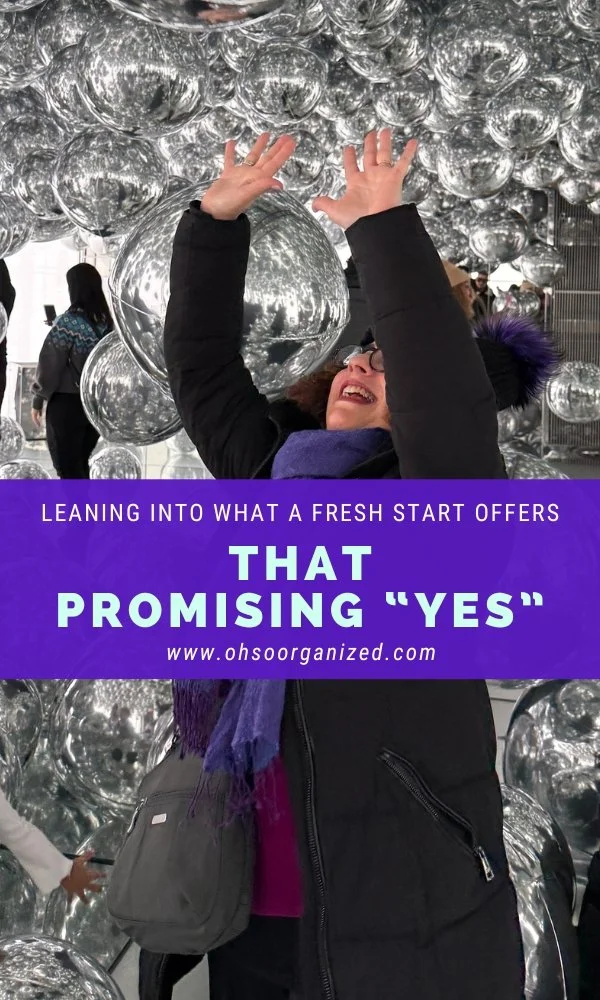
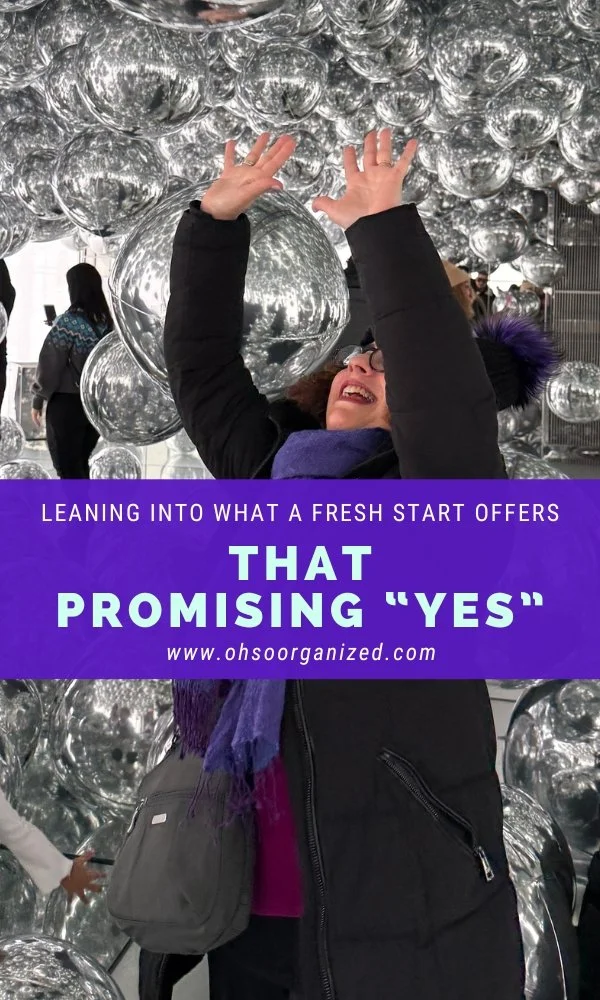
It turned out to be an overcast, cloudy day, so the views weren’t visible. It didn’t matter because there was plenty to explore. Although I would like to go again on a clear day. I loved the Affinity room, where we were surrounded by floating silver balloon-like orbs. It was so much fun catching and throwing them. I felt like a little kid.

My sense of balance and confidence was tested as I walked across mirrored glass floors. You know that wobbly feeling you get when you’re high up? I worked to accept the sensations so I could enjoy the experience.

The benefits: By the end of the weekend, I was vibrating with joy and excitement. Seeing, exploring, and doing new things was uplifting. I wanted to do that more. The weekend helped me celebrate while embracing the newness of a fresh start. The time away also reminded me of things I value: family, connection, art, presence, exploration, learning, curiosity, and experimentation.


What Will Enhance Your Fresh Start?

Fresh starts can be invigorating, especially when you embrace new opportunities. Is there something you said “yes” to this month that you’re glad you did? What have you noticed? Do these ideas resonate with you?

I’d love to hear your thoughts. I invite you to join the conversation.


How Can I Help?

Do you feel overwhelmed, disorganized, or stressed? Would you like to make changes this year? I’m here to help! Virtual organizing is an extraordinary path forward – Local feel with a global reach.

Let’s connect! I’m easy to reach.

Getting organized and making changes are possible, especially with support.


Vibrant New Year Brings Fresh Starts, Young Blooms, and Welcome Perspectives

The start of a new year can feel hopeful. It’s a chance to try new things, set your goals, adopt healthier habits, and lean into the fresh-start energy the new year brings.

Unlike the end of the year, when you might have been working furiously to complete those last few projects or tasks, January feels different. It’s like a blank journal. There are no entries yet, only possibilities. The story has time to unfold and be written.

Here are some questions to consider as you write your story:

  • What will your pages include?

  • Do you foresee challenges?

  • Are you picturing successes?

  • What are you looking forward to?

  • What do you want to invite in?  

  • What do you want to let go of?

  • What projects, plans, travel, or gatherings will be included?

  • Will your year bring growth, stability, change, or something else?


Fresh Starts

I’m still working through my year-long planning process, which has evolved over time. Some years it has been more involved than others. Last year, my plan was almost non-existent. I was under a tight deadline from the end of December into January. The project completion overlapped with the time I typically use to review and plan. By the time I came up for air, I opted to forgo the ‘planning gymnastics’ I usually do and simply let go. Instead of intensive reviewing and future-thinking, I let the days flow.

This year, however, I returned to reviewing and planning because I missed doing it. I’m taking note of the more casual process from last year and layering it over this one. I don’t want to make the planning process burdensome or too elaborate, as it has felt in the past.

I’m gifting myself time to review and prepare at a non-pressured pace. The process involves several tasks, which include:

  • Review Last Year’s Calendar – This section is complete. I noted workshops given, major projects, day trips and vacations, gatherings hosted, conferences and meetings, learning experiences, volunteer activities, and time with family, friends, and clients.

    What I observed: There was a good balance between work, play, and volunteering, alone and people time, and home and away time.


  • Revisit Previous Planning Tools – Already completed. I reviewed my goals and planning materials from past years. It was fun to see what information I captured, whether it was helpful, what goals I set, and which goals were relevant to bring forward. One thing I definitely want for this year is to simplify my process.

    What I observed: There is value in reviewing and capturing those observations in a visual format. It’s also useful to change things up so the process doesn’t feel stale.


  • Look at iPhone Photos – With a few projects I worked on at the end of last year, I already did a quick pass through the photo library. However, I want to take a longer look so I can “feel” and understand the year visually.

    What I observed: I love taking photos, as evidenced by the volume of images and videos I have taken. These images capture the sights and sounds of nature, people, places, and events. They also feature saturated color, light, shadow, and many close-up details.


  • Read Journal – Reread last year’s entries to identify patterns, significant events, lessons learned, challenges, successes, and the general mood or feeling for the year.


  • Three Things Reflection – Fill out the questions adapted from The Compass Journal. This is one of the tools I’ve used for years and didn’t do last year. I missed it, so I’m working through it again this year. I’m partly done, but I want to read my journal first to help me complete this exercise.

  • Select Word or Motto of the Year – This is another exercise I let go of last year. I opted not to choose a word and settled on a motto only. I liked the 2024 motto, “You got this,” so much that I repeated it for 2025. However, for 2026, I want something new. I compiled a list of potential words and motto options. Nothing is quite right yet, so I’ll let those simmer a while longer before I commit. I’m still uncertain whether I’ll choose a word and a motto, or just one.

“Lean into the fresh-start energy the new year brings.”
— Linda Samuels, CPO-CD®, CVOP™

Young Blooms

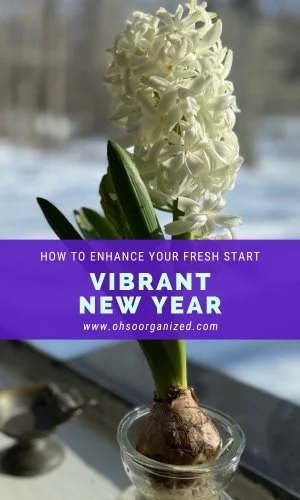
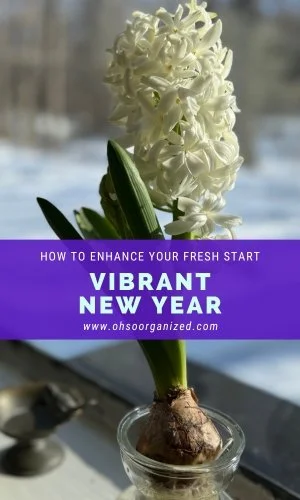
Recently, I received a lovely gift—a jar with a hyacinth bulb in water. My friend told me it would thrive indoors as long as I gave it sun and kept it watered. Weeks passed, and finally the milky-white blooms began to open.

It felt quite magical. One day, they were invisible, and the next, they were in full view. Since then, I’ve been enjoying their perfumey fragrance and the unfolding of more blooms.

What a beautiful analogy for this new year. Tend to your garden. Water it. Give it the nourishment it needs. Your blooms will arrive, bringing wonder, joy, and growth.


Welcome Perspectives

One value of embracing a clean slate is the openness it brings. Instead of superimposing your familiar thought patterns, habits, or conventions on the clutter, you have an opportunity to see things in a new way. The vastness gives us space for a different perspective.

Especially if you’ve been feeling stuck or overwhelmed, having space to see things in a new way is helpful. You can sort things out on your own or ask a trusted source for help.

Several weeks ago, Todd Henry posed this question, which I thought could be helpful for you. He asked,

“What problem are you wrestling with solo that would benefit from outside input or perspective this week?”

Design the year you envision. And if you’re stuck, reach out for help. You don’t have to go this alone.


What Will Your New Year Be Like?

There are many ways to make the most of the new year. I shared a few ways to craft your year. Do any of these resonate with you? What is your process for designing your year? Are you doing anything differently this year?

I’d love to hear your thoughts. I invite you to join the conversation.


How Can I Help?

Do you feel overwhelmed, disorganized, or stressed? Would you like to make changes this year? I’m here to help! Virtual organizing is an extraordinary path forward – Local feel with a global reach.

Let’s connect! I’m easy to reach.

Getting organized and making changes are possible, especially with support.


12 Inspiring Quotes of the Year That Will Make You Feel Hopeful

This is a wonderful time to reflect on the past twelve months before the new year begins. In 2025, we had emotional, enriching, and deep conversations on the blog.

We walked together, shared tumultuous times, made exciting discoveries, and navigated life balance. In our free-flowing exchanges, insights, new perspectives, and hope emerged.


Meaningful Conversations

Our conversations about life balance, change, clutter, letting go, time management, motivation, organizing, hope, and more brought comfort, connection, learning, and joy.

Thank you for being part of this community. You inspire me to show up, write, think, and engage.


Deepest Gratitude

I am profoundly grateful for your thoughtful words and generous sharing. Based on your comments this year, I curated twelve of my favorite insights from you. Thank you, Diane Quintana, Ellen Delap, Hazel Thornton, Janet Barclay, Jill Katz, Jonda Beattie, Julie Bestry, Kim Tremblay, Melissa Gratias, Sabrina Quairoli, Seana Turner, and Yota Schneider.

You are consistent voices and participants who bring our conversations to life. I am grateful to you and to everyone who reads the blog, contributes to our discussions, or shares the posts. You infuse this community with hope, humor, curiosity, perspective, and learning.

Enjoy the year in review, one quote at a time!


12 Inspiring Quotes from Our Conversations This Year That Will Make You Feel Hopeful


1. Fresh Start | 3 Ways to Take a Slow Exhale & Refocus Energy for a New Fresh Start

“Giving yourself permission to downshift, reset, and refresh is the best way to pave the way for the next project.”
— Ellen Delap
“Change can be hard. Focusing on one small thing at a time can help.”
— Kim Tremblay
“I was just in the middle of talking myself out of doing something because of uncertainty. Okay, time for a deep breath and some rational thinking.”
— Melissa Gratias
“People are more likely to let go of items if they know they are going to a good place.”
— Jill Katz
“Focusing only on the next step keeps me from becoming overwhelmed by decluttering and other large projects.”
— Janet Barclay
“As for productivity, no, it isn’t a dirty word, but neither is setting it aside for a while. I get a lot of satisfaction from completing my to-do list and from giving myself to the activities that soothe my spirit.”
— Yota Schneider
“Waiting to feel motivated never works for me. It’s more like I start, and then the motivation catches up.”
— Seana Turner
“I have my people to call for different types of help – the ones who just let me vent, the ones who want to help me brainstorm and plan, and the ones who are on my doorstep almost immediately. ”
— Jonda Beattie
“Virtual organizers can pull out the essential steps and manage them, helping the client feel more in control of their time during this stressful moment.”
— Sabrina Quairoli
“I love reframing! One of my favorites is this: Instead of thinking ‘I’m anxious,’ or nervous to do something, think ‘I’m excited!’ to do it.”
— Hazel Thornton
“Tolerating discomfort, in particular, means that waiting is so much easier when you can focus on the fact that any uncomfortable situation is temporary. ”
— Julie Bestry
“I love the idea of embracing fun! It’s easy to get bogged down by the minutiae and to forget to look outside our to-do list and notice things around us.”
— Diane N. Quintana


Past Reflections and Future Possibilities

What was most significant to you this year? Which quote resonates most? What do you want to focus on in the New Year? I’d love to hear your thoughts. I invite you to join the conversation.


How Can I Help?

Let’s make 2026 a fabulous year! Do you want support in creating a better balance, letting go of what no longer serves you, or getting more organized? I’m ready to help. Virtual organizing is an extraordinary path forward - Local feel with a global reach.

Let’s connect! I’m easy to reach.

Getting organized is possible, especially with support.

I wish you a happy, healthy, organized, and joy-filled New Year!