Posts tagged humor
Does Clutter Make It Extra Hard to Find Stuff and Cause You Stress?

My clients often say that clutter causes them stress. Clutter-related stress can come from several sources, such as:

  • An overabundance of items to manage and maintain

  • Too much visual stimulation or overload

  • Difficulty making decisions

  • Being the recipient or holder of other people’s things, such as adult kids or deceased loved ones’ belongings

  • Accumulating things, yet rarely editing or letting go

  • Perfectionism

  • Overshopping

  • Executive functioning challenges that make it difficult to plan, categorize, prioritize, or sequence

  • Not establishing ‘homes’ for things


Where Is It?

I want to focus today on the last point about ‘homes’ for things. When you can’t find what you’re looking for, it’s stressful and frustrating. It can make the simplest task take twice as long because you can’t find what you need to do ‘x.’ Not knowing where your things are can affect your time and relationships, leading to lateness and causing stress with family, friends, or co-workers.

The challenge of not having ‘homes’ for things can show up in various ways.

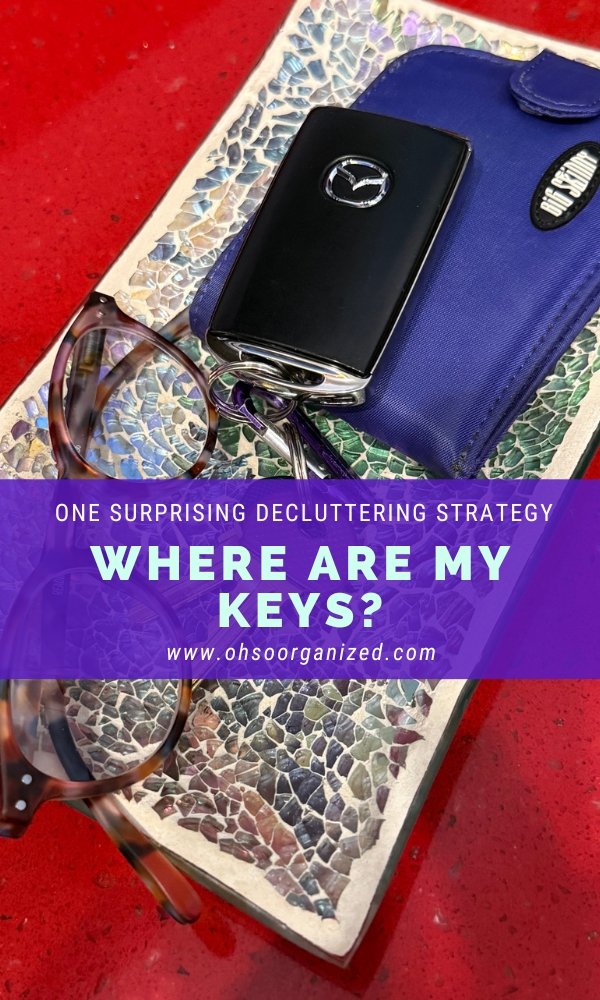
  • Have you ever misplaced your keys and spent 30 frantic minutes looking for them, only to be late for a coffee date with your friend?

  • Have you ever tried to cook dinner and couldn’t find the pot you needed, the measuring spoons, or the recipe you wanted to use?

  • Have you ever gone to pay for your purchases at the local store only to realize you couldn’t find your wallet?

  • Have you ever been about to make an important call and couldn’t find your cell phone anywhere?

Do these scenarios, or anything like them, resonate with you?

When you can’t find what you’re looking for, it’s stressful and frustrating.
— Linda Samuels, CPO-CD®, CVOP™

The ‘Adult Version’ of a Childhood Song

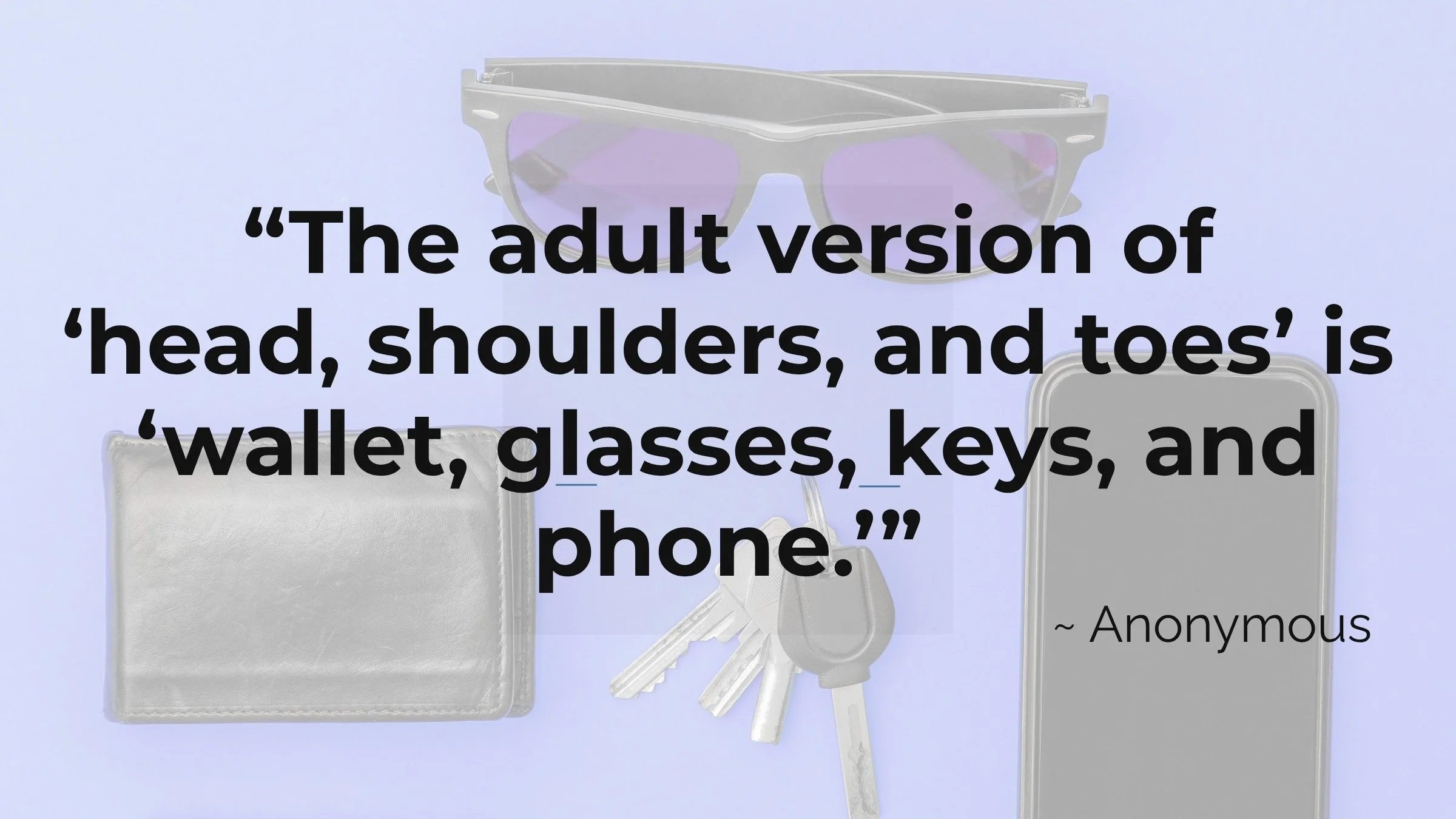
A while ago, I found an anonymous Internet meme or joke that connects to the childhood singsong, “Head and shoulders, knees and toes.” Do you remember that one? If not, check out this short, silly video.

This meme is:

“The adult version of ‘head, shoulders, knees, and toes’ is ‘wallet, glasses, keys, and phone.’”

The song helps you identify and quickly locate your body parts. It’s useful to apply the same strategy to your belongings by creating ‘homes’ for them. When you think of the object you want, knowing it has a home means you immediately know where to find it.

You can use this song to:

  • Reinforce the value of having reliable homes for your belongings.

  • Create a home right now for the thing you’re looking for, so you’ll always know where to find it.

  • Lighten your mood and reduce stress when something is missing. A little humor can go a long way.


What Needs a Home?

As you think about your belongings, which things do you frequently misplace or don’t have a place for? Pick one and create a home for it right now. Build from there.

What is one consideration you use when creating an effective home for your stuff? Have you tried creating homes that don’t work? Can you describe the difficulty? I’d love to hear your thoughts. I invite you to join the conversation.


How Can I Help?

Do you feel overwhelmed or disorganized? Is the clutter in your life causing stress and frustration? I’m here to help! You don’t have to do this alone. Virtual organizing is an extraordinary path forward – Local feel with a global reach.

Let’s connect! I’m easy to reach.

Decluttering, getting organized, and living with more ease are possible, especially with support.

 
 
How to Joyfully Lean Into a Promising “Yes” One Fresh Start Offers

The first day of this new year has come and gone. Yet that fresh-start energy lingers. I’m feeling it, especially today, as a massive winter storm blankets much of the United States with an enormous amount of snow. By tomorrow, we’re expecting 12”-16” of snow in New York. It’s giving us a giant pause, asking us to sit tight, get cozy, and weather the storm. Please stay safe, my friends.

As I sit here to write, my ‘IMAGINE’ mug filled with piping-hot coffee by my side, I’m thinking about the relationship between fresh starts and saying “yes.” I’ve noticed that, especially during this time of year, when I’m reflecting and planning, new opportunities appear. It’s not just their arrival, however. I’m in a more receptive mood, which means I’m more likely to be open and say “yes” to opportunities.

Why is that? Doing something differently or trying something new energizes me. And new changes the mood as one year ends and a new one begins. Possibilities also bring excitement and hope. Doing something different can get me out of a rut, change my perspective, or bring more joy and satisfaction. There are also serendipitous outcomes and benefits that weren’t anticipated.


Three “Yeses” Inspired by the Fresh Start

1. 20 Minutes a Day Challenge

A few of my dear friends invited me to participate in a January movement challenge. The barrier to entry was so low that saying “yes” was easy.

The instructions were simple:

  • Move 20 minutes a day, every day in January.

  • Move in some way. No pressure about the intensity or the type of activity. This could be stretching, yoga, walking, swimming, or any other movement.

  • Text each other daily about what you did or didn’t do. No judgment, only support.

The benefits: The obvious one was that I was more aware of my movement during the day, which felt good. I was less sedentary. Having accountability partners encouraged me to move, even when I didn’t feel like it. The more serendipitous benefit was how much I loved this purposeful, low-pressure daily connection, banter, humor, interaction, and encouragement with my friends.

This ‘yes’ has been such a positive experience that we decided to extend the challenge through mid-February. 


2. 21-Day Tiny Shifts Experience

Dr. Elisha Goldstein, psychologist and author, offered an intriguing program beginning in January. This was another easy “yes.” With a small investment of time and money, he would help us engage in “daily, 3-minute practices to support your nervous system and help you show up differently, one small shift at a time.”

I’m all about small shifts and changes, as it’s integral to my client work. I thought it would be beneficial to try a similar experiment for myself.

During the kickoff meeting, Elisha stressed how this experience wasn’t about “fixing what’s wrong or applying pressure.” It was about:

  • Engaging in “small, repeated moments of regulation.”

  • “Learning to recover faster and more often.”

  • Building resilience.

  • Interrupting stress loops.

  • Experimenting with “nervous system friendly practices.”

  • Understanding that it’s not just about being calm, but about helping you to show up better.

  • Being more grounded and present.

Today’s practice encouraged us to “allow a little more ease,” which is exactly what I’m going to channel today, tomorrow, and going forward. It might even become my 2026 mantra. Thank you, Elisha.

The benefits: I look forward to the daily recorded messages from Elisha, which encourage me to think, relax, and regulate my emotions. The practices are simple and doable. I’m only in the first week, but so far I’ve felt more grounded, taken needed pauses, and feel more present. I’ve been reminded of how powerful the breath is for emotional regulation, and I’ve even integrated it into some of my virtual organizing sessions. I’m also appreciating the community of participants who share their thoughts through a private platform. I enjoy reflecting and learning about what others are experiencing.

Fresh starts can be invigorating, especially when you embrace new opportunities.
— Linda Samuels, CPO-CD®, CVOP™

3. Explore Somewhere New – My wonderful husband gifted me a weekend in New York City for my birthday. He planned everything, which was a gift in itself. I always love our time together. I appreciate the simple things we do, like running errands on Saturday morning, kayaking on a lake, walking hand in hand, or sharing meals. Most of our time is spent doing everyday things.

However, for the special weekend, we did things we don’t do every day. It was so much fun. That it happened in January energized the fresh start even more. We visited the Museum of the Dog. Some of my favorite things were playing with the interactive video dog, Molly, and learning about different dog breeds. It made me miss our black lab, Norton. He was an amazing soul.

We also visited the Morgan Library, which I hadn’t been to in years. It has a gorgeous, relatively new wing attached to the historic library. I got emotional when looking at Renoir’s journals and sketches. I had a yearning to draw again like I used to. Who knows? Maybe I will rediscover my art supplies this year.

After visiting two museums, enjoying lots of yummy meals, and an unplanned visit with our kiddos, who were also visiting New York City that weekend, we went on to our next adventure. Across from Grand Central Terminal is the Summit at One Vanderbilt, an immersive art experience with panoramic views of the city. The Summit is located on the 91st-93rd floors of this eco-friendly skyscraper, one of the tallest buildings in Midtown Manhattan, completed in 2021.

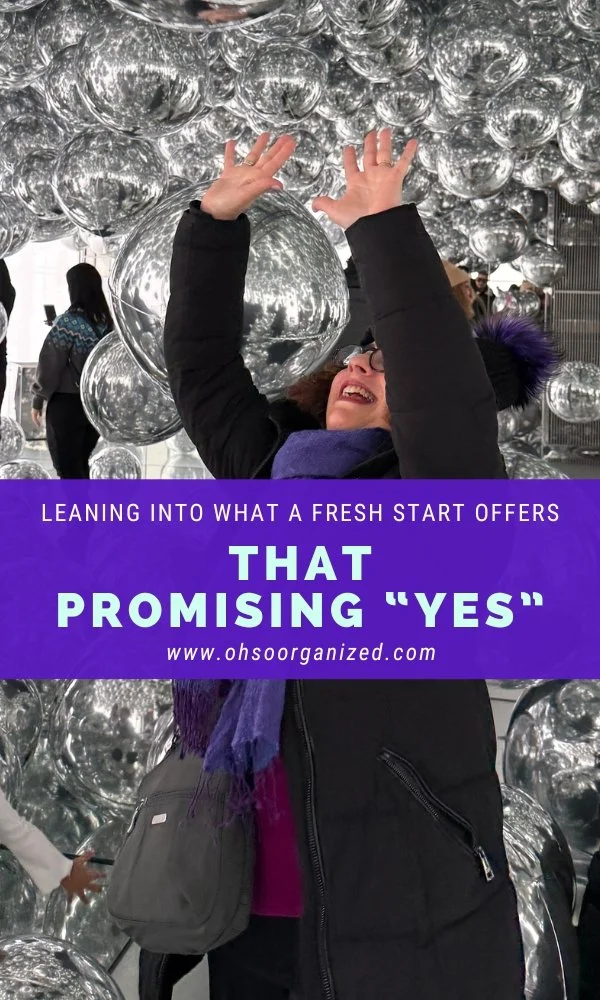
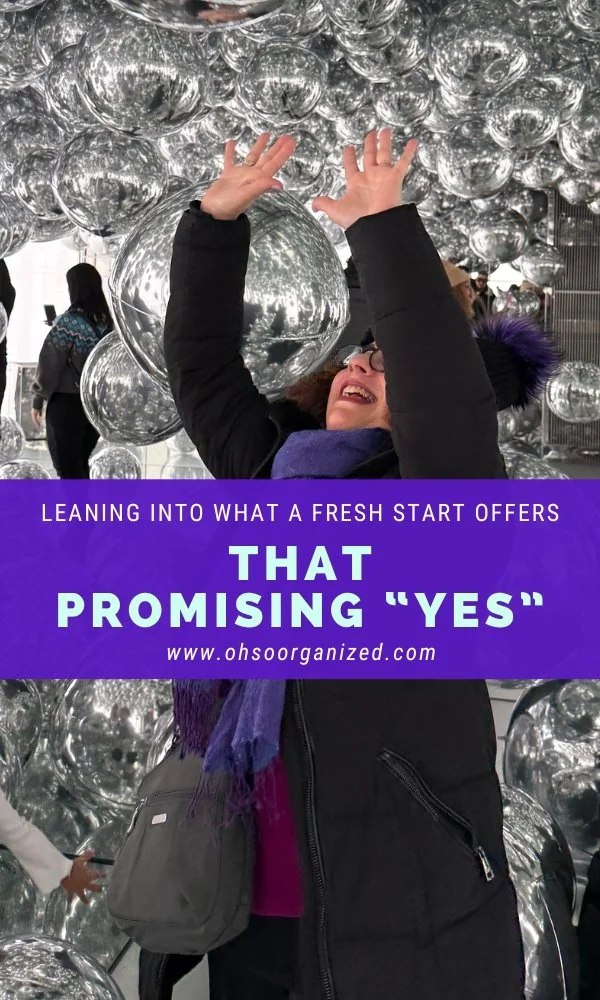
It turned out to be an overcast, cloudy day, so the views weren’t visible. It didn’t matter because there was plenty to explore. Although I would like to go again on a clear day. I loved the Affinity room, where we were surrounded by floating silver balloon-like orbs. It was so much fun catching and throwing them. I felt like a little kid.

My sense of balance and confidence was tested as I walked across mirrored glass floors. You know that wobbly feeling you get when you’re high up? I worked to accept the sensations so I could enjoy the experience.

The benefits: By the end of the weekend, I was vibrating with joy and excitement. Seeing, exploring, and doing new things was uplifting. I wanted to do that more. The weekend helped me celebrate while embracing the newness of a fresh start. The time away also reminded me of things I value: family, connection, art, presence, exploration, learning, curiosity, and experimentation.


What Will Enhance Your Fresh Start?

Fresh starts can be invigorating, especially when you embrace new opportunities. Is there something you said “yes” to this month that you’re glad you did? What have you noticed? Do these ideas resonate with you?

I’d love to hear your thoughts. I invite you to join the conversation.


How Can I Help?

Do you feel overwhelmed, disorganized, or stressed? Would you like to make changes this year? I’m here to help! Virtual organizing is an extraordinary path forward – Local feel with a global reach.

Let’s connect! I’m easy to reach.

Getting organized and making changes are possible, especially with support.


7 Winning Ways the Reminders You Display Will Help You Each Day

We constantly receive internal and external messages. Do they help or hurt you? Have you heard of the 5:1 magic ratio? Research suggests that to counteract the sticky Velcro-like negativity bias, it takes approximately five positive encounters, thoughts, or experiences for every negative one.

Consider fortifying your Personal Positivity Bank by making regular deposits. Here are a few ways to build your reserves:

  • Create a “Feel Good” file with positive emails, notes, or letters you received from family, friends, clients, or colleagues:

  • Keep an ongoing gratitude list

  • Connect with nature

  • Prioritize self-care

  • Spend time with people who energize and uplift rather than drain you

  • Display positive reminders in your environment

Today, I am focusing on that last one, the visible messages you see every day. I’m sharing several of my favorites below. I’ve written before about the fidget bowl on my desk. This fun collection of miniature objects combines word reminders, trinkets from places visited, old toys, and visual and tactile delights. Playing with the tiny pieces while I’m in meetings helps me focus. Having uplifting messages front and center enhances my well-being. What encouraging messages will you surround yourself with?


7 Ways the Reminders You Display Will Help You Each Day

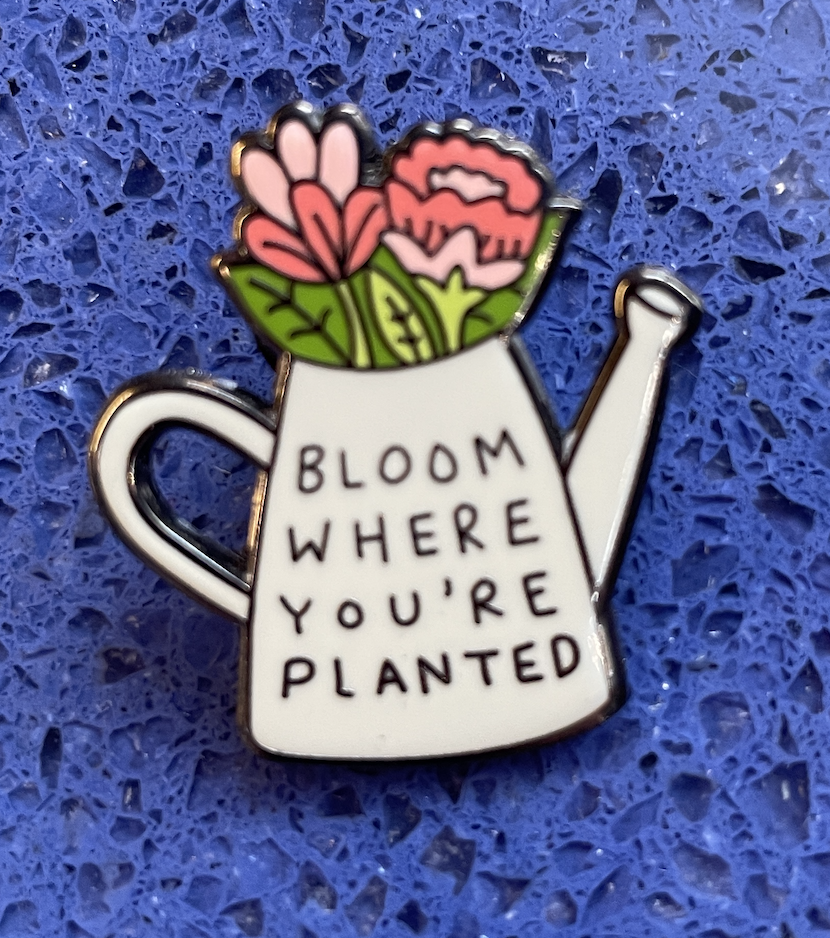
1. Bloom Where You’re Planted

Bloom where you’re planted encourages me to embrace the growth mindset anywhere, anytime. Every encounter, action, observation, experience, success, and failure are opportunities to learn, expand, and blossom.


2. Head & Heart

Navigating life’s hiccups and choices can be stressful. “Head & Heart” reminds me to use my cognitive and sensing gifts to support positive decisions and outcomes. While not included in this purple pin, my gut is another guiding element. When I listen, it leads me with a distinct “yes” or “no.”


3. Nourish

My Word of the Year is nourish. This essential encourages me to feed my heart, mind, and body so they feel nurtured, positive, and supported to thrive. My heart wants connection. My mind needs stimulation, and my body wants loving care.


4. You Are Here

While these words are often found to locate yourself on a map, to me, they embody presence. Especially when my mind is racing, and even when it’s not, this message prompts me to pause, notice, and ground myself with where I am, what I’m doing, what I’m feeling, and what I’m experiencing. When distracted, I use these words to gently bring me back, reset, and move on.


Fortify your Personal Positivity Bank by making regular deposits.
— Linda Samuels, CPO-CD®, CVOP™

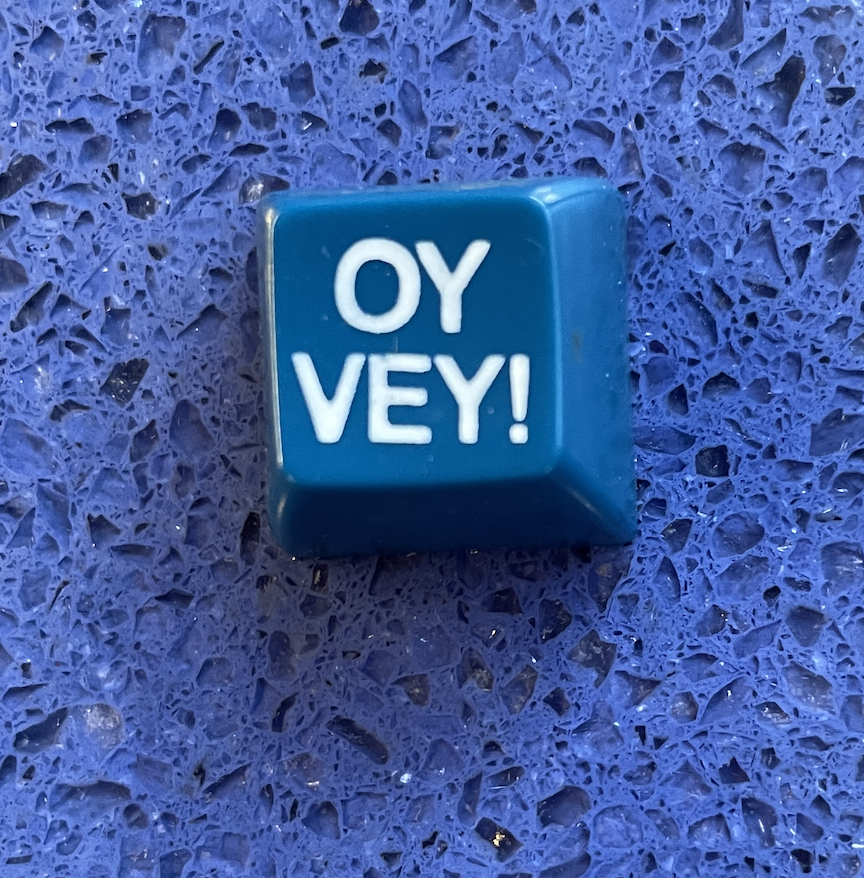
5. Oy Vey!

Years ago, I gave my dad this blue “Oy Vey!” computer key. It became a favorite inside joke between us, and one of the many things that connected us was our shared sense of humor. This message reminds me that things in life have the potential to go sideways. However, my sense of humor can bring a brighter perspective and allow me to laugh at myself during difficult situations.


6. Radiate Positivity

According to the CliftonStrengths assessment, one of my top strengths is Positivity. Seeing the “Radiate Positivity” button helps me with several things:

  • It reminds me to continuously develop and live from my strengths.

  • My natural inclination towards positivity helps me be resilient and growth-oriented.

  • Positivity is ‘catching,’ so my mood can have an encouraging effect on others.


7. Exhale the Bullshit

This new pin has quickly become a favorite. We all experience life ‘stuff’ (aka difficult situations, conflicts, threats, bullshit). During those challenging encounters, you can experience emotional hijacking. Stress triggers are sent to the amygdala, the part of the brain responsible for emotional processing. Your automatic warning system goes on high alert, and your body wants to protect you. Your heart races, your palms sweat, your face flushes, and your breathing turns rapid or shallow.

“Exhale the Bullshit” reminds me to take a deep breath through my nose and a longer exhale through my mouth. Repeating that several times, I soothe my system, access the rational part of my brain, and am better equipped to respond calmly to the circumstance.

How does having positive visual reminders help and influence your day? What helpful messages are in your view? I’d love to hear your thoughts. I invite you to join the conversation.


What Letting Go Can Do for You: Unexpected Benefits Found

Letting go is usually intentional. At least, it seems purposeful most of the time for my clients and me. Holding on can create stress, conflict, overwhelm, disappointment, confusion, or anxiety. The same can be said for the process of letting go. Thinking about saying ‘good-bye’ to things or situations can be its own type of challenge. However, when we finally let go, it allows for open space, growth, and relief.

I often consider letting go like a muscle that needs exercise and practice. The more you use the letting go muscle, the easier the process becomes. Decision-making goes more smoothly, too, as you set boundaries or rules around what stays or goes.

What happens when you accidentally let go? You might wonder how someone can unintentionally let go like one giant, whoops. I experienced this last week.

You are probably familiar with the term “inbox zero.” Some set a goal to have no (as in nothing, none, nil, zilch) emails in their inbox. Instead of keeping all emails visible, you route incoming emails to specific, organized locations to achieve a clear inbox. They can move to the trash, action, or archive folders along with a cue to follow through on a trusted task list.

Let’s return to my saga. With full disclosure, I can’t tell you exactly how it happened, but I remember that multitasking was involved. I couldn’t repeat the mistake if I tried. But the result was that I accidentally deleted all the emails in my inbox and couldn’t get them back. There were about 100, and I had responded to most but not all of them.

My first reaction was panic. Then I tried to undo the error. In my frenzy, I think I made things worse. So, I stopped. I took several deep breaths and asked myself, “Linda, now what?” There were several options, including getting on the phone with tech support to see if they could help retrieve the deletions. I lacked time, confidence, and patience for that option. I was also in the middle of several deadlines and needed to focus on those instead of my big mistake. I knew how quickly my day could have deteriorated with negative self-talk, paralysis, and frustration. Those weren’t good options.

Letting go allows for open space, growth, and relief.
— Linda Samuels, CPO-CD®, CVOP™

I felt calmer when I recognized that some emails could be retrieved through the “sent” email box if needed. In addition, if I missed something important, the sender would hopefully resend it to me. If you sent me an email and I never responded, please resend it. Thank you.

Letting Go: Unexpected Benefits

It’s been over a week without those deleted emails, and it’s been OK as of today. I let go of a lot and discovered some things along the way.

  • There is no perfect.

  • I’m human and make mistakes.

  • Life goes on even without a full inbox.

  • The most important things were handled.

  • I recognized growth in how I kept my initial panic to a minimum.

  • Resilience was visible as I quickly recovered from ‘the incident.’

  • Multitasking can be dangerous.

  • Appreciate the improved focus with fewer emails visible.

  • Be grateful for the empty inbox, even if unintentional.

  • Acknowledge the available time doing fun things like planting my small vegetable garden instead of stressing over retrieving emails.

  • Find the humor in the situation.

  • Remember the big picture.

In the end, letting go, while unexpected, was valuable. I’ve recovered from the mishap, appreciate a less full inbox, and feel lighter and less encumbered.

Have you ever let go accidentally? If so, what happened? What did you discover? I’d love to hear your thoughts. I invite you to join the conversation.