Posts tagged Institute for Challenging Disorganization
When Organizing Challenges Feel Overwhelming, It's Time to Ask for Help

Over the 30+ years I’ve been helping overwhelmed individuals create organization and calm in their lives, most of my clients have been affected by chronic disorganization (CD).

When I first started Oh, So Organized! in 1993, I didn’t know what chronic disorganization was. What I did recognize was that the organizational challenges many of my clients faced were complex, persistent, and deep.

It wasn’t until 1995, when I met Judith Kolberg, a pioneer and thought leader in the organizing industry, and heard her speak at my first NAPO (National Association of Productivity and Organizing Professionals) conference, that I learned about the term chronic disorganization, which she coined. I began to understand the complexities of CD and the similarities between my clients and those Judith described.

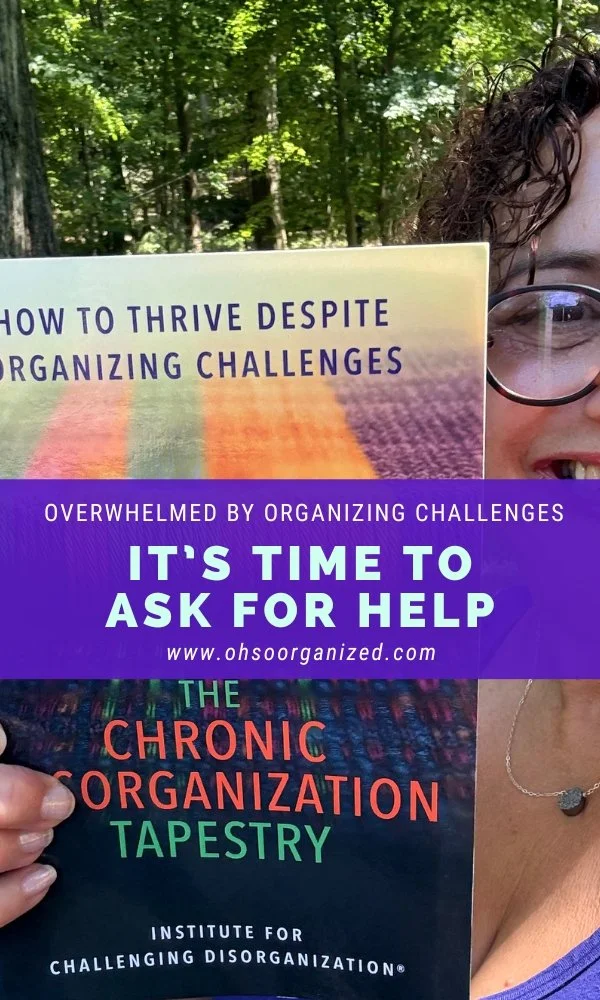
As a CPO-CD® and contributing author to The Chronic Disorganization Tapestry, I’ve spent more than three decades helping people affected by chronic disorganization navigate their organizing challenges with compassion and practical support.

What is Chronic Disorganization?
As defined by the Institute for Challenging Disorganization (ICD), chronic disorganization:

  • “Persists over a long period of time

  • Frequently undermines the quality of life, and

  • Recurs despite repeated self-help attempts.”

The ICD website further clarifies that “chronic disorganization may be present with brain-based challenges such as ADHD, anxiety, depression, Hoarding Disorder, PTSD, TBI, and more.”

Little did I know that Judith’s panel session at NAPO would have such a profound impact on my work. Since then, I have consistently invested in education, professional development, and certifications to deepen my understanding of chronic disorganization and provide the best possible help and support to my clients. I became actively involved with ICD, received much of my training from ICD, and served as its past president.


The Chronic Disorganization Tapestry

Almost two years ago, I was invited, along with eleven of my colleagues, to be a contributing author to an ICD book they planned to publish. This was an easy “yes” because I’m a big advocate for ICD, the premier educational resource on chronic disorganization.

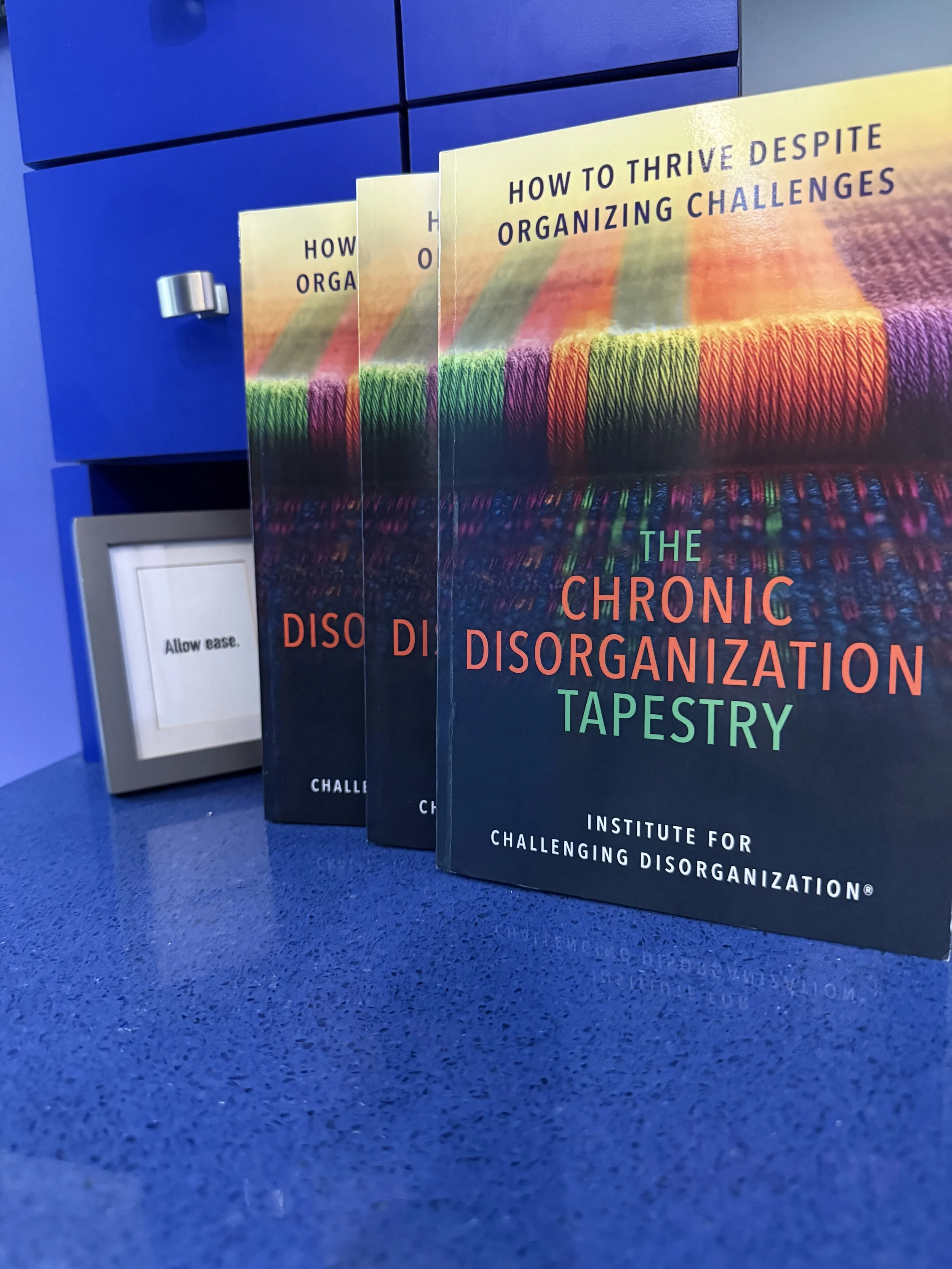
Fast-forward to now, and The Chronic Disorganization Tapestry – How to Thrive Despite Organizing Challenges is finally available! This book is a guide that covers:

  • the unique challenges of chronic disorganization

  • simple, evidence-based strategies

  • case studies

  • insights from industry experts

This publication wouldn’t have been possible without the fierce dedication of the Chronic Disorganization Tapestry Task Force members: Carolyn Caldwell, Laurene Livesey Park, Ingrid Tielemans, and Nacho Eguiarte, and the authors’ contributions. My deepest gratitude and congratulations to all!


A Quick Content Guide

I am honored to be included in ICD’s wonderful new publication, written for people affected by chronic disorganization, professional organizers, and other professionals who support them.

Here is a quick guide to the chapter topics and their authors:

The book is available from retailers including Amazon, Barnes & Noble, Alibris, and Bookshop.

We aren’t meant to go through this life alone. Everyone needs help at times.
— Linda Samuels, CPO-CD®, CVOP™

My Chapter: The Challenge of Giving and Receiving Support
From a young age, I always loved helping others. Over three decades ago, when I considered starting my own company, I knew that helping people had to be a key element of my business. After brainstorming ideas for what type of business would ‘fit’ that requirement, I eventually founded Oh, So Organized!

It felt especially meaningful to be asked to contribute a chapter on giving and receiving support to The Chronic Disorganization Tapestry.

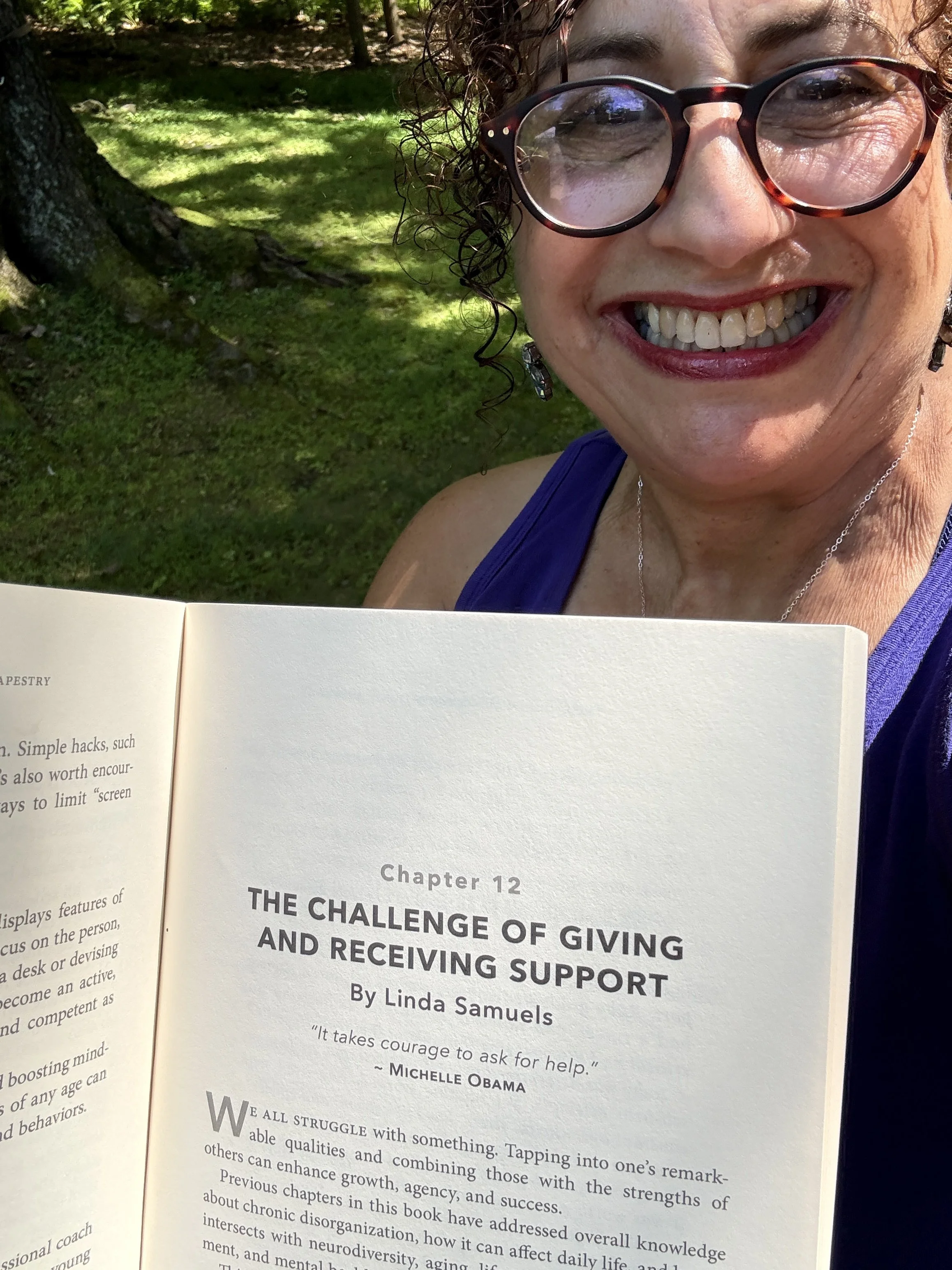
In Chapter 12, “The Challenge of Giving and Receiving Support,” I explore chronic disorganization in that context and ways in which giving and receiving help can foster progress and growth. Perspectives are considered from:

  • individuals affected by CD

  • related professionals who support people affected by CD

  • professional organizers who work with individuals affected by CD

We aren’t meant to go through this life alone. Everyone needs help at times, whether it’s practical, technical, or emotional, or simply the presence of another person alongside us. For people affected by chronic disorganization, and for those who support them, fostering compassion, curiosity, and agency is essential to progress and growth.


How Can I Help?

Do you feel overwhelmed, disorganized, or stuck? You don’t have to do this alone. I’m here to help! Virtual organizing is an extraordinary path forward – Local feel with a global reach.

Let’s talk! I’m easy to reach.

Getting organized, building confidence, and reaching your goals are possible, especially with support.


One Excellent Tool to Assess Clutter's Impact on Your Mental Health

Have you wondered how clutter affects your mental health and well-being? As a Professional Organizer for over 30 years who works with individuals challenged by disorganization, I have seen firsthand how clutter can negatively impact behaviors, self-esteem, and mental health. I’m about to share an insightful tool for assessing the impact of clutter on your life.

Recently, Melissa Tracey interviewed me for the Houselogic article, How Clutter Creates Stress and Anxiety: Strategies for Decluttering, and a podcast for The Housing Muse about the relationship between home clutter and its effect on mental health.

Many of my clients have mental health conditions, including anxiety, depression, and OCD. Clutter can worsen issues by increasing feelings of stress, anxiety, sadness, frustration, and overwhelm. While professional organizers can help with specific strategies to reduce clutter and increase organization, having the support of a mental health professional can be essential.


Mental Health Awareness Month

May is Mental Health Awareness Month. It began in 1949 to reduce the stigma around mental health conditions and provide awareness, support, and resources. The World Health Organization states:

  • 1 in every 8 people, or 970 million people in the world, live with a mental disorder

  • Anxiety and depressive disorders are the most common

  • Mental disorders involve significant disturbances in thinking, emotional regulation, or behavior

  • Most people do not have access to adequate care

Contact the National Alliance on Mental Illness (NAMI) for information, helplines, and support.


Self-Assessment Clutter Tool

The Clutter Quality of Life Scale (CQLS) was developed by Dr. Catherine Roster, Associate Professor at Anderson School of Management at the University of New Mexico, with help from volunteers from the Institute for Challenging Disorganization (ICD). Catherine is a dynamo, and I had the privilege of working with her on the ICD Board.

The CQLS is a self-assessment tool “designed to measure inward, or subjective, consequences of clutter from the individual’s perspective.” Clutter is defined as “an overabundance of possessions.”

The CQLS scale contains 18 statements about clutter, which a person rates from 1 = strongly disagree and 7 = strongly agree.” These statements reflect the level of negative consequences clutter has on four areas: your relationships, personal finances, the livability or functionality of your home and space, and feelings of anxiety, guilt, and depression. Here are a few examples from the assessment:

  • Social impact: “I avoid having people come to my house because of the clutter.”

  • Livability impact: “I have to be careful when walking through my home in order to avoid tripping over objects.”

  • Financial impact: “I often buy things I already have because I don’t know where things are in my home.”

  • Emotional impact: “I feel depressed by the clutter in my home.”

Click on the link to take the CQLS assessment.

I feel depressed by the clutter in my home.
— The Clutter Quality of Life Scale


Personal Impact of Clutter on Mental Health and Well-Being

Clutter shows up in many ways and can negatively affect your mental health and well-being. Here are a few examples of what you might experience:

  • Your sink is always full of dishes, which makes it difficult to cook and eat nutritiously. It also affects your energy and health.

  • Your bed is cluttered with clothing waiting to be cleaned or put away. You’re been unable to sleep there for weeks. As a result, your anxiety increases as your lack of sleep, energy levels, decision-making abilities, and mood suffer.

  • Your papers are in piles on your kitchen counter. You can’t find the bill you know is due tomorrow. Your anxiety increases as you search for the bill. Hours later, you discover it buried in a pile in another room.

Have you noticed ways clutter affects mental health and well-being? I’d love to hear your thoughts. I invite you to join the conversation.

If you are struggling with clutter and mental health issues, don’t go it alone. Get the support you need from a Professional Organizer like me and a mental health provider.

Reach out and email me, Linda, at linda@ohsoorganized.com, call 914-271-5673, or schedule a Discovery Call. Decluttering is possible, especially with support.


How to Make New Favorite Ideas From Organizing Conference Empower Helpful Possibilities

Professional development and education are some of my top priorities. I continually invest in learning to understand, nourish my curiosity, grow, and better help people. This past week, I attended the Institute for Challenging Disorganization’s (ICD) conference, celebrating its 20th anniversary. I’m an ICD past president (2014-2016) and have been a member of this stellar educational association for 19 years.

Due to the pandemic, the conference was virtual. Using the Remo platform, people attended from eleven countries around the world. We had four days of workshops presented by leading experts with networking time with colleagues new and old. Possibilities, hope, compassion, and a zest for learning and sharing permeated the sessions and conversations.

In my effort to assimilate a small portion of what I discovered, I distilled ideas from 11 sessions and 20 plus pages of my notes to share with you. I couldn't include everything, so I focused on sharing incredibly inspiring concepts full of possibilities


Favorite New IDEAS to Empower Possibilities

1. Power of Reframing

Our first speaker was Dr. Edward (Ned) Hallowell, an expert on ADHD, founder of Hallowell ADHD Centers, podcast host, and author of 20 books, including his newest ADHD 2.0. His presentation was so uplifting and poignant. I became emotional several times. He focused on the gifts accompanying ADHD, such as being creative, intuitive, curious, entrepreneurial, intelligent, and original. Dr. Hallowell has ADHD and has devoted his life to helping people with ADHD “develop a vision of greatness.” He believes that everyone is capable of more than they think they are, can combat negative self-talk, and develop good self-care hygiene.

He reminded us “what matters is the striving, not the doing or accomplishing.” The “victory is loving the game.” He spoke about the importance of connection and having supportive people to protect and believe in you. 

Hallowell shared the three defining hallmarks of ADHD, which are distractibility, impulsivity, and hyperactivity. He prefers focusing on the positive flipside- seeing distractibility as curiosity, impulsivity as creativity, and hyperactivity as energy. At 71, he said he was “happy to have a turbo pack on his back.”

When it comes to organizing and reaching his goals, he strives for “well enough organized.”

If you reframe your perspective, what is possible?


2. Living Your Strengths

As humans, we seek to understand ourselves and others. Dr. Ryan Niemiec, Education Director at the VIA Institute on Character, author of 10 books, and award-winning psychologist, shared that understanding your character strengths is essential for building your well-being, managing adversity, and increasing happiness. What would be possible if you lived using your strengths and appreciated the strengths of those around you?

In 2003, the VIA Survey of Character Strengths was created. The extensively researched survey emerged from the field of positive psychology. It focuses on 24 universally valued (cross-cultural) character strengths such as hope, curiosity, and gratitude. It has been taken by 16 million people and continues to be taken every 10 seconds. Click here for your free VIA assessment (it takes about 10 minutes) and discover your top signature strengths.

Niemiec made several key points: no strength is better than another, all 24 strengths matter, and they are in all of us. Your top strengths represent the positive parts of your personality, which can change over time. Our strengths reflect our identity, produce positive outcomes for ourselves and others, and contribute to the collective good.

I’ve taken the survey three times over the past ten years, and I’ve seen some shifts in my top five strengths. With the most recent survey, my top strengths are love, gratitude, perspective, appreciation of beauty & excellence, and humor.

I’d love to know more about you. After taking the survey, please share your top five strengths in the comments below if you feel comfortable doing so.

What matters is the striving, not the doing or accomplishing.
— Dr. Edward Hallowell

3. Designing Your Space

Andrea de Pavia, MA, architect, urban planner, author, professor, and founder of NeuroAU, shared her expertise and insights on NeuroArchitecture. This interdisciplinary field connects cognitive science, architecture, design, and urbanism, focusing on “the brain, behavior, and their interconnection with the physical environment.” De Pavia explained how our spaces affect our physiology, making changes in the brain and body. Her goal is to “make science-based choices to improve the environment” and not design solely based on creativity or aesthetics. 

With sensation transference, elements such as light and sound can affect how things taste, your perception of others, and your memories. Perceptual fluency relates to how easy or challenging it is to be in a particular space. In a “fluent space,” it will be easier to process and experience cognitive restoration. Our physical environment can affect stress levels and health. Lack of multisensory coherence can impair perception and attention, deplete mental resources, and impair decision-making. Imagine being in a cluttered space (whatever ‘cluttered’ means to you.) Notice how you feel. Are you calm, relaxed, anxious, or agitated? 

Our space can help or impair our cognitive restoration. De Pavia shared several ways to design and organize spaces to decrease stress and save mental resources, such as incorporating nature. Include pictures of nature, use natural light, add plants (real or not,) water features, and natural materials. This is known as biophilic design.

Don’t underestimate the importance of windows and natural light. Uncover the windows and position yourself closer or facing them. Seeing the sky (day or night) helps control our circadian rhythm, which affects our biological clock. It syncs our body with the environment and affects our energy during the day and quality of sleep at night. Natural light supports the production of serotonin, a hormone that stabilizes our mood, feelings of well-being, and happiness.

I often write about organizing homes and offices to support who you are and what you do. This science-backed research reinforces the importance of decluttering, creating calm spaces, and being in environments that allow us to restore, reset, and be productive. What would be possible for you as you imagine being in a cognitively supportive space?


Possibilities are all around as we look at ways to reframe our perspective, live using our top strengths, and create spaces that support our minds and bodies. So much is possible. Which ideas resonate with you? I’d love to hear your thoughts. I invite you to join the conversation.


Enlisting Help Isn't Cheating

August 3, 2010 | Updated August 2026

Do you often feel like you’re cheating when you ask for help? Do you think you have to, or should be able to, do everything yourself?

We can think that seeking help is a sign of weakness. I’m not sure why this happens, and I’m occasionally guilty of feeling this way myself.

Over time, I’ve discovered that enlisting help is a great way to learn, reduce frustration, and boost self-esteem.


Value of Enlisting Help

Sixteen years after I first wrote this, I’ve had many more opportunities to experience the value of giving and receiving help—both personally and professionally. My perspective has deepened: asking for help isn’t simply a way to get something done.

The right support can help you:

  • Feel less alone

  • See possibilities you might not have noticed on your own

  • Build confidence

  • Move forward when you’re stuck

These ideas took on a special meaning as I contributed a chapter on giving and receiving support to The Chronic Disorganization Tapestry, a 2026 book published by the Institute for Challenging Disorganization (ICD).

Enlisting help is a great way to learn, reduce frustration, and boost self-esteem.
— Linda Samuels, CPO-CD®, CVOP™

Barriers To Getting Organized

Let’s look at getting organized. Many of my clients experience organizing challenges and have hired me to help them. At times, they’ve expressed their disappointment or guilt, saying things like, “Why can’t I do this myself?” or “What’s wrong with me?”

They might compare themselves with people who seem to organize easily and think that they’ve failed, are inadequate, or have something intrinsically wrong with them. This simply isn’t true. You are not broken. Comparison isn’t helpful. Focus on your strengths and build systems using that perspective.

Organizing strategies aren’t one-size-fits-all, as each person is unique. To make progress, it’s essential to design organizing strategies that support your needs, the way you think, and the way you process.


What Happened When I Enlisted Help

Before I published my book, The Other Side of Organized, I knew I needed help from others with publishing expertise. I hired a book coach, an editor, a designer, a printer, and a publicist. I also sought advice from other professionals, friends, family, and colleagues.

I still made mistakes along the way, but having a team to guide and advise me shortened the learning curve and lessened the impact. Knowing I had these professionals to support me didn’t diminish my confidence; it actually boosted it.

Instead of fighting the desire for support, I embraced the idea of building a team of experts to help me grow and succeed.


How Can I Help?

The next time you find yourself struggling to get organized or facing another challenge, consider reaching out for help. It isn’t cheating. This could be the best decision you make to end your frustration and bring you closer to your goals.

What help would be valuable right now to move you to the next step?