Posts tagged Sara Skillen
How a Fantastic Conference Taught Me More About Virtual Organizing

Recently, I returned from the Institute for Challenging Disorganization’s (ICD) conference, held in Canada this year. Colleagues from around the globe gathered to learn, connect, and explore the latest ideas and research related to neurodivergence and people affected by chronic disorganization.

The conference covered a fascinating range of topics, including ADHD, decision-making, navigating life transitions, clutter, emotional labor, hoarding disorder, motivational interviewing, and communication.

I was thrilled to be part of the panel, “Cultivating Connection: Best Practices for Communication with Neurodivergent Clients,” alongside my wonderful colleagues. Sara Skillen moderated, and Leslie Josel and Elizabeth Brink were the other panelists.

Whenever I’m learning, I have one goal: to learn at least one new thing, discover one new resource, or deepen my connection with something I already know. Honestly, with that simple goal, I consistently come away with far more than one thing.

The ICD conference was no exception.

I’m excited to share some of my takeaways and how they expanded my thinking, reinforced what I already know, and will influence the virtual organizing work I do with clients.


What Expanded My Thinking About Virtual Organizing

Emotional Labor

In “The Art of the Invisible: Helping Neurodiverse Families Navigate the Emotional Labor Lifecycle,” presenters Regina Lark, PhD, CPO®, CPO-CD® and Leslie Josel, PCC, discussed how emotional labor, which is mostly invisible and disproportionately handled by moms, is “the exhausting work” and the “cognitive management of household systems.”

Navigating emotional labor, work that never ends, requires executive function (EF) skills that rely heavily on the prefrontal cortex. These include:

  • Planning

  • Focusing

  • Remembering instructions

  • Juggling multiple tasks

  • Managing emotions

  • Working memory

  • Organizing

However, as many of my clients have experienced, EF skills can be especially challenging if you are highly stressed, have prefrontal cortex damage, or have conditions such as ADHD, autism, dyslexia, dyspraxia, or Tourette’s syndrome.

One of the biggest takeaways was distributing the emotional load through “radical delegation. Take perfection off the table. Delegate to someone else, even if they aren’t good at it.  Go for “good enough.”

This made me think differently about virtual organizing. When we work together, we’re not only organizing possessions or creating systems. We’re also considering the mental load behind those systems. What decisions are constantly being made? What is someone trying to remember? What are they managing for themselves or others? And what might be possible to let go of, share, or accept as “good enough”?

Life Transitions

We experience many life transitions. Professor and researcher Dr. Michelle Pannor Silver focused on four in her presentation, “Unpacking Identity: Navigating Later Life Transitions for Those with Organizational Challenges.” She discussed retirement, menopause, clutter, and prioritizing physical resilience.

Much of my work involves helping clients navigate transitions such as moving, starting a new job, divorce, birth, losing a loved one, and other life changes like those Dr. Silver discussed.

One takeaway came from the retirement section. Since our identities are often tied to our work, figuring out what comes next takes thought. Silver stressed the importance of creating “time and mental space to imagine retirement.” It’s not just about getting your finances in order. Take time to envision how you want your post-work life to feel and what you want it to be like. Include “sparking joy” activities.

Another idea that resonated was “recalibrating after loss.” In later years, loss can arrive in many forms, including changes in work status, moving from a familiar environment, changes in physical or cognitive abilities, and the loss of loved ones.

I am thinking differently about virtual organizing in the context of reimagining and recalibrating life. We go through periods when the organizational systems or patterns that used to work suddenly become ineffective. They no longer support who we are now. Virtual organizing sessions can be a wonderful way to work through these shifts and create systems and schedules that support who you are now.

“Decision-making is at the center of everything. It is a core part of being human.”
— Elizabeth Brink, PCC, PCNC®, SEP®

What Reinforced What I Already Know About Virtual Organizing

ADHD

Ari Tuckman, PsyD, MBA, presented “ADHD Can Make Organizing Psychologically Messy.” He emphasized that the ADHD challenge is “not the knowing, but the doing.” Challenges with activation, attention regulation, perfectionism, and time management can make it harder to start. You might know what to do, but these obstacles can make it challenging to get things done.

One question Tuckman suggested was, “What’s a realistic, sustainable goal that you’ll allow yourself to feel good about?” Emphasizing “realistic” and “sustainable” is central to my work with clients.

Tuckman shared many strategies that reinforced the tools and concepts I use with clients. They included:

  • Time – Use analog clocks, alarms, and schedules to build time awareness and make time more visible.

  • Fun – Make tasks less boring and more enjoyable through gamification or a playful spin.

  • Clarify – Ask, “How important is ‘this’ relative to everything else?”

  • Momentum – Do a “bit of something,” and always “hope for momentum.”

  • Experiment – “Be willing to flounder, and be confused.”

  • Decision-Making– If you are having difficulty choosing, flip a coin. It can clarify what you really want.

  • Perfectionism – Focus on “good enough.”

These strategies reflect what I see every day in virtual organizing: knowing what to do and being able to do it aren’t always the same. Virtual organizing sessions can help clients identify what gets in the way, experiment with different approaches, and find strategies that are realistic and sustainable for them.

Decision-Making

Elizabeth Brink, PCC, PCNC®, SEP®, a neurodivergent-centered coach, educator, and trainer, presented “Decision-Making: Neurodivergence, Trauma, and Chronic Disorganization.” Brink stated, “Decision-making is at the center of everything. It is a core part of being human.”

Brink went on to say that “Decision-making is a special kind of hard for neurodivergent humans.” She also said that for neurodivergent people, “Overwhelm is a reasonable response to decision-making.”

When Brink said, “It’s a big deal how to help people make decisions,” I recognized how central nurturing decision-making skills and building agency are to my virtual organizing work. People reach out to me when they feel overwhelmed, and much of that overwhelm comes from difficulty making decisions.

Decision-making skills can be learned. Brink featured several skill-building strategies that align with how I support my clients in making decisions. They include:

  • Empathy – Understand and appreciate what they may be feeling or experiencing, without judgment.

  • Demystify – Learn how they make decisions, what’s worked well for them in the past, the process they’ve used, and how we can tweak or apply that process to current choices.

  • Capacity – Be mindful of their capacity at that moment, normalize pauses, take breaks to avoid decision fatigue, and encourage a slower pace when needed.

Always Be Learning

Every conference leaves me with something to think about, but this one reminded me why I value learning so much. Sometimes a new idea changes how I approach my work. Other times, it gives me language for what I already know and see in my work with clients. Both are valuable.

I’m excited to bring these insights into my virtual organizing sessions and stay curious, experiment, and learn alongside my clients.

How Can I Help?

Do you feel overwhelmed, stuck, or disorganized? You don’t have to face it alone. I’m here to help! Get unstuck and make progress. Virtual organizing is an extraordinary path forward—with a local feel and a global reach.

Let’s talk! I’m easy to reach.

Getting organized, making progress, and reaching your goals are doable, especially with support.


When Organizing Challenges Feel Overwhelming, It's Time to Ask for Help

Over the 30+ years I’ve been helping overwhelmed individuals create organization and calm in their lives, most of my clients have been affected by chronic disorganization (CD).

When I first started Oh, So Organized! in 1993, I didn’t know what chronic disorganization was. What I did recognize was that the organizational challenges many of my clients faced were complex, persistent, and deep.

It wasn’t until 1995, when I met Judith Kolberg, a pioneer and thought leader in the organizing industry, and heard her speak at my first NAPO (National Association of Productivity and Organizing Professionals) conference, that I learned about the term chronic disorganization, which she coined. I began to understand the complexities of CD and the similarities between my clients and those Judith described.

As a CPO-CD® and contributing author to The Chronic Disorganization Tapestry, I’ve spent more than three decades helping people affected by chronic disorganization navigate their organizing challenges with compassion and practical support.

What is Chronic Disorganization?

As defined by the Institute for Challenging Disorganization (ICD), chronic disorganization:

  • “Persists over a long period of time

  • Frequently undermines the quality of life, and

  • Recurs despite repeated self-help attempts.”

The ICD website further clarifies that “chronic disorganization may be present with brain-based challenges such as ADHD, anxiety, depression, Hoarding Disorder, PTSD, TBI, and more.”

Little did I know that Judith’s panel session at NAPO would have such a profound impact on my work. Since then, I have consistently invested in education, professional development, and certifications to deepen my understanding of chronic disorganization and provide the best possible help and support to my clients. I became actively involved with ICD, received much of my training from ICD, and served as its past president.


The Chronic Disorganization Tapestry

Almost two years ago, I was invited, along with eleven of my colleagues, to be a contributing author to an ICD book they planned to publish. This was an easy “yes” because I’m a big advocate for ICD, the premier educational resource on chronic disorganization.

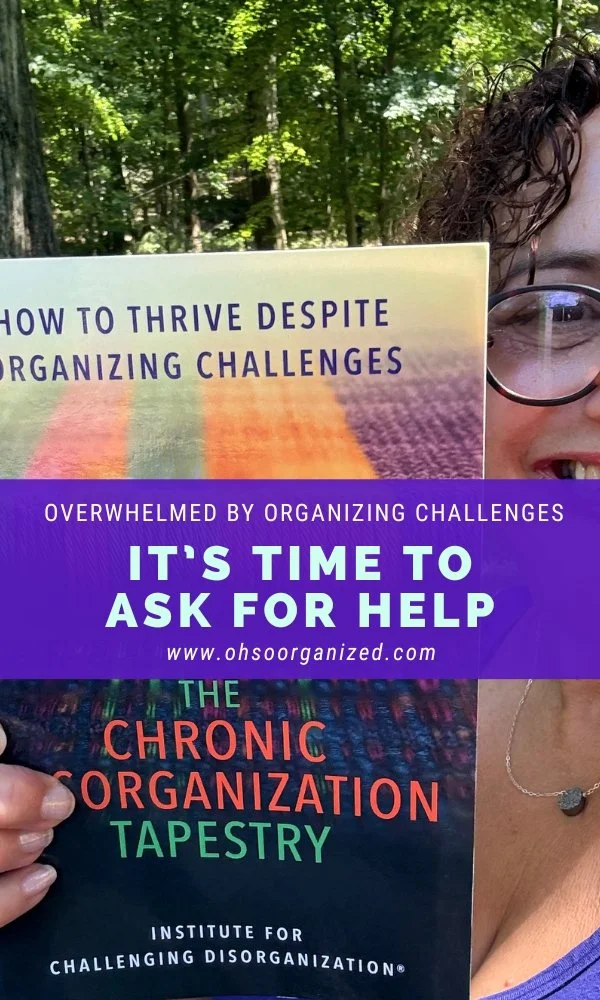
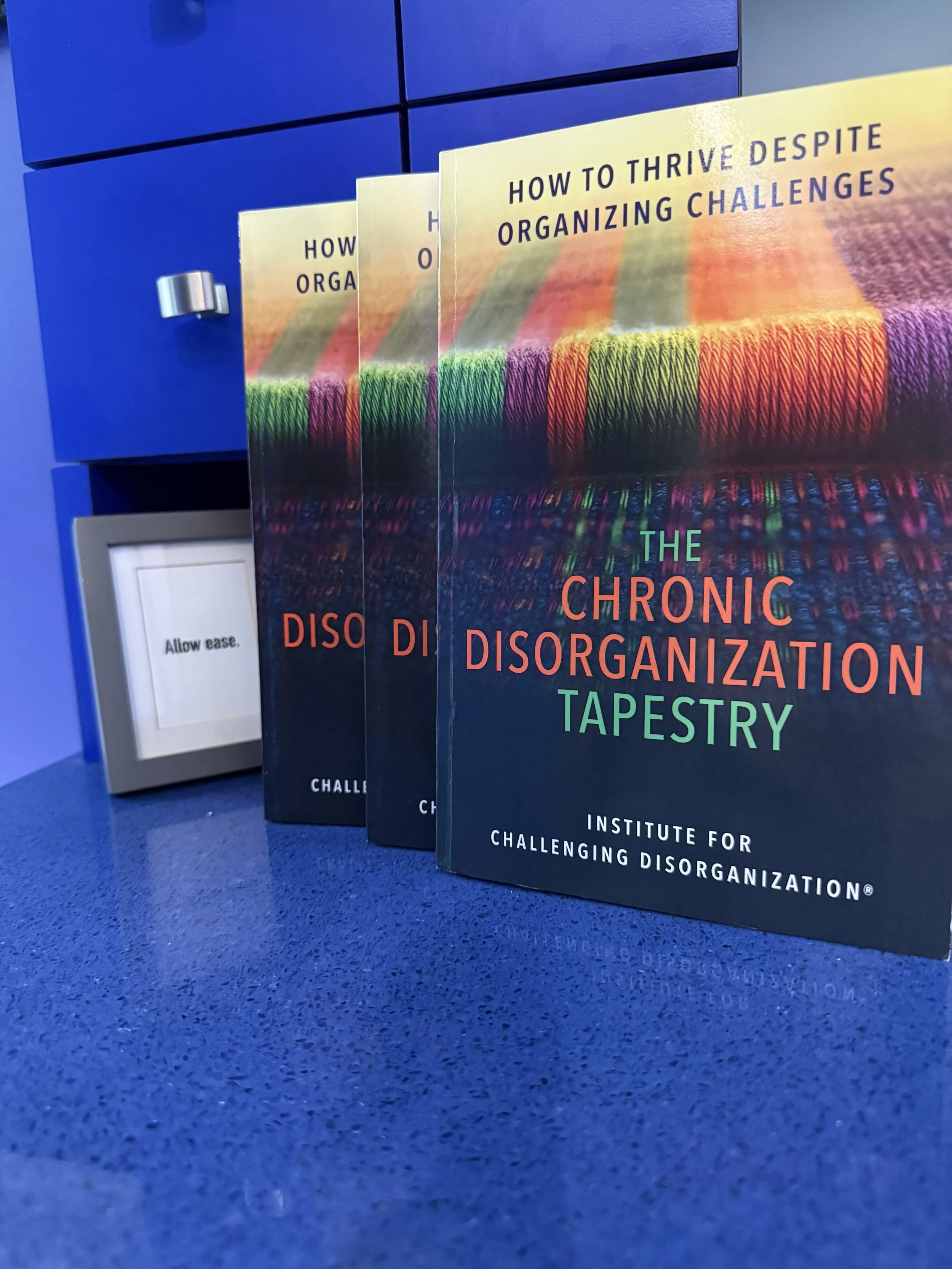
Fast-forward to now, and The Chronic Disorganization Tapestry – How to Thrive Despite Organizing Challenges is finally available! This book is a guide that covers:

  • the unique challenges of chronic disorganization

  • simple, evidence-based strategies

  • case studies

  • insights from industry experts

This publication wouldn’t have been possible without the fierce dedication of the Chronic Disorganization Tapestry Task Force members: Carolyn Caldwell, Laurene Livesey Park, Ingrid Tielemans, and Nacho Eguiarte, and the authors’ contributions. My deepest gratitude and congratulations to all!


A Quick Content Guide

I am honored to be included in ICD’s wonderful new publication, written for people affected by chronic disorganization, professional organizers, and other professionals who support them.

Here is a quick guide to the chapter topics and their authors:

The book is available from retailers including Amazon, Barnes & Noble, Alibris, and Bookshop.

“We aren’t meant to go through this life alone. Everyone needs help at times.”
— Linda Samuels, CPO-CD®, CVOP™

My Chapter: The Challenge of Giving and Receiving Support

From a young age, I always loved helping others. Over three decades ago, when I considered starting my own company, I knew that helping people had to be a key element of my business. After brainstorming ideas for what type of business would ‘fit’ that requirement, I eventually founded Oh, So Organized!

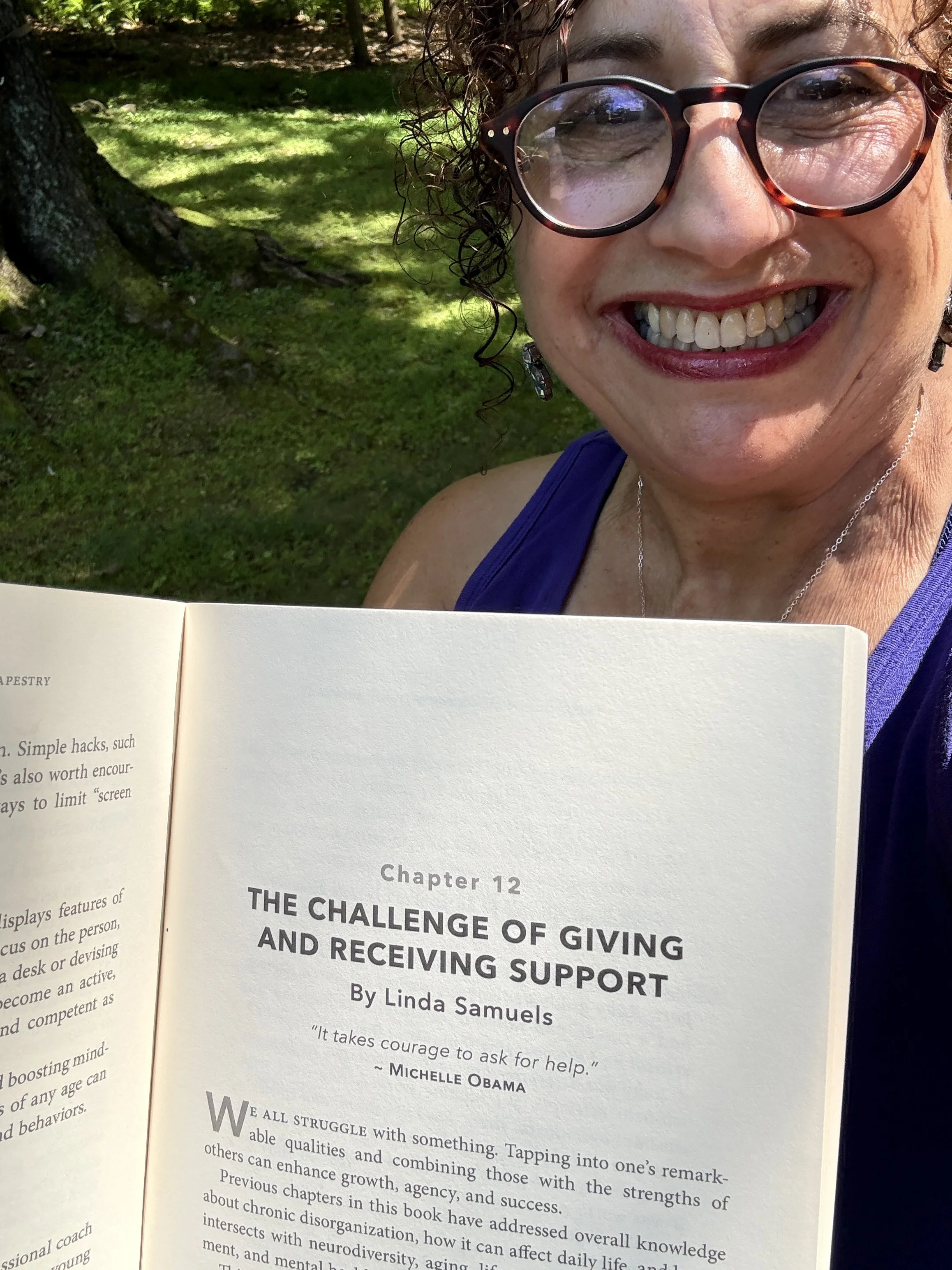
It felt especially meaningful to be asked to contribute a chapter on giving and receiving support to The Chronic Disorganization Tapestry.

In Chapter 12, “The Challenge of Giving and Receiving Support,” I explore chronic disorganization in that context and ways in which giving and receiving help can foster progress and growth. Perspectives are considered from:

  • individuals affected by CD

  • related professionals who support people affected by CD

  • professional organizers who work with individuals affected by CD

We aren’t meant to go through this life alone. Everyone needs help at times, whether it’s practical, technical, or emotional, or simply the presence of another person alongside us. For people affected by chronic disorganization, and for those who support them, fostering compassion, curiosity, and agency is essential to progress and growth.


How Can I Help?

Do you feel overwhelmed, disorganized, or stuck? You don’t have to do this alone. I’m here to help! Virtual organizing is an extraordinary path forward – Local feel with a global reach.

Let’s talk! I’m easy to reach.

Getting organized, building confidence, and reaching your goals are possible, especially with support.


10 Fantastic Pros Share the Best Reasons to Ask for Help

Do you resist asking for help? Maybe you’re unsure who to ask, prefer to do things yourself, or feel too overwhelmed to figure out what guidance you need. However, there are so many reasons to enlist support.

As a professional organizer, I am in the helping industry and love assisting my clients. I help overwhelmed individuals challenged by disorganization get unstuck and organized. Services can include assisting with long and short-term projects, providing accountability, editing, decluttering, designing customized organizing solutions, brainstorming, and planning.

While I like to do many things independently, I ask for help, too. Support has been incredibly beneficial for:


“Having a need and needing help is not a sign that you’re weak. It’s a sign that you’re human.”
— Kate Northrup

Does this sound familiar? If so, you’re going to love what follows. You’re about to discover uplifting stories about the power and relief of enlisting help.

I invited a marvelous group of colleagues to share their personal experiences. They describe their time to ask-for-help indicators and the value of listening to those cues. These generous friends include Diane Quintana, Ellen Delap, Janet Barclay, Janet Schiesl, Jonda Beattie, Julie Bestry, Kara Cutruzulla, Sara Skillen, Seana Turner, and Yota Schneider.

My deepest gratitude goes to this inspiring group for sharing their time, hearts, and wisdom with us. I asked them to respond to and elaborate on this prompt . . .

Describe one indicator that it’s time to ask for help.


10 Best Reasons to Ask for Help

Help Indicator #1: Annoyances

“The best indicator that you should seek help is when others call attention to how often (or for how long) you've mentioned a problem. Whether it’s a tech kerfuffle or health concern, a household area in disarray, or a financial hiccup, we may not notice how much we tolerate repeated annoyances. We get used to jerry-rigged computer solutions or an aching back, sagging closet shelves, or mystery fees. But when friends or colleagues reflect back to us that we’ve repeatedly referenced a frustration that we haven't made the effort to solve, it's a clue that it's time to seek professional guidance or outside support.”

Julie Bestry, CPO® – Certified Professional Organizer, Productivity Specialist, Author &  Blogger


Help Indicator #2: Prioritization

“A solid indicator of needing help is when I’m feeling what I call ‘locked up.’ It’s challenging for me to prioritize. I start making weird little mistakes, and I’m exhausted. Physically, it feels like I’m surrounded by invisible walls. I try to get ahead of it and affirm that it’s not only acceptable to reach out for support but imperative. As someone who’s been a solopreneur for years (wearing all the hats!), now transitioning into a role with lovely people happy to help me, it’s fun - if a bit strange - to recognize I don’t have to do everything alone.”

Sara Skillen, PCC, COLC, CPO® – Director of Education, Coach, Author & Blogger


Help Indicator #3: Task Completion

“One indicator of when to ask for help is when you struggle to complete a task that you used to do easily.

In my case, I used to trim all the bushes along the front of our house. I own a power trimmer, and while trimming isn't glamorous, I was quite able to get the job done. Over the years, in spite of my trimming, the various bushes have grown, requiring me to reach higher and higher to trim the tops of the bushes. Last year, I realized that I could no longer reach high enough. I considered climbing a stool to trim the bushes, but the weight of the trimmer was hard to balance. I finally acknowledged that the job had gotten beyond my ability and brought in a third party. Yes, it cost me a bit of money, but in the end, it was the wisest, safest, and most efficient solution. 

Seana Turner – Professional Organizer and Productivity Coach


Help Indicator #4: Technology

“I know it's time to ask for help when a task takes longer than I can reasonably bill for, especially if it’s due to technical issues beyond my expertise. Recently, I added an event calendar to a client’s website, but the registration buttons weren’t working. Instead of agonizing over it, I contacted my tech support team, and the problem was fixed in under 15 minutes. Having access to experts who can help in various areas—both business and personal—saves time and reduces stress.” 

Janet Barclay – Certified Care Plans Specialist, Website Caregiver & Designer


Help Indicator #5: Emergencies

“When my clients first reach out to me for help, I often hear the expression, ‘so overwhelmed.’ I recently experienced that feeling myself. My husband had a medical emergency that landed him – and me by his side – in the ICU with no idea of how many days we would be there. For me to give him my full attention, I knew it was time to ask for help from my tribe. What burdens they lifted from me!”

 Jonda Beattie – Professional Organizer


Help Indicator #6: No Progress

“It’s time to ask for help when I remain stuck, even after reviewing the problem and creating a plan for moving forward. If I’ve done all that work and still can’t progress, I am confident I need support and will get help.

My current problem is creating and implementing a marketing plan. I am a professional organizer and a former primary school teacher, but I do not have a business background, even though I manage and run my business. It has taken many failed attempts at marketing the different aspects of my business to get me to accept that I need hands-on help. 

Diane N. Quintana, CPO-CD®, CPO® – Certified Professional Organizer, ADHD Organizing Specialist, Author & Blogger


“It’s time to ask for help when I remain stuck.”
— Diane N. Quintana


Help Indicator #7: Collaboration

“I am a born collaborator! Any task has better results and is more fun when I collaborate. Also, I know it is time to enlist help when I have reached my final level of skill and know the project needs a tweak.

An example of this is opening my Etsy shop with new content. I reached a point where I knew that the e-book needed sparkle for effective marketing and professional appeal. Fortunately, I had identified an amazing collaborator with great design skills and knowledge of opening a shop. Enlisting help not only improved the end product but also made the process run smoothly. Having this positive experience also helps me know that this is the right decision to ask for help in the future.”

Ellen Delap, CPO® – Certified Professional Organizer


Help Indicator #8: Heavy Lifting

"Asking for help and getting the help we need the way we need it can be complicated. I was wired and conditioned to be self-reliant and independent, and I like to know how things work and how to fix them. Also, specific projects provide the creative outlet I need. Still, depending on the nature, goal, and cost of a project, certain things are better addressed by those who know what they are doing. As an example, this comes to mind.

When the pandemic hit, we invited our daughter to move back home with us. Her office in New York City, where she lived, had closed, and it made no sense to stay there. Until then, we used to do the heavy lifting whenever our daughters needed to move. This time, we hired a friend and professional mover to help. The experience was not only less stressful but almost enjoyable. Could we have done it ourselves? Sure, but it would have taken much more time and placed undue stress and burden on our bodies."

 Yota Schneider, Certified Seasons of Change® Master Coach –Retreats Facilitator & Blogger


Help Indicator #9: Overwhelm

“I know it's time to ask for help when I feel overwhelmed, and sometimes it sneaks up on me. Recently, my mom's health deteriorated, which has caused many changes - big life events. As the organized sibling, I usually take the lead when things happen with Mom, but recently, I've been overwhelmed as things get added to the list of to-dos. I start worrying that I'm dropping the ball on something important.

Asking for help from my siblings and my husband has helped. We each take on tasks that fit into our schedules and lines of expertise. Keeping the lines of communication open through a text thread and phone calls is key to our efforts. We all want what's best for Mom, so my indicator of when it's time to ask for help is when I feel overwhelmed.

Janet Schiesl, CPO® – Professional Organizer, Owner of Basic Organization


Help Indicator #10: Perspective Shift

“I’ve been noticing a specific sensation: when I feel like I’m staring down a long, dark hallway without doors, it’s a sign my work or creative project is trapped in tunnel vision. I’m stuck asking, ‘How do I do this?’ when I should ask, ‘Who can help me do this?’ This reframing nudges me to clearly define my needs and the people who can help. Quickly, a new ‘who’ can illuminate the path, offer guidance, or simply encourage you to keep going – and suddenly, doors can appear.”

Kara Cutruzulla – Author, Lyricist & Project Coach


When did you recently ask for help? What benefits did you experience? I’d love to hear your thoughts. I invite you to join the conversation.

If you feel stuck or overwhelmed and want to get organized, I’m here to help. I love supporting my clients in making progress. Contact me, Linda, at linda@ohsoorganized.com, call 914-271-5643, or schedule a Discovery Call. Your goals are attainable, especially with support.

 
 
Virtual Organizing Clients Make Positive Change in About One Hour

Several weeks ago, one of my colleagues, Sara Skillen, wrote a post about the power of the words we use, which can be kind, harsh, energizing, or demotivating. Expressions influence our behavior and choices, so awareness is essential. Negative self-talk is common. It’s also damaging because the berating can hurt your self-esteem and prevent you from moving forward.

When working with my virtual organizing clients, I listen in various ways and pay close attention to their words.  One of the changes, which frequently happen during our sessions, is a positive mindset shift. As most sessions are only one hour, this change occurs quickly. It’s exciting to see.

At the start of a virtual organizing session, I check-in and ask, “How are you doing?” We review what transpired in between sessions, discuss discoveries or challenges, and clarify the session’s focus along with their starting thoughts. Fear is one of the common emotions that surface. We don’t ignore or dwell on the words. We let them reverberate, re-clarify what we’re working on, and take action steps forward with encouragement and focus. When fear and overwhelm are met with a small action step, movement happens, and a positive shift occurs.

“When fear and overwhelm are met with a small action step, movement happens, and a positive shift occurs.”
— Linda Samuels, CPO-CD®, CVPO

Positive Change Clients Experience

This is a small sample of the types of changes my clients have experienced in less than an hour. Their actions were on projects such as organizing papers, clothing, schedules, memorabilia, books, and housewares. Movement enabled them to progress on their organizing goals and morph their negative thoughts into positive and hopeful ones.

“Dread” became “not overwhelmed.”

 “Distracted” became “I made headway.”

“Frazzled” became “I feel good.”

“Stomach in a knot” became “better than expected.”

“Frustrated” became “I’m feeling better.”

“Worst fears” became “not scary anymore.”

“Terrified” became “I can do this!”

Recognizing the agency we have over certain parts of our lives is liberating. Our choices, when paired with action, will help us overcome fear and overwhelm. By acknowledging our emotions, we have the opportunity to work with them to bring about positive change in our lives. 

Have you experienced a change in thought patterns because of actions you took? What helps you shift from negative self-talk to something more useful? I’d love to hear your thoughts. I invite you to join the conversation.