Posts in Virtual Organizing
9 Marvelous Ways Virtual Professional Organizers Can Help With Transitions

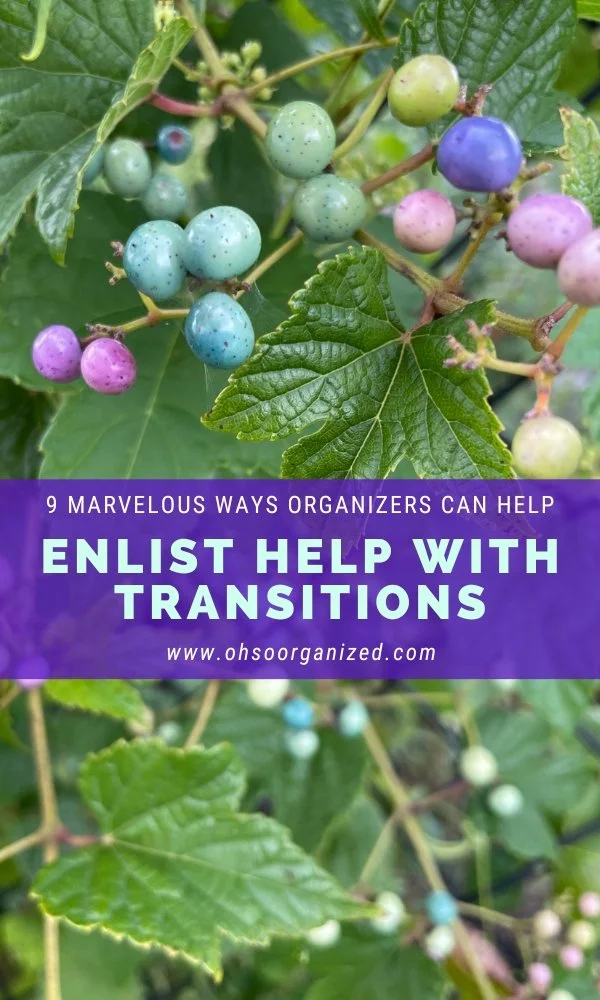
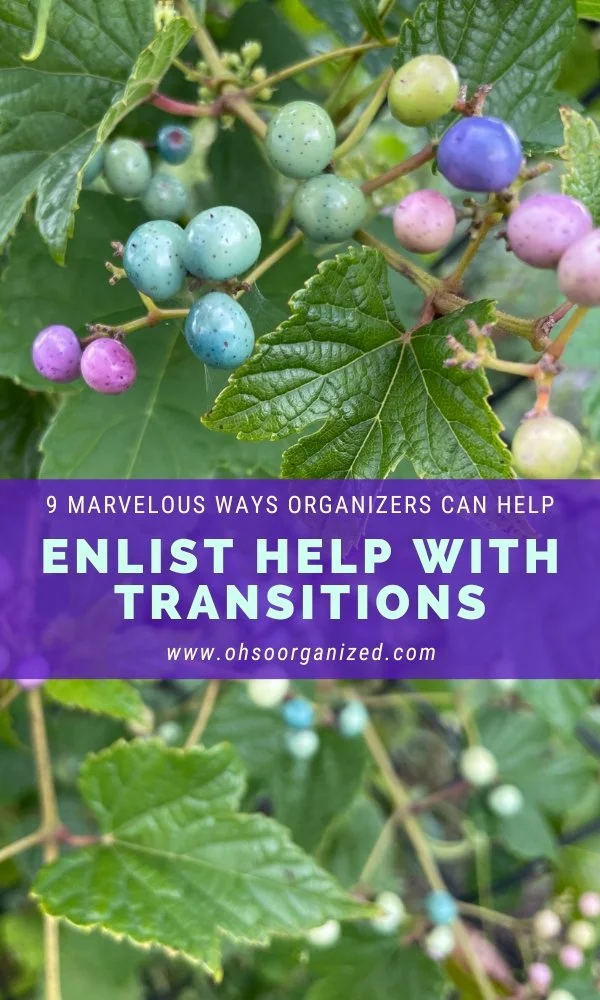
Can you feel it? Transitions are in the air. The summer is coming to a close. Fall is around the corner, and change is on its way. One transition signal I noticed on a recent walk was the appearance of these beautiful berries that start white and turn to blue and purple hues. Oh, yes. Fall is coming. The transition is happening.

How do you feel about transitions? Are you excited, optimistic, empowered, sad, scared, apprehensive, or overwhelmed? Change can be challenging. You let go or say goodbye to what was and move forward to something different. The ‘different’ could be an unknown, a new stage of life, or a smaller, seemingly insignificant change. Navigating transitions can be much easier when you get planning, implementing, and supporting help.

Here's the good news. Many people can provide support, including friends, family members, colleagues, or virtual professional organizers like me. Much of my work centers around helping people of all ages and stages during their life transitions.


9 Ways Organizers Can Help With Transitions

1. Resetting for the New Season

Can you enlist the help of an organizer to do a clothing edit and organization? As you store your spring/summer clothes and bring out your fall/winter ones, choose the items you will no longer wear and can release. Could you hire an organizer to support your decision-making and organizational ideas? Your seasonal clothing transition will go more smoothly.


2. Going Back to School

You had one pattern for the summer, but now it’s time for the kiddos to return to school. This is a transition time where habits and schedules change. An organizer can help you create great organizational systems that work for your family.


3. Becoming an Empty Nester

Perhaps going back to school means you’re now an empty nester. This is an enormous transition for both you and your kiddo. If you need help getting your college-bound kid organized to leave the nest or need help reorganizing your home and schedule now that your kid is out, enlist help from a professional organizer.


4. Becoming a Parent

When a new life arrives, everything changes. You will prepare emotionally and physically during this transition. You can use the services of an organizer to help create an organized space for your little one.


5. Changing a Relationship

Whether you are moving in with your partner, getting married, or divorced, these transitions can be stressful and complicated. There are emotional aspects to navigate. There are also scheduling and space transitions, which an organizer can be especially helpful with. Whether merging two households into one or dividing one home into two, it’s beneficial to have a non-judgmental, compassionate person to plan, organize, and navigate this transition.


Transitions are an opportunity for growth, renewal, and possibilities.
— Linda Samuels, CPO-CD®, CVOP™

6. Moving and Downsizing

Moving and downsizing are significant transitions. This can be anxiety-producing, especially if you work with a tight deadline or do not want to move. There are many things to handle, even when your deadline is flexible, or you’ve purposely chosen the change. Hiring an organizer to help you plan, support your decisions, and share resources can ease the stress of these complex transitions.


7. Retiring

You worked a lifetime, and now you’re ready to stop. You’re used to being highly scheduled with less free time to pursue hobbies and friendships. As you transition into this new stage of life, consider what you want and no longer need. What can you let go of? What do you want to make space for? You can work with an organizer to figure out what ‘belongs’ now.


8. Experiencing Health Challenges

While you have your medical health professionals’ support team, an organizer can help with health-related transitions in many ways. Perhaps you need a system for documenting doctor visits, instructions, or medications. Maybe you need to reorganize space in your home, declutter, or create an unobstructed flow. Especially when you’re not feeling your best, having another person to support your transition and organizational needs can be helpful.


9. Losing a Loved One

When someone we love dies, life changes instantly. It doesn’t matter if it is expected or not. Loss is loss. Everyone grieves in their way. At a point when the grief fog lifts, you might feel ready to make changes, like rethinking the use of rooms or letting go of some of your loved one's belongings. This is a highly emotional time. Having an organizer to work with can help you honor your loved one’s possessions as you organize, let go, and move forward.


As Tom Stoppard said, “Every exit is an entry somewhere.” As you travel from where you are to where you are heading, don’t go it alone. Gather your team who will help, support, and be there as you navigate. Transitions are an opportunity for growth, renewal, and possibilities.

Are you going through a transition? Who is on your team? Do you want additional help? I’d love to hear your thoughts. I invite you to join the conversation.




How to Stop Ruminations Using Self-Help Strategies and Virtual Organizing Help

Rumination is a common cognitive pattern that feeds on negative thoughts and worries. Noom, a behavior change wellness company, says, "Rumination is thinking repetitively about causes, processes, and consequences of something that’s happening or happened...It's focusing on the problem over and over again instead of looking for solutions."

To improve your mental well-being and ability to move forward, shift from ruminating to focusing on solutions. Help is here.


6 Self-Help Strategies to Stop Ruminations

1. Mindfulness and Self-Awareness: Practice mindfulness to help develop awareness when you're ruminating. Pay attention to your thought patterns and notice when you're stuck in negative loops. Self-awareness is the first step in breaking this cycle.

2. Problem-Solving Techniques: Once you notice you're ruminating, shift your thinking towards problem-solving. Instead of dwelling on the causes or consequences of a problem, focus on finding solutions.

3. Positive Visualization: Visualize the desired outcome rather than getting stuck in the negative aspects. Imagine what a successful resolution looks like and how it would feel. This positive visualization can stop the negative thought loop and motivate you to take action.

4. Time-Limited Reflection: Give yourself a specific amount of time to reflect on the causes and consequences, but set a timer. Once the time is up, switch your focus to solutions. This technique helps prevent excessive rumination.

5. Action-Oriented Approach: Take small, actionable steps toward solving the problem. No matter how tiny, each action will build momentum and confidence.

6. Growth Mindset: Consider what you can learn from the situation. Challenges and setbacks provide helpful insights that can be used in the future.


To improve your mental well-being and ability to move forward, shift from ruminating to focusing on solutions.
— Linda Samuels, CPO-CD®, CVOP™

5 Ways Virtual Professional Organizers Can Help

What if you want additional assistance to break your rumination cycle? Virtual professional organizers can provide valuable help, especially when you're overwhelmed or stuck in those negative loops. Here are five ways organizers can help:

1. Objective Perspective: A professional organizer can offer an unbiased viewpoint and help you view things differently. 

2. Expertise: Professional organizers are skilled in organizational strategies, problem-solving, and collaborating. With additional support, you will move forward with less stress and more ease.

3. Accountability: Having an accountability buddy is an effective strategy for making progress. A virtual professional organizer can help you set goals, track progress, and encourage positive actions.

4. Customized Solutions: Organizers provide personalized strategies to address your specific challenges and to help create a more organized and positive environment.

5. Flexibility: With virtual professional organizers, you can access their services from anywhere, making it convenient and flexible to fit into your schedule and location.

I encourage you to find a virtual professional organizer who can help with your goals and needs and who you feel comfortable working with. They can be a valuable partner in your journey for less ruminating and more solving.

How can I help? Contact me, Linda, at 914-271-5673, linda@ohsoorganized.com, or click here.


7 Ways to Joyfully Enlist Help Making Decisions When You're Really Stuck

One of the most common reasons my clients get stuck is being unsure about making decisions. A lack of confidence in decision-making might only affect specific areas. For example, they have no issue deciding which groceries to purchase or which social activities to attend. However, the decision-making challenge can surface when choosing how many black pants to let go of or where to begin organizing their home. It can feel like overwhelm, paralysis, or stress. This is an excellent time to reach out for help. There is no reason to remain in Stuckland.

There is another aspect to making decisions. Often, we’re on the fence about what to do. We have a few ideas but aren’t 100% sure which way to go. This is another terrific reason to enlist help. Use a decision-making buddy to help discuss options, weigh the pros and cons, or boost your confidence in making a choice.


7 Ways to Enlist Help Making Decisions

10 10 10 Rule

Before you make a decision, ask three questions:

  • 10 minutes from now, how will I feel about this decision?

  • 10 months from now, how will I feel about this decision?

  • 10 years from now, how will I feel about this decision?


40/70 Rule

Former Secretary of State Colin Powell used this approach when making a quick decision. He would aim not to decide with less than 40% of the information needed, then act when he had close to 70% of the data.


80/20 Rule

Known as the Pareto Principle, this rule says that 80% of the outcomes (or outputs) result from 20% of all causes (or inputs) for any event. We often use this in the organizing world. For example, we only wear 20% of our clothes or refer to 20% of the papers we file. With that recognition, opting to let go will be easier.


3 Elements of Decision-Making

  • ClarifyIdentify the decision to make or problem to solve.

  • Consider – Think about the options and the positive and negative consequences of each choice.

  • Choose – Choose the best choice.


When all else fails, flip a coin.
— Linda Samuels, CPO-CD®, CVOP™

Golden Rules of Decision-Making

Make decisions when you’re . . .

  • not in pain and when your body feels strong

  • feeling loved and supported

  • feeling you are enough


Coin Flip

When all else fails, flip a coin. Heads you let ‘it’ go, tails you keep ‘it.” Then pay attention to how you react. Let your intuition guide you. Do the opposite of the coin toss result if the option doesn’t sit right in your gut.


Virtual Organizing

Decision-making is integral to all virtual organizing sessions with my clients. I provide support by:

  • Discussing the options

  • Holding space to think through a choice without feeling pressured

  • Setting boundaries around the decision

  • Reviewing pros and cons

  • Encouraging curiosity and experimentation

  • Empowering agency to make decisions

  • Focusing on progress, not perfection


These are just a few ways to boost your decision-making skills. What helps you get unstuck so you can make a decision? I’d love to hear your thoughts. I invite you to join the conversation.

Contact me, Linda, if you are stuck and need help and guidance to make decisions. Call at 914-271-5673, email linda@ohsoorganized.com, or click here. I’m here for you.


3 Delightful Ways to Increase Your Motivation Now

What drives you to do something? There are many factors, and motivation is one of the most significant ones. Author and educator Kendra Cherry said, “It [motivation] is the driving force behind human actions.” However, you can’t take this “force” for granted. Motivation needs to be cultivated and encouraged. Even when you’ve clarified your why, using additional strategies to stay motivated can be valuable.

Summer brings longer days and a change of pace. This is an excellent season to attend to organizing and other projects or goals you have on hold. Is a lack of motivation preventing you from achieving your goals? If so, here are three quick strategies to help.


3 Ways to Increase Your Motivation Now

1. Set a Deadline

There’s nothing as powerful as a deadline to light the ‘motivation’ fire under you. One way to accomplish this is to bundle finishing tasks and projects with an event deadline, such as having guests over, leaving for vacation, or working between meetings. That added ‘beat the clock’ incentive creates a motivation boost.

Recently, we went away for vacation. While packing was one of the necessary things I did before departing, I was also incentivized and motivated by the ‘leaving soon’ deadline to finish other projects and tasks. I could go away with a clear mind, fully enjoy my time off, and return home to a calm environment.


2. Create Accountability

The number one reason clients contact me is because they are overwhelmed. When overwhelm is present, it can block the motivation needed to take action. The second reason clients reach out is that they recognize the value of accountability and want an accountability partner. Virtual organizing is a great way to mesh accountability and motivation for achieving your goals.

If you need help getting unstuck, moving forward with your organizing projects, or figuring out what comes next, let me know. I am ready to help. Contact me at linda@ohsoorganized.com or through this form.


Motivation needs to be cultivated and encouraged.
— Linda Samuels, CPO-CD®, CVOP™

3. Pause to Restore

Being overworked and exhausted impairs motivation. Life isn’t only about doing and accomplishing. It would help if you had time to rest and restore. Even a short pause can be an effective way to increase your motivation.

Your pause can be a coffee break, a walk outside, several deep breaths, a mindfulness meditation, a quick nap, a massage, or a conversation with a friend. There is no limit to the types or lengths of pauses you can take.

One of the great pleasures for me is lying in our hammock. It’s a perfect way to pause, relax, rest, and restore. A few weekends ago, my husband and I took the pause together. What a joy! After a good rest, I had the energy and motivation to work on one of my projects.


Do these strategies resonate with you? What helps increase your motivation? I’d love to hear your thoughts and invite you to join the conversation.