Posts tagged kayaking
One Joyful Approach to Reach Your Goals and Nurture Motivation

During the long holiday and very hot weekend (heat wave, folks), I made a fascinating discovery about motivation and goals. The funny thing was that I hadn’t been searching for this insight, but when the light bulb turned on, I knew I had to share it with you.

Here is the backstory. This past weekend, many people gathered with family and friends to celebrate July 4th, honor the United States’ 250th Anniversary, watch fireworks, or go to BBQs. My husband and I didn’t do those things. Instead, we sought relief from the heat and opted to go somewhere we could submerge ourselves in water. We had several ideas and chose a local outdoor town pool we hadn’t visited in decades. 

After securing our passes and paying the entrance fees, we set up our chairs and towels, lathered on sunscreen, and headed into the pool. The water’s temperature was perfect and a welcome relief from the sun and heat.

Now that you have the context, I’ll explain what happened and how you can apply this approach to achieve your goals and sustain your motivation.


The Pool-Inspired Motivation Approach

I love most things water-related! This includes swimming, kayaking, going to the beach, washing dishes, taking showers or baths, looking at water, listening to water sounds, watering plants, and much more.

Swimming is one of my favorite water activities, especially in a pool. There are no fish or other sea creatures to contend with. It’s just pure, clear water to swim in.

I sloshed and swam for hours. I cannot express how much I enjoyed swimming, treading water, and going from one end of the pool to the other. I wasn’t trying to go quickly, but I was aware of reaching the end, touching the ‘goal,’ and turning around to do it again.

Even though reaching the far end of the pool was my goal, the journey was the most joyful part. I swam slowly, luxuriating in the feel of the water, the motion of my arms and legs pulling me forward, and the pleasure of cooling off from the summer heat. I was so happy that I couldn’t stop smiling.

Then it hit me. How often do you get so focused on your goal that you rush through the doing? Instead of enjoying the actions that move you from where you are to where you want to be, you neglect to delight in the process.

While reaching the end of the pool, turning around, and heading for the other end was the goal, it wasn’t what propelled me forward. It was the joy of the doing, the immersive, gleeful swimming experience, that kept me going. Hours went by without my realizing how much time had passed.

The fun of doing (not thinking about swimming, but actually swimming) became a natural motivator, overshadowing the goal.


How often do you get so focused on your goal that you rush through the doing?
— Linda Samuels, CPO-CD®, CVOP™


How Can I Apply This Motivation Approach to My Goals?

What goals do you have for the next month or the upcoming quarter?

Do you want to:

  • Organize your closets

  • Downsize or move

  • Create more flow in your spaces

  • Design a better schedule

  • Work on your finances

  • Release things you don’t use, like, or need

Think about ways to infuse more joy and fun into the organizing process. While it probably won’t involve swimming, one of these options might work, such as:

  • Develop a more positive mindset. Shift from “I have to do this” to “I get to do this.”

  • Find an organizing buddy (a friend, family member, or a professional organizer like me) you enjoy working with. My clients often tell me they enjoy the organizing process more when I’m helping them. One client said, “Linda’s joy and energy are so infectious. Who knew organizing could be so fun?!!!”

  • Activate your senses. Being more mindful and aware of what you are doing can make the experience more pleasurable. Feel the objects as you edit them. Make your environment more uplifting by playing your favorite music, opening a window to let in fresh air, or lighting a scented candle. 

Motivation often comes after action. Making actions more enjoyable will naturally boost motivation. ‘Swim’ your way forward.


Fun Is the Natural Motivator

Goals can feel achievable or lofty. Either way, you can get stuck, deflated, or demotivated. However, when you make the journey more enjoyable, motivation will grow exponentially.

What nurtures your motivation? How could you benefit from the pool-inspired motivational approach? Which goals could you apply this strategy to? I’d love to hear your thoughts. I invite you to join the conversation.


How Can I Help?

Do you feel overwhelmed, disorganized, and stuck? Are you struggling with a lack of motivation? I’m here to help! You don’t have to do this alone. Virtual organizing is an extraordinary path forward – Local feel with a global reach.

Let’s connect! I’m easy to reach.

Getting organized, staying motivated, and reaching your goals are possible, especially with support.

 
 
How to Easily Decide It's Time to Release Something Irritating

Do you hold too much in your time or space containers? It’s interesting how often you keep things that are annoying, unsatisfying, or in your way. These could be things that take up physical space, creating cluttered rooms and areas. The volume of stuff has become a tripping hazard. Or, having so many things makes it difficult to know what you own or to find what you’re looking for. Your space containers are beyond full, and it may be time to let go of some things.

There are also time containers that can overflow. Instead of physical items, a time challenge can look like-

  • Crammed schedules

  • Saying “yes” to too many requests

  • Underestimating how long a task will take

  • Always running late because you have just one more thing to do

  • Having unhealthy boundaries

  • Spending more time than needed to get something “just right”

  • Being constantly interrupted or distracted

  • Multitasking and trying to do too many things at once

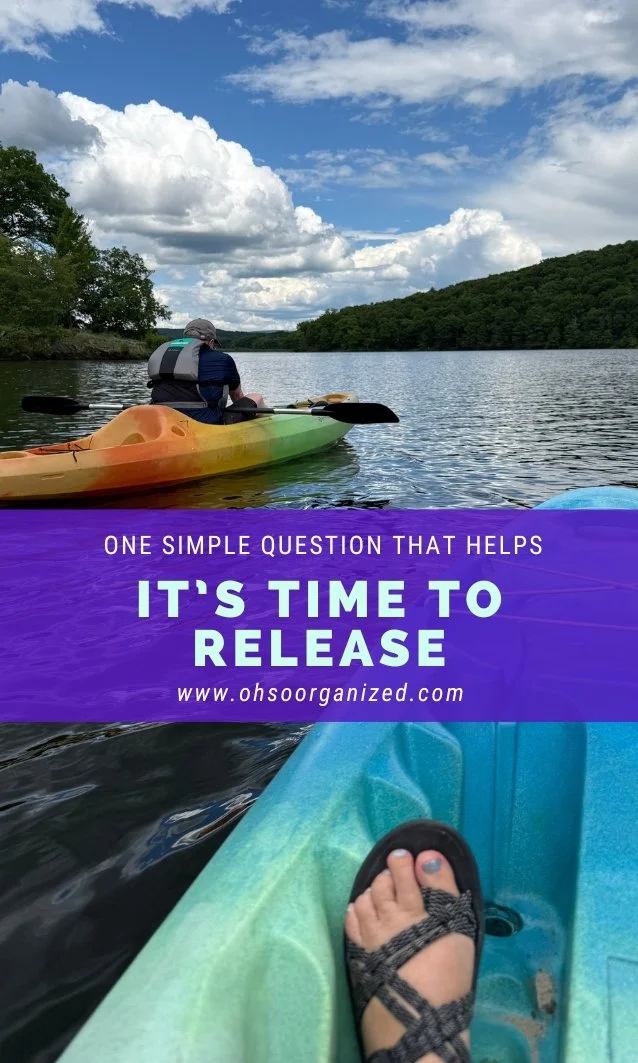
Letting go creates space for what’s most important and valued. That might mean more time to enjoy doing what you truly love, like kayaking, spending time with family and friends, or learning something new.


Asking One Simple Question

A while ago, I read something in James Clear’s 3-2-1 newsletter that resonated with me. He asked a direct question that gets to the heart of what I just shared with you – how to manage your space or time containers when they’re overflowing.

Clear’s question is,

What can you eliminate this week?
— James Clear

Setting a deadline (this week) creates urgency and encourages you to act sooner rather than later. Pick an area of focus, such as your full calendar or the distractions you're facing.

Then ask, “What can you eliminate this week?” This might include-

  • Removing or rescheduling an appointment to make your day flow better

  • Pausing to evaluate before saying “yes” to anything else

  • Delegating some tasks or errands

  • Setting a time limit on social media scrolling

Is there anything specific that came up when you thought about removing something this week?


Decide to Let Go

Your space and time can quickly overflow. The good news is that you can change the dynamic through the process of elimination. One question, one focus area, one decision, and one action at a time.

What is making your space or time feel too full? What would it be like to practice letting go? Which area would you like to focus on first? I’d love to hear your thoughts. I invite you to join the conversation.


How Can I Help?

Do you feel overwhelmed and disorganized? Are your space and time containers overflowing? I’m here to help! You don’t have to do this alone. Virtual organizing is an extraordinary path forward – Local feel with a global reach.

Let’s connect! I’m easy to reach.

Managing your time, getting organized, and living with more ease are possible, especially with support.
 
 
Did You Know That Taking Breaks Is Key to Better Time Management?

When you think about managing your time, how often is it about being more productive, reaching those big goals, or getting more items crossed off your to-do list today? You wonder how other people get so much done. You’re frustrated that you’re constantly working, yet your lists and goals feel hard to finish or even to start.

After all, there are only 24 hours in a day. For most of us, at least six to eight of those hours are devoted to sleep. Subtract time for eating, transitions, bio breaks, managing distractions, and handling the unexpected, and your available time to get things done is significantly reduced.

I remember my mom used to get annoyed about having to sleep. She would say, “We sleep a third of our lives away. Sleeping is a waste of time.” I never bought into the idea that sleep was a waste. Instead, I saw her words as reflecting her intense need to make the most of every moment.

I’m all for making the most of the time I have. Time is finite and a precious resource. However, one of the best ways to manage your time better is to take intentional breaks. Sleep is one aspect, but taking breaks while awake is just as essential.


What Types of Breaks Will Help You Be a Better Time Manager?

I know I’m stating the obvious, but you need energy and focus to get things done. Working longer or beyond capacity doesn’t help. You’ve probably reached the point of diminishing returns. You know those nights. You’re exhausted, pushing to finish that spreadsheet, dealing with a sink full of dishes, packing for a trip, or writing one more email response.

However, understanding the benefits of taking breaks and integrating them into your life will help.

It’s more than ‘will help.’ Taking breaks is essential not only for energy, focus, and getting things done but also for your overall well-being. Life isn’t only about doing more. It’s about stepping away for short, medium, or longer breaks.

What can these mid-size breaks look like? Let’s review some options to help you better manage your time. These pauses are about giving you time to recover so you can return to ‘the work’ refreshed, recharged, and energized.


1. Short Breaks

You might be thinking, “I’m so busy that I barely have time for a bio break, let alone any other break.” Believe me, I get it. You are not alone in feeling overwhelmed by the pace of life.

However, it is possible to integrate several short breaks into your day. If “short” feels too long, reframe it as a micro-break.

These tiny resets can be taken a few times a day and may include:

  • Close your eyes and take several slow breaths in and out.

  • Stand up and shake out your body.

  • Send a quick email or text to someone you love.

  • Enjoy a few leisurely sips of coffee or iced tea.

  • Eat a snack.

  • Doodle on a sheet of paper.

  • Go outside for fresh air.

  • Take a walk around the office or the block.

  • Roll your shoulders forward and backward.

  • Dance or sing loudly to a favorite song.

  • Take a few deep, loud sighs.

  • Splash cold water on your face.

  • Sit and do nothing for a few minutes.

  • Meditate for 1 to 5 minutes. Insight Timer offers many excellent options.

What else could work well for your micro-break?


Life isn’t only about doing more.
— Linda Samuels, CPO-CD®, CVOP™

2. Medium Breaks

Those mini breaks are wonderful, but at times you will benefit from something longer. If you can carve out more than 5 minutes, a medium break is beneficial. While micro-breaks can be impromptu, a medium break might require some advance planning.

Here are some recharge ideas for breaks ranging from 20 minutes to several hours:

  • Take a 20-minute nap.

  • Go to the movies.

  • Take a walk in nature.

  • Meet a friend for lunch.

  • Explore a museum, garden, or town.

  • Get a massage.

  • Meditate for 30 minutes.

  • Write in your journal.

  • Call a loved one.

  • Go to the pool or the beach.

  • Read a book (or a portion of one).

  • Spend time in a hammock.

  • Go for a bike ride.

  • Make something with your hands.

  • Daydream.

  • Take a yoga class.

What other types of medium breaks could benefit you?


3. Long Breaks

Full disclosure here. Today I took a micro break (meditated) and a medium break (walked by the river). I also just returned from a long break, a family vacation in the Finger Lakes. I have to say, as much as I need my shorter breaks regularly, the extended ones are just as vital. They can be more challenging to take because of the expense or limited time.

Yet, going somewhere for several days (if possible) and stepping away from your regular routines and responsibilities is one of the best ways to recharge. You will return refreshed, more focused, and ready to re-engage with your projects and lists.

It also gives you time to float, think, catch up on sleep, connect with family and friends, or simply do nothing. But a long break doesn’t have to mean only getting away.

Here are some long-break ideas when you have more than 24 hours:

  • Take a staycation and stick to fun or relaxing activities.

  • Take a personal retreat focused on rest and reflection.

  • Unplug for several days.

  • Learn a new skill just for fun.

  • Create a home retreat with no obligations, errands, or projects.

  • Go away for the weekend, or extend it to a long weekend.

  • Vacation somewhere you have to fly to.

  • Travel to somewhere on your bucket list.

  • Check into a spa or wellness retreat.

  • Go camping or glamping.

  • Vacation somewhere reachable by car.

  • Take a biking, kayaking, or boating trip.

  • Spend an extended visit with loved ones.

What have you enjoyed most during your long breaks?


Are You Ready to Give Yourself the Breaks You Deserve?

Busy is how many of you describe your lives. There’s nothing inherently wrong with a full life. But make sure you also take a variety of intentional breaks. Breaks are the yin to your ‘busy’ yang.

Do you take regular breaks? What types do you take? Would you benefit from adding more pauses to your life? How would taking more breaks help you manage your time better? I’d love to hear your thoughts. I invite you to join the conversation.


How Can I Help?

Do you feel overwhelmed, disorganized, and have difficulty managing your time? I’m here to help! You don’t have to do this alone. Virtual organizing is an extraordinary path forward – Local feel with a global reach.

Let’s connect! I’m easy to reach.

Managing your time, getting organized, and living with more ease are possible, especially with support.
 
 
How to Get Motivated, Excited, & Take Action When You Don’t Feel Like It

Have you ever struggled to get motivated and take action? Many of my virtual organizing clients have encountered periods of low motivation and activation. It’s a common human experience to have lulls.

Reduced motivation can happen for many reasons, including:

  • Feeling overwhelmed by the enormity of what you want to accomplish.

  • Being uncertain about what to do next.

  • Desiring rest rather than active engagement.

  • Feeling sad or depressed.

  • Resenting the project you need to work on.

  • Being unclear about your why.

  • Wanting to play instead of working on a project.


The Backstory

Sunday is usually the day I write and post my blog. After almost a week of summer vacation fun, I found it hard to get motivated to write. While I planned to write, I struggled to get started.

However, despite feeling unmotivated today, I managed to turn things around. I’ll share the strategies I used to boost my motivation and get going. The next time you’re stuck, I hope one of these ideas helps you.

The irony isn’t lost on me that I was struggling with motivation, and it’s also the topic I’ll be writing about all month.


Four Ways to Get Motivated and Take Action When You Don’t Feel Like It

1. Move the Body

After a week of joyfully kayaking, exploring, and walking, the thought of sitting at my desk for hours to write wasn’t appealing. I wanted to be more physically active.

Instead of writing immediately, my husband and I took a walk along the Hudson River before it got too hot. Well, that was the idea at least. Even though we got outside early, it was already pretty warm. We walked, but shortened our route.

Moving my body first made me feel motivated and less restless about sitting inside to write.


2. Clear the Noise

Especially after being off for a while, some life management things needed my attention. Could they have waited a day or so? Yes. However, the mind clutter they caused made it hard for me to focus on anything else.

It was worth taking the one or two hours to handle those things, so that my thoughts would be clearer to write this post.

Cluttered thoughts or spaces can negatively impact motivation. Doing a simple clearing is significant enough to increase motivation for the task or project you are avoiding.  

Doing a simple clearing is significant enough to increase motivation for the task or project you are avoiding
— Linda Samuels, CPO-CD®, CVOP™

 3. Set the Stage

When I write, I like to have a hot or cold beverage to sip on. Preparing and keeping it nearby signals that it’s time for me to work. After setting up my drink, I take several additional steps to cue myself to write. These include:

  • Create a new blank Word document.

  • Choose the exact topic. These are either from materials in my blog ideas binder or current thoughts that are on my mind.

  • Write the title.

  • Add the title to my Blog Plan document.

Once those elements are in place, I’m ready to start writing. No more procrastinating, questioning whether I need to write, or searching for motivation. Just setting up initiates the process.


4. Find the Joy

As I mentioned, part of setting up involves choosing a specific topic I will write about. I reviewed my blog ideas and found something that could work. I wasn’t excited, but I thought it would be a helpful concept to explore.

Then, just before I committed to that plan, I had another idea. What if I shared my experience of lacking motivation instead? I jotted down a few ideas, including the Find the Joy part.

What is the joy part? This is about identifying the element that makes you happy to work on the project you’re doing. The joy factor you include becomes one of the motivating elements.

For me, this meant capturing happy memories of our vacation by making a video, which I included below.


How to Get Motivated?

Motivation isn’t something that is present 100% of the time. Experiencing a dip in motivation is a normal part of life. When you want to take action, yet feel stuck, there are many ways to move forward. What helps you boost your motivation in these situations? Which ideas resonate with you?

I’d love to hear your thoughts. I invite you to join the conversation.


How Can I Help?

Do you need support with organizing, getting motivated, or activating? I’d love to help! Virtual organizing is an extraordinary path forward – Local feel with a global reach.

Let’s talk. You can:

Organizing and sustaining motivation is possible, especially with support.