
Posts in Embrace Change
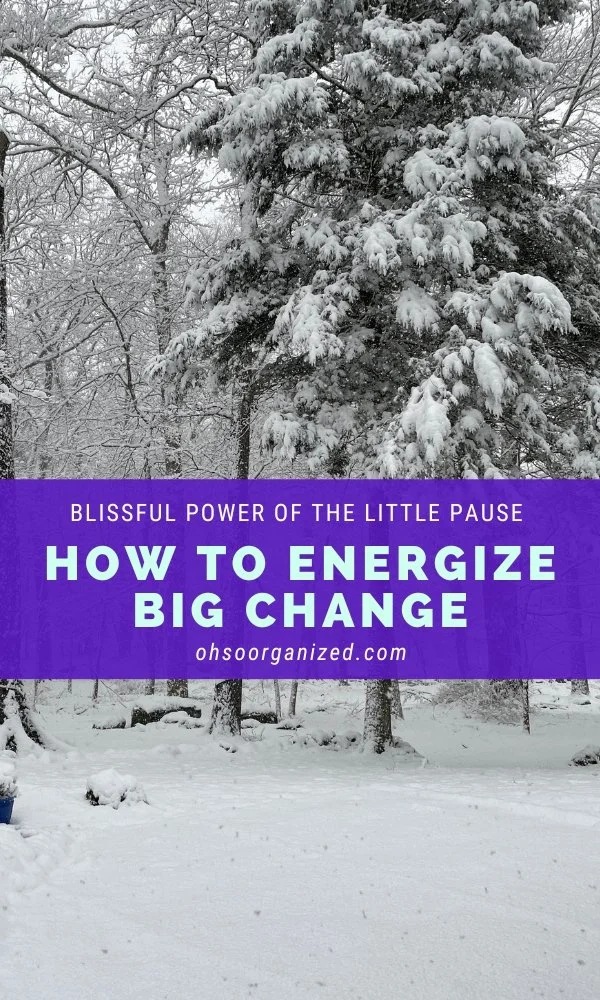
How to Energize Big Change with a Blissful Little Pause

When you’re making a significant change, it takes sustained energy and focus. This can be exhausting. When pursuing change, motivation is an essential ingredient. However, it’s not enough. Sometimes, you’ll need to act even when you don’t feel like it and your motivation is low or non-existent.

Taking action through small, consistent steps will facilitate the change you desire.

There is another aspect to proactive change that goes beyond desire, motivation, and action. It’s recognizing the powerful and energizing effect a brief pause has.

Last week, I wrote about capacity. The pause is connected to that idea. Consider how much stamina it takes to make a change in your life. Along that journey, which could take days, months, or years, the endurance needed won’t be sustainable without rest cycles.

Clients’ Organizing Goals

I admire my clients’ dedication to pursuing their organizational goals and making changes in their lives. There are weeks when things flow easily for them. At other times, it’s more challenging to activate and move forward. They don’t give up. I support them as they navigate the change process. They balance the intense periods of action with taking breaks. They’ll step away briefly and then return.

The power of their pause is noticeable. After their hiatus, clarity, energy, and determination return. The downtime creates space to breathe, rejuvenate, and refocus.


My Big Changes

You may recall how the pandemic influenced significant changes for my organizing business, Oh, So Organized! In 2020, after almost thirty years of working in-person with clients, I pivoted to offer virtual services only. My organizing company helps overwhelmed individuals challenged by disorganization get unstuck and organized with nonjudgmental, personalized one-on-one sessions, workshops, and publications.

I’ve led workshops for decades. Most of those were hosted by other companies or industry associations. However, in 2022, I started sponsoring my own workshops. I’ve hosted four since then and plan to offer two more this year. It’s been a positive change that I’m still exploring.

In the first quarter of 2024, I had four workshops scheduled, one of which I hosted. I’ve already given three and was invited to present next month for Denise Wenacur’s Design Lab. These changes have been exciting yet intense because of the deadlines.

To sustain the pursuit of the changes you seek, step away from doing to recharge.
— Linda Samuels, CPO-CD®, CVOP™

A Gentle Pause

Do you remember I mentioned how my clients balance their change pursuits with taking breaks? Well, I’m no different. I integrate breaks, too. And luckily, in the last few weeks, we’ve had some beautiful snowfall in the Hudson Valley. You may wonder how snow and pausing connect.

These particular snows were incredibly peaceful, covering the landscape in white and making the quiet feel even quieter. I loved pausing to watch the snow steadily fall to the ground. It was meditative and made me feel calm and relaxed. Watching the gently floating snowflakes encouraged me to appreciate the moment and temporarily disengage from my projects. Observing was enough of a break to help me reset, energize, and prepare for the next step.

Weird Facts shared this idea about the quiet a fresh snow brings:

“Fresh snow absorbs sound, lowering ambient noise over a landscape because the trapped air between snowflakes attenuates vibration. That’s why it gets so quiet when it snows.”

Don’t underestimate the power of a pause. To sustain the pursuit of the changes you seek, step away from doing to recharge. Pause and see the snow descend, take a coffee break, or go away for a few days. You’ll be happy you did.

What type of pause benefits you? How does it help you pursue the changes you want?


Help is Here

If you are in the midst of change and want assistance, I’m here to help. Please email me at linda@ohsoorganized.com, call 914-271-5673, or click here to schedule a Discovery Call. Change is doable, especially with support.


Many Fascinating Ways Your Capacity Affects Your Ability to Change

What is your relationship to change? Do you love change and readily seek it out? Or do you avoid change at all costs? It may depend on the situation. Your feelings about change are influenced by your capacity at any given moment. When you are stressed, overwhelmed, and with no energy or motivation, your capacity for change is low. However, when you’re excited and ready, even if you don’t have all the facts or steps, you have more capacity to seek changes and new opportunities.

It's important to know where you are and what you need. The outcome won’t be great if you try to make a significant change when you’re sleep-deprived and can’t think straight. At those times, instead of pushing beyond your capacity, it’s best to pull back and support what you need. That might mean more sleep, some quiet, or a walk outside.

When you’re ready to stretch and grow, pushing beyond your capacity will be possible. You can do things you’ve never done. This will require physical and emotional energy and mental toughness to stretch past your comfort zone.

Your feelings about change are influenced by your capacity at any given moment.
— Linda Samuels, CPO-CD®, CVOP™

Monthly Sharing Retreat

Each month, I participate in a fantastic virtual retreat led by my wonderful friend and Clarity Coach, Yota Schneider. She creates a safe, supportive space for women to gather, meditate, write, and share.

On a recent retreat, the theme was capacity. I wrote this passage in my journal during our free-write after the meditation, which I’m sharing with you. The more I thought about it, the more I realized how intertwined capacity is with your ability for change.

Thoughts About Capacity

One thing is for sure. My mind has the capacity to go on in a bazillion directions thinking about capacity. Knowing that, I will take one of the tangents and go with it.

Milk Bottles

I thought about a bottle. I was filling up a bottle, like those old rectangular glass milk bottles delivered to the back kitchen door when I was a kid. As I filled up this bottle with clear liquid, guess what? There was a point when it was to the top, and then, in a moment, it was spilling over. To full, overflowing, beyond capacity. What a mess!

Conferences

Next thought. I thought about a professional conference I went to. It was jam-packed with three days of learning. Experts spoke about the brain, learning differences, chronic disorganization, and more. The presenters taught us for six to eight hours each day. Between learning and socializing, my brain was too full by the end of the day. I couldn’t think or formulate a coherent sentence. My intake for the night was beyond capacity. I felt like a soaked sponge that couldn’t absorb another drop. I knew it was time to retreat to the quiet of my hotel room.

Flaco

And lastly, there’s Flaco. He is a giant Eurasian owl born in captivity to parents who also were. He lived in New York City’s Central Park Zoo for over a decade. Then, one night, someone broke into his cage, and he escaped. However, because he was born in captivity, Flaco never learned to hunt or fend for himself. He could barely fly. His capacity was contained.

After his escape, incredible things happened. He became a fascination and inspiration to New Yorkers. One man has been documenting Flaco’s adventures this past year. Flaco, who has a six-foot wingspan, can now fly. He’s a fantastic hunter and can be spotted on tops of buildings or park benches. He stretched beyond his capacity and thrived. Who says owls can’t change?

Milk bottles, conferences, and giant owls. Sometimes, we feel limited by our capacity and must stop or retreat. At other times, we feel inspired to soar to new heights.

Knowing and honoring your capacity for both is the kindest gift you can give. Know when it’s necessary to pull back. Know when it’s time to reach beyond.

Flaco the Owl | Late Night with Seth Meyers

Your Capacity for Change

Locate yourself on the change-capacity scale. Is it time to step back or extend?

If you want assistance aligning your capacity with your change goals, I’d love to help. Please email me at linda@ohsoorganized.com, call 914-271-5673, or click here to schedule a Discovery Call. Change is possible, especially with support.


How to Prompt One Helpful Ingredient to Encourage Change

You might wonder how baking cookies relate to encouraging change or getting organized. At first glance, they may seem unrelated. However, a funny thing happened recently, which is how I made the connection. I tested out a new cookie recipe from Amy Bowers, my friend who is a Health Coach. To ensure the best outcome, I used the specific ingredients she recommended, including almond butter, coconut sugar, and my favorite, dark chocolate chips.

A successful change journey also requires distinct ingredients. One, in particular, is crucial.


Essential Ingredient to Encourage Change

There are different types of change. Some changes we proactively seek, and some changes happen unexpectedly. There is an ingredient that is valuable for both. Successful change hinges on your choices and the decisions that follow.

Choice and decisions are not one but two things. However, I see them as a connected unit, so I’m offering them as one helpful ingredient.

When you seek change, you desire something different. You may want to establish a new habit, create more organization, or design your next stage of life. Desiring is one thing. That aspect is crucial because it provides your motivation and why. But desire alone isn’t enough.

To encourage actual change, you have many choices. Recognizing those choices is crucial. Identifying them is the thought part. Pairing a choice with a decision is the action part. A dynamic choice-decision-making cycle is vital for change to occur.


The Ingredients Of Practice

Let’s return to my cookie-baking analogy.

The choices went something like this:

  • Is this recipe enticing enough to test, or not?

  • Is it a recipe I can make on my own, or not?

  • Do I have the ingredients, or will I have to buy some?

  • Do I have the time to bake the recipe today or sometime in the future?

Nothing would have changed if I stopped after asking those questions and didn’t move on to the decision-making phase. There would have been no baking, cookies, or new favorite recipes. However, curiosity led me to continue. I couldn’t stop thinking about the enticing cookie photo Amy posted on Instagram.

The decision-making cycle looked like this:

  • I carefully read the recipe and determined it was easy and well within my baking skills.

  • I had most, but not all, of the ingredients.

  • I looked at the time needed. It included going to the grocery store for the items I didn’t have, assembling the ingredients, and baking. I had the interest, ability, and time to test the recipe that day.

The cookies were baked, and they were incredibly delicious. They were so yummy that it was challenging to stop eating them. That’s a story for another day. If you want the recipe, email me at linda@ohsoorganized.com, and I’ll happily share it, or you can see Amy’s post for the details.

Successful change hinges on your choices and the decisions that follow.
— Linda Samuels, CPO-CD®, CVOP™

The Change You Seek

We’re in the second month of this new year. What changes are you working on? How are they going? Are you noticing your choices, making decisions, and taking action? Are you moving forward on your own or enlisting help?

Change happens when you repeatedly identify the choices, make decisions, and take action. You can bring about the change you crave through questioning, doing, readjusting, and staying curious.

If you want assistance with any part of the change process, I’d love to help. Please email me at linda@ohsoorganized.com, call 914-271-5673, or click here to schedule a Discovery Call. Change is possible, especially with support.


How to Make the Courageous Connection Between Risk and Change Really Helpful

Let’s face it. Making a change involves taking risks. No matter the size of the risk, you’ll need the courage to dive into unknown waters. Your risk tolerance level will influence how easy or challenging it will be to pursue change. If you are comfortable taking risks, you will more likely welcome change and take necessary actions without too much deliberation. If you are risk-averse, change is still possible, but the journey will be more difficult.


Risk Tolerance Scale

Your response will vary depending on the scenario and type of risk. Consider your risk tolerance level concerning change using a scale from 1 to 10.

1   =   Risk-Averse:  Reluctant to take risks

10 =   Risk-Taker:  Eager to take risks

Imagine the change you want is to have less clutter in your home. Part of that process will include editing and releasing things. Using the Risk Tolerance Scale, you recognize how easily you can let go of junk mail and old newspapers. You give yourself a 10 because you can recycle them without much thought. However, when it comes to mementos, you struggle to make decisions because of your emotional attachments. You feel a sense of loss when letting go of things from the past, and give yourself a 2.


Preparing for Change

There are a few ways to facilitate change. Using the example above, refer to the Risk Tolerance Scale to identify the areas that feel less risky to work on, like junk mail and newspapers. As you build confidence and progress in those areas, you’re preparing to tackle the more challenging things next.

Another idea, which is especially helpful in risk-averse scenarios, is to ask the question,

What risk are you happy you took?

Revisiting risks you handled in the past that had successful outcomes will help build confidence in taking new risks and making changes. Invest time in remembering.


Making a change involves taking risks.
— Linda Samuels, CPO-CD®, CVOP™

Taking Risks in Pursuit of Change

There’s no question that when we pursue change, letting go occurs. This can include physical stuff, places, people, or ideas. During a recent virtual organizing session, my client shared something while gently releasing a category of papers from the past. It spoke to one of the benefits of embracing risk in pursuit of change and was so moving. She said,

“I’m letting go of part of my life that is no longer part of my life.”

What an insightful recognition that in moving forward and embracing change, you can let go of those things that no longer have a place in your present.


How does your risk tolerance level influence the changes you seek? In what ways have you noticed a connection? I’d love to hear your thoughts. I invite you to join the conversation.