
What Are Today's Interesting Finds? - v30
How to Be Inspired By Possibilities With Fall’s Astonishing Cues

The latest installment (v30) of the “What’s Interesting?” feature is here with my recent discoveries that inform, educate, and relate to organizing and life balance. I’ve included unique and inspiring, change-related finds, which reflect this month’s blog theme.

You are a wonderfully generous, warm, and engaged group. I am deeply appreciative and grateful for your presence, positive energy, and contributions to this community.

I look forward to your participation and additions to the collection I’ve sourced. What do you find interesting?


What’s Interesting? . . .

1. Interesting Read – Motivational Change

The Motivation Code by Todd Henry

Making a change can be challenging enough. When we understand what motivates us and why, we can create an environment for success in our lives.  In The Motivation Code – Discover the Hidden Forces That Drive Your Best Work, Todd Henry, author, consultant, and creative, shares research that identifies twenty-seven unique motivational themes that drive us. We each have a specific combination of motivation drivers that can be discovered by taking the MCODE assessment. Todd says, “Your Motivation Code is not intended to be worn like a name tag. It is meant to help you better understand why you are driven to achieve certain outcomes, and the unique opportunities that accompany those drives.” If you feel challenged by change and motivation, your insights from reading this book and taking the assessment will be valuable. As Todd says, “Operating within what naturally drives us allows us to work toward the outcomes we most crave.”


2. Interesting Resource – Clever Change

The pandemic has accentuated the need to have rooms serve multiple purposes. An eating space, living room, or bedroom is also an office, meeting, or learning space. Having furniture that is functional, well designed, and easily transformable for your needs sounds too good to be true. Not anymore! Expand Furniture in Canada has an impressive collection that changes coffee tables into desks, ottomans into extra chairs, desks into dining tables, and many more options. The only downside is that I’m now addicted to watching their YouTube channel. 


If you’re ready to change your attitude about the cold, focus on ‘koselig,’ a Norwegian strategy for thriving in winter.
— Linda Samuels, CPO-CD®, CVPO


3. Interesting Article  – Mood Change

The Norwegian Philosophy of Thriving in Winter by James Ware

With the pandemic, various quarantine levels, and winter’s cold, short days, many of us feel unsettled. In a recent Forge article, The Norwegian Philosophy of Thriving in Winter, James Ware shares the Norwegians’ secret for creating a positive mindset in winter. They focus on koselig, which is “a sort of shared, safe togetherness.” It’s a feeling of warmth and safety that can “describe a house, a situation, a meal, a conversation, or a person.” It’s similar to the word, cozy, or the Danish concept, hygge. Psychologist Kari Leibowitz researched the winter mindset. Ware shared her thoughts and said, “the koselig mindset is about making the best out of a bad situation.”  If you’re ready to change your attitude about winter, try one of the suggestions: create a cozy ecosystem at home and with people, find creative ways to be social, be in nature, and reach out to help someone else.


4. Interesting Season – Organizational Change

The cold temperatures, mounds of snow, and pandemic likely means you are spending more time inside than out. Are you working from home, helping your kids learn remotely, and trying to carve out some personal time? Is your home feeling cozy and supportive or chaotic and disorganized? Winter is a great time to set your organizing goals, declutter the extraneous, and create the calm at home that you deserve. Change is possible, especially with support. If you are struggling, enlist help from a compassionate and non-judgmental friend, family member, or professional organizer like me. I’m ready to help. Discover how virtual organizing can work for you. Let’s talk. Call 914-271-5673 or email me at linda@ohsoorganized.com.


5. Interesting Thought – Fear of Change

Let’s face it. Change can feel scary. Our fear can be paralyzing. However, I’ve noticed from personal and client experiences how our fear exaggerates the actual change. Fear isn’t a bad emotion. As a matter of fact, it’s present to warn us of danger and to take a specific action. When we move away from the familiar and comfortable, we can be afraid. Recognizing that growth and positive change are available to you on the other side can help normalize your feelings and move you forward despite your fear. 

What are your interesting finds? Which of these resonate with you? I’d love to hear your thoughts. I invite you to join the conversation.

 
 
How to Actually Make a Change Even When Feeling Emotional and Apprehensive

Opportunities for change appear in dramatic and mundane ways. However, it’s not always clear if it’s time to make a change, even when a cue presents itself. Maybe you’re not ready. Perhaps you aren’t aware of the hint. Or, you know something needs to shift, but you’re more comfortable with the familiar and are hesitant to pursue the unknown. Fear and anxiety can surface, which clouds objectivity and decision-making. 

Several weeks ago, I received an obvious change indicator. It couldn’t be any clearer. Did I boldly go for it and make the necessary change? Eventually, I did, but not without some angst. For iPhone users, this scenario will sound familiar. My phone started acting up. What happened? The icon on the home screen indicated the battery was 100% charged. Within minutes, the battery dropped to 10% and then shut off the phone. The first time it happened, I thought I misread the icon. After all, the symbol is tiny, and I have a hard time seeing it without my glasses. It happened four times and with increased frequency. Even though I wanted to pretend that it was nothing, I could not ignore the facts. My phone wasn’t working, and a change was inevitable.


Technology and our devices are great when they work. But when they don’t, it can be frustrating. At the height of my annoyance and awareness, I called Apple for their help. Within minutes, a calm, knowledgeable tech support person ran a diagnostic on my phone and quickly determined the problem. He said my “battery has reached its full lifespan.” Full lifespan? I thought that phrase sounded odd, so I asked for more clarification. He read back the report, which specifically stated my battery had “exceeded expected lifespan.”

How often is the choice for change that clear? Translated, “exceeded expected lifespan” meant it was time to move on, Linda, and get a new phone. I won’t go into the details of what happened next with my research, numerous conversations, sleepless nights, and the decision-making process. The vital part of this story isn’t about next, but about how we can notice and lean into change.

Whether your change indicators are subtle or bold, they are waiting for you to discover them.
— Linda Samuels, CPO-CD®, CVPO

Without seeing an indicator, you won’t make a change. Once you are aware that change is necessary, the process begins. An internal switch gets flipped from being oblivious to aware. Awareness sets choices into motion, which bring about change.

As I said at the beginning, not all cues are as clear as my iPhone diagnostic revealed. How often do we get the message that something has “exceeded expected lifespan,” and it’s time to move on? Whether your change indicators are subtle or bold, they are waiting for you to discover them.

Have you noticed cues for change? What are they encouraging you to pursue? I’d love to hear your thoughts. I invite you to join the conversation!


My Surprising Find in a Fortune Cookie Is the Amazing Secret About Change

We turned the page on the first month of the year and have arrived in February. Is anyone else wondering, “Where the @!#?! did January go?” I sure am. Last month, many of us were motivated by the fresh start signal a New Year brings. This month, we are poised and ready to embrace change. What will that mean for you? What changes are you pursuing? Is there a secret to initiating successful change? That’s where this story begins.

It isn’t the first time I’ve written about my love of fortune cookies. Yes. I do like the taste and their unique shape. But it’s the fortune that I really love. To me, it’s thrilling to discover a well-timed message tucked into my cookie. So when we order takeout, I always buy additional cookies- at least a dozen. Because why skimp on fun? Over the weekend, we did just that. When it came time for dessert, my husband and I started eating the cookies and reading the fortunes. Some fortunes were so-so, and others made no sense. But then, I read this one, and I knew I had to share it with you.

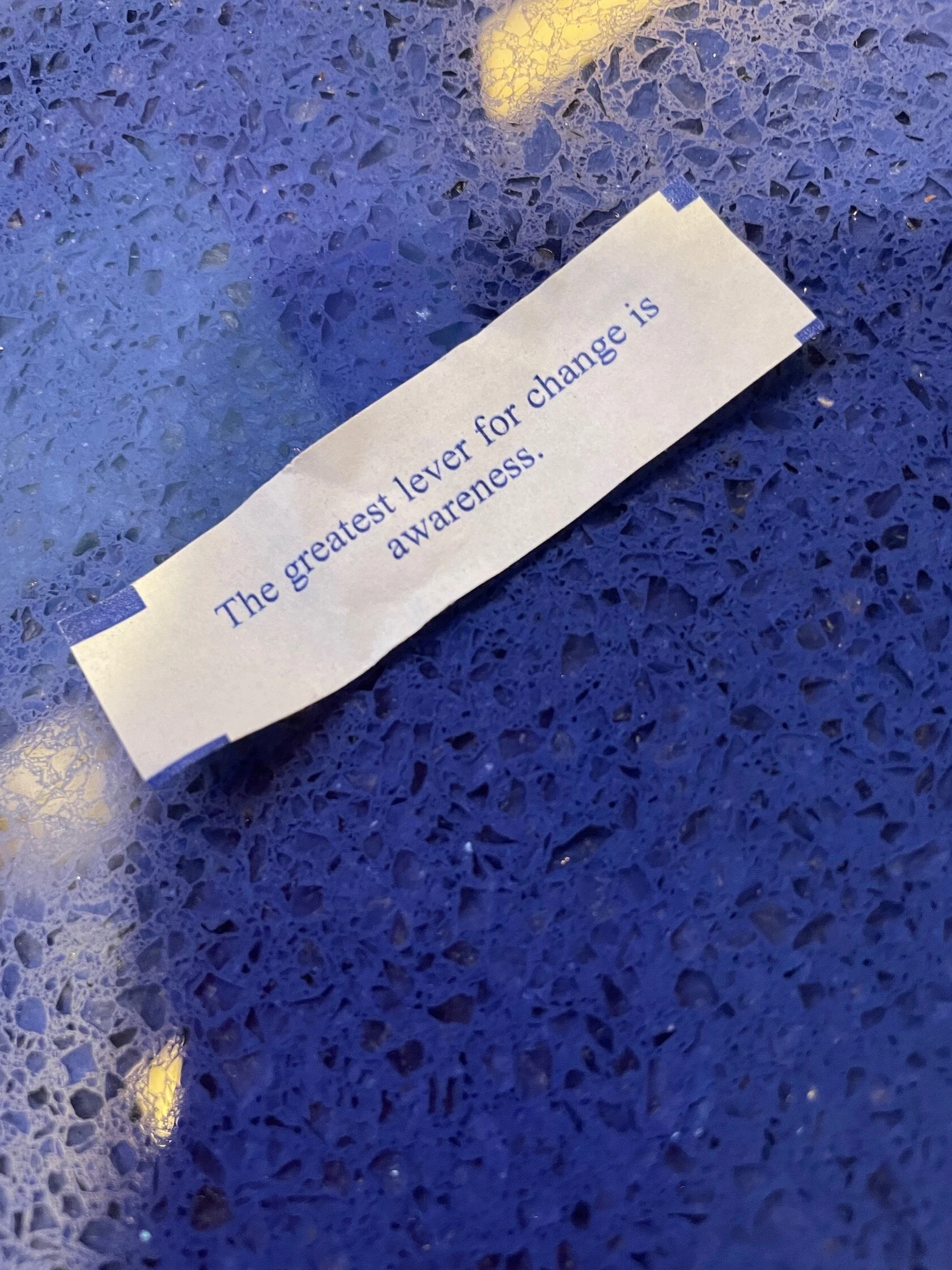
The greatest lever for change is awareness.
— Fortune cookie


A Wow Moment

“The greatest lever for change is awareness.” - Fortune cookie

Let’s savor that one. “The greatest lever for change is awareness.”  How can we change if we don’t know what we want to pursue, what challenge needs solving, or the next step? The changes we pursue begin with awareness. Noticing might be subtle at first. It could be a rumble, inkling, or a feeling. It could show up as frustration, like the challenge of getting dressed when closets are overflowing and disorganized. Maybe you feel overwhelmed and stressed because your schedule is filled with so many commitments that you have no time to breathe. Change is only possible when you notice and become aware. Change begins there.


Master Awareness Skills

We are constantly scanning our day, using cues to transition, change, and maintain habits. We wake in the morning as the sun rises. The daylight cues us to begin the day. We feel a twinge in our stomach, which indicates it’s time to eat something. We see the snow falling, which clues us that shoveling-time is coming. We see the sun setting and know workday wrap-up is close. We walk in the door and see the bowl, which reminds us to drop our keys in their ‘home.’ All of these things are tied to awareness. Change begins by noticing a distinct cue or indicator. 

Change begins by noticing a distinct cue or indicator.
— Linda Samuels, CPO-CD®, CVPO

Our awareness increases our readiness for change. As you pay attention to the cues to maintain your habits or transition from one part of the day to the next, you develop your awareness skills. Your noticing abilities are available to help you discover the indicators, which will encourage change.

Have you experienced rumblings that might indicate it is time for a change? What have you noticed? What change are you ready to make? I’d love to hear your thoughts. I invite you to join the conversation.


How to Embrace a Fresh Start After Feeling Upset by Your Break in Continuity

Have you ever tried to create a new habit or behavior? Altering your habit cue will encourage a different result. For example, if you want to stop losing your keys, you can put a small bowl in a landing spot to catch your keys when you enter your home. The bowl becomes your new cue and helps to change your habit. No more misplaced keys because you have established a specific home where you will always find them. This sounds good, right? What happens when you successfully put your keys in the bowl for days, even months, and then one time you forget to do it? You frantically hunt for your misplaced keys and berate yourself for losing them. How do you bounce back from there? Do you give up? Do you engage in negative self-talk? Will you embrace a fresh start even after your break in continuity?

Recently, I had an upsetting experience with one of my habits. I’ve been practicing mindfulness meditation for four years. I’ve meditated almost daily with a gap here and there. For a while now, Insight Timer has been my favorite meditation app. Aside from the app offering diverse meditations and teachers to choose from, it also tracks my activity. So I know how many consecutive days I’ve meditated. To help keep me committed to my practice, I also use a daily repeat on my to-do list that cues me. 

So what happened? I intentionally deviated from my normal morning routine, including mindfulness meditation, so I could make a special birthday breakfast for my husband. My plan was to meditate later that day or at bedtime. However, the day got away from me for various reasons, and before I realized it, it was past midnight. I missed my practice that day. I’ve missed meditation practice a day or two at other times, so why was I so upset? I mentioned before that Insight Timer tracks my activity. Up until the other day, I had 390 consecutive days of practice. By missing that single day, the consecutive days counter restarted. I was so disappointed in myself. How could I have missed a day? The negative self-talk was quite insistent. And then something happened. I asked, “What lesson can I learn?” I wanted to shift my unhelpful thinking to a more positive, growth-oriented mindset.

What lesson can I learn?
— Linda Samuels, CPO-CD®, CVPO

3 Lessons Learned From My Break in Continuity

1. It’s just a number.

Seeing the consecutive days’ number increase after each meditation gives me a motivation boost. But the reason I meditate has nothing to do with the number. I meditate to feel calmer, provide quiet space, practice focus, shift attention, and be more mindful. None of those things have anything to do with a number. I don’t meditate for the gold star or days tracked by the app. However, by missing one practice, I recognized how reliant I had become on the tracker, which wasn’t healthy.

What I know is that the more I practice, the better I feel, and the more I’m able to regulate my emotions. The 390 consecutive days I practiced aren’t lost. And the meditations ahead will continue to be helpful. I reminded myself to use the tracking if it helps, but recognizing it only represents a tiny part of the entire story. 


2. Understand the “what-the-hell effect.”

I recently attended a meeting with fellow Executive Mom Nest Advisor, Monica Moore, a health and fertility coach. She talked about habit change and how certain actions can derail us. Monica described the “what-the-hell effect,” a term behavioral scientists use. It’s a feeling of shame we can experience when we mess up and deviate from a habit we’ve established. For example, let’s say you committed to not eating ice cream. You successfully eliminated it from your diet. Then one day, you eat a small spoonful. Instead of stopping there, you down the entire pint thinking, “I already screwed- up, so I might as well keep going.” 

This made me think about missing my morning meditation practice. I could have gone down the “what-the-hell” path. But I rejected the ‘all or nothing’ thinking. Yes, I made one sidestep that I was unhappy about. However, I stepped back in the following day, practiced, and gifted myself a fresh start.


3. When all else fails, let go.

I woke up to face the Insight Timer app. After my morning meditation, I knew that the consecutive days displayed wouldn’t increase to 391 but would revert to just 1. Ouch. My berating began again, which wasn’t helpful. I wanted to reframe my negative thoughts. I selected one of my favorite practices, Letting Go Meditation, guided by Annemaree Rowley. Before the meditation ended, she read a poem by Erin Hanson. I love the last line, “. . . not everything you ever lose, is bound to be a loss.” How true that is. I lost consecutive day 391. However, in doing so, I strengthened my commitment to my practice, remembered my why, and let go of the negative self-talk. 

. . . not everything you ever lose, is bound to be a loss.
— Erin Hanson

Is it possible to embrace a fresh start, especially when your habit or goal get derailed? You always have the opportunity to begin again. When you go off course, what helps you move forward? I’d love to hear your thoughts. I invite you to join the conversation.