Posts in Too Much Clutter
How Celebrating Clutter Can Make Surprising and Heart-Warming Outcomes

Have you ever considered celebrating clutter? Most people don’t think about it that way. We often view clutter as an overabundance of things, thoughts, or time that prevents us from living in the ways we value most.

The idea of celebrating clutter might almost seem like an oxymoron. More often, clutter feels like a burden, which can be overwhelming or paralyzing. It gets in the way and blocks forward movement.

Perhaps a better word choice is honoring instead of celebrating. What becomes possible when you approach clutter in this way? I will share a story with you to illustrate how this idea originated.


The Origin Story for Celebrating Clutter

Recently, I reread a post I wrote fifteen years ago, “As Sure as a Crocus.” Surprisingly, I found a comment (also from then) that I had never seen or responded to. I’m unsure how I missed it because I usually respond to all comments.

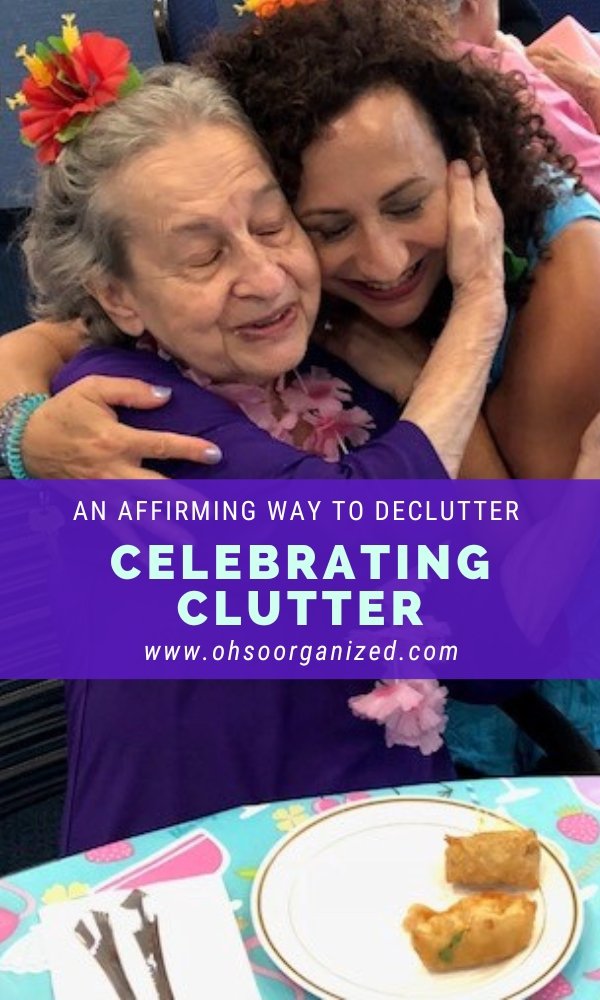
This message was especially poignant and heart-warming because it came from my mom, who has passed away. Seeing her signature made me smile, as she signed it with a secret name I knew was hers.

The timing of reading her words was significant for me. It was in March, the anniversary month of her birth and death. She’s been gone for four years, and I miss her terribly. As I read Mom’s sweet note of support, encouragement, and gratitude, I deeply and immediately felt her love and our connection, transcending the constructs of time and space.

How does this connect to celebrating clutter?


Why Celebrate Clutter?

Addressing the clutter in your life can be approached in many ways. One strategy is to identify and release those things that no longer belong, serve a purpose, or align with who you are now. From there, you can focus on organizing the “keepers.”

Another approach is to find the treasures and keepers first. After that step, edit those things you want to let go of.

With both strategies, you will undoubtedly make discoveries. You’ll find letters from loved ones now gone, notes with great ideas to pursue one day, children’s art, old photos, vacation memorabilia, or materials from previous careers.

These findings can evoke a range of emotions as they highlight and represent different stages and aspects of your life.

Celebrating clutter can enhance the decluttering process in several ways by gifting yourself time to:

  • Revisit and appreciate the items you’re releasing.

  • Enjoy and review some of the “treasures.”

  • Celebrate with a dance, high-fives, or cheers after a decluttering session.


Celebrating clutter can enhance the decluttering process.
— Linda Samuels, CPO-CD®, CVOP™

How Does Clutter Affect You?

Decluttering can be energizing or exhausting, depending on your mindset and situation. Approaching it with a celebratory perspective can transform your experience and make it more positive and affirming.

What is your relationship to clutter? What could celebrating clutter look like for you? I’d love to hear your thoughts. I invite you to join the conversation.


How Can I Help?

Do you want support organizing, editing, or decluttering? I’d love to help! Virtual organizing is an extraordinary path forward – Local feel with a global reach.

Please schedule a Discovery Call, email me at linda@ohsorganized.com, or call 914-271-5673. Living clutter-free is possible, especially with support.


7 Inspiring Resources to Quickly Motivate You to Declutter Now

If you have a little clutter, a lot, or somewhere in between, you can benefit from editing and letting go. What happens when you hold onto things that no longer serve you? What results when your ‘stuff’ takes up too much physical, emotional, or energetic space?

Clutter can intensify feelings of:

  • Overwhelm

  • Anxiety

  • Stress

  • Frustration

  • Hopelessness

It can significantly affect your daily life, sense of agency, self-esteem, and energy.

The good news is that you can change your relationship with clutter and live with more ease. I’ve compiled a list of seven resources to help motivate you to declutter. From simple questions to client-inspired experiences to advice from experts, you’ll find what you need to support your decluttering journey.


Seven Resources to Motivate Decluttering

1. Commitment – Is Decluttering Worth It?

Let’s face it. Decluttering takes effort and time, and you might feel you have a limited supply of both. Ciéra Cree interviewed me for the Livingetc article, “Is Decluttering Worth It? Experts Say Yes – and Highlight Why a Clutter-Free Space Feels So Good.”

Only you can decide if decluttering is worth it. As shared in the article, “Countless clients of mine have experienced the positive effects of decluttering their space…they feel relief, as if a weight has been lifted. They are more energetic, productive, and optimistic about their space.”


2. Well-Being – What is Clutter’s Impact on Mental Health?

Clutter can negatively affect your mental health and well-being. If you are looking for several valuable resources that dive into the impact of clutter on your life and some helpful tools, check out my article, “One Excellent Tool to Assess Clutter’s Impact on Your Mental Health.”

The article includes links to my interviews with Melissa Tracey for

  • “How Clutter Creates Stress and Anxiety: Strategies for Decluttering” – Houselogic article

  • “You’ll Never Look at Your Home’s Clutter the Same” - The Housing Muse podcast


3. Observation – Does Clutter Blindness Affect You?

How can you declutter if you are clutter blind? Ciéra Cree interviewed me for the Apartment Therapy article, “4 Signs You May Be Struggling with ‘Clutter Blindness’ – And How to Fix It for Good.”

I defined clutter blindness as “the experience of having clutter in your life that you no longer see.”

Cultivate curiosity by developing awareness of clutter by purposefully noticing what’s around you. Focus on heightening your awareness. This will “help shift your internal perspective as well as your actual view of the physical clutter.”


4. Motivation – What Are the Top Reasons That Motivate Decluttering?

Significant life events can make the decluttering process easier and faster. This is because the reasons to declutter are clear. Decision-making goes more quickly and less stressfully because your choices are aligned with your goal.

The five top decluttering motivators are:

  • Moving – Downsizing, upsizing, or right-sizing

  • Cycling – Revolving door stage when kids leave and return home frequently during the college years and beyond

  • Surprising – Experiencing extreme weather events that damage possessions

  • Ending – Handling deceased loved one’s possessions

  • Stabilizing – Adjusting the environment to accommodate unanticipated medical or mental health conditions

To learn more, read my post, 5 Strong Motivation Reasons to Get Rid of Your Clutter.”


Significant life events can make the decluttering process easier and faster.
— Linda Samuels, CPO-CD®, CVOP™

5. Distress – What to Do First When Overwhelmed by Clutter?

Does clutter overwhelm you? If so, you’re not alone. You will love this resource if you’re curious about excellent first-step strategies.

Caroline Bologna recently interviewed me for the HuffPost piece, “The First Thing Professional Organizers Do When They’re Feeling Overwhelmed by Mess.”

There are many practical approaches. I prefer to change my internal state first to gain control so that I can more calmly and easily alter the external state, the clutter. You can achieve this by taking several slow, deep breaths. Then, shift your thoughts to more proactive and positive messages.


6. Solutions – Where Are the Best Tips for Decluttering and Organizing?

For over thirty years, I’ve been helping clients declutter and organize. Fast-forward to 2009 when I started blogging about organizing and life balance.

The categories I write about include clutter, letting go, virtual organizing, mindfulness, parenting, motivation, change, and more. Use the Browse the Blog feature or the search icon to learn more about a specific topic that interests you.

Many excellent organizing blogs are great resources for tips and strategies. Each blog has a distinct focus and personality. Feedspot recently featured its favorite organizing blogs on two lists, and I was thrilled to be included.

They are:


7. Progress – How Can the Decluttering Process be Simplified?

One of my favorite creatives and authors, Todd Henry, shared an excellent question in his book, Daily Creative. While he didn’t pose the question specifically for clutter challenges, I thought it could be effectively used in that context.

Todd asked,

“What’s the very next thing I need to do to make any kind of progress?”

I appreciate three aspects about this question and why it’s so powerful. They are:

  • The emphasis is on “the very next thing.” This implies not worrying about the entirety of your goal but instead reducing the scope to take one small next step at a time.

  • The qualifier “any” encourages you to start decluttering wherever you choose.

  • Including “progress” focuses your effort on moving forward rather than on perfection or completion. A progress pursuit is easier to measure, reduces overwhelm, and boosts motivation.


What Motivates Decluttering?

Is clutter challenging for you? What are your go-to resources that motivate you to declutter?  I’d love to hear your thoughts. I invite you to join the conversation.


How Can I Help?

Do you want support organizing, editing, or decluttering? I’d love to help! Virtual organizing is an extraordinary path forward – Local feel with a global reach.

Please schedule a Discovery Call, email me at linda@ohsorganized.com, or call 914-271-5673. Living clutter-free is possible, especially with support.


What Does Your Clutter Feel Like? One Client Shares Insights

When you think about clutter, do you consider how it makes you feel? In the thirty-plus years I’ve been a Professional Organizer, I’ve seen first-hand the array of emotions and effects of clutter on individuals, families, relationships, households, work, and other environments.

Clutter can keep you stuck, and releasing it can have positive, long-lasting effects on your life. One of my clients shared unique insights about the effect clutter has on her. You’ll learn more about it soon. Before diving deeper into her discoveries, let’s look at how clutter can negatively or positively affect you.

NEGATIVE EFFECTS Clutter Can Cause:


Positive Effects Reduction of Clutter Can Foster:


One Client’s Experience of Clutter

As mentioned above, one of my clients recently shared her profound clutter experience with me during a virtual organizing session. She gave me permission to share it with you. She said,

“Clutter creates chronic inflammation.”

I asked her to tell me more about her perspective on clutter. She elaborated and described how . . .

  • Chronic inflammation is a physical unpleasantness.

  • It feels like an embodied experience.

  • It’s physiological.

  • A cluttered environment makes her feel agitated and angry.

  • Any action taken to clear surfaces in her visual field reduces chronic inflammation.

  • Even tiny decluttering acts immediately solve chronic inflammation.

My client’s description of chronic inflammation caused by clutter describes the physiological connection clutter can have. While the term chronic inflammation was new to me, I’ve often heard clients describe the weightiness of clutter. They explain when clutter is released, it feels like “a weight has been lifted.” This is another example of the potential physiological and psychological effects clutter can have.

Do you know someone who has experienced clutter this way? What feelings and sensations arose?

Clutter creates chronic inflammation.
— Oh, So Organized! Client

How Clutter Feels – A Podcast

Last week, I wrote about clutter’s impact on mental health and well-being. I included links to the interviews by journalist and podcast host Melissa Tracey, who featured me in a Houselogic article and her Housing Muse podcast.

During the podcast, we discussed the relationship between home clutter and its effect on mental health. You can listen below to episode 50: You’ll Never Look at Your Home’s Clutter the Same.

How does clutter make you feel? When you release clutter, what changes do you notice? I’d love to hear your thoughts. I invite you to join the conversation.

If you are struggling with the weight of clutter, enlist help. Reach out and email me, Linda, at linda@ohsorganized.com, call 914-271-5673, or schedule a Discovery Call. A clutter-free life is possible, especially with support.


One Excellent Tool to Assess Clutter's Impact on Your Mental Health

Have you wondered how clutter affects your mental health and well-being? As a Professional Organizer for over 30 years who works with individuals challenged by disorganization, I have seen firsthand how clutter can negatively impact behaviors, self-esteem, and mental health. I’m about to share an insightful tool for assessing the impact of clutter on your life.

Recently, Melissa Tracey interviewed me for the Houselogic article, How Clutter Creates Stress and Anxiety: Strategies for Decluttering, and a podcast for The Housing Muse about the relationship between home clutter and its effect on mental health.

Many of my clients have mental health conditions, including anxiety, depression, and OCD. Clutter can worsen issues by increasing feelings of stress, anxiety, sadness, frustration, and overwhelm. While professional organizers can help with specific strategies to reduce clutter and increase organization, having the support of a mental health professional can be essential.


Mental Health Awareness Month

May is Mental Health Awareness Month. It began in 1949 to reduce the stigma around mental health conditions and provide awareness, support, and resources. The World Health Organization states:

  • 1 in every 8 people, or 970 million people in the world, live with a mental disorder

  • Anxiety and depressive disorders are the most common

  • Mental disorders involve significant disturbances in thinking, emotional regulation, or behavior

  • Most people do not have access to adequate care

Contact the National Alliance on Mental Illness (NAMI) for information, helplines, and support.


Self-Assessment Clutter Tool

The Clutter Quality of Life Scale (CQLS) was developed by Dr. Catherine Roster, Associate Professor at Anderson School of Management at the University of New Mexico, with help from volunteers from the Institute for Challenging Disorganization (ICD). Catherine is a dynamo, and I had the privilege of working with her on the ICD Board.

The CQLS is a self-assessment tool “designed to measure inward, or subjective, consequences of clutter from the individual’s perspective.” Clutter is defined as “an overabundance of possessions.”

The CQLS scale contains 18 statements about clutter, which a person rates from 1 = strongly disagree and 7 = strongly agree.” These statements reflect the level of negative consequences clutter has on four areas: your relationships, personal finances, the livability or functionality of your home and space, and feelings of anxiety, guilt, and depression. Here are a few examples from the assessment:

  • Social impact: “I avoid having people come to my house because of the clutter.”

  • Livability impact: “I have to be careful when walking through my home in order to avoid tripping over objects.”

  • Financial impact: “I often buy things I already have because I don’t know where things are in my home.”

  • Emotional impact: “I feel depressed by the clutter in my home.”

Click on the link to take the CQLS assessment.

I feel depressed by the clutter in my home.
— The Clutter Quality of Life Scale


Personal Impact of Clutter on Mental Health and Well-Being

Clutter shows up in many ways and can negatively affect your mental health and well-being. Here are a few examples of what you might experience:

  • Your sink is always full of dishes, which makes it difficult to cook and eat nutritiously. It also affects your energy and health.

  • Your bed is cluttered with clothing waiting to be cleaned or put away. You’re been unable to sleep there for weeks. As a result, your anxiety increases as your lack of sleep, energy levels, decision-making abilities, and mood suffer.

  • Your papers are in piles on your kitchen counter. You can’t find the bill you know is due tomorrow. Your anxiety increases as you search for the bill. Hours later, you discover it buried in a pile in another room.

Have you noticed ways clutter affects mental health and well-being? I’d love to hear your thoughts. I invite you to join the conversation.

If you are struggling with clutter and mental health issues, don’t go it alone. Get the support you need from a Professional Organizer like me and a mental health provider.

Reach out and email me, Linda, at linda@ohsorganized.com, call 914-271-5673, or schedule a Discovery Call. Decluttering is possible, especially with support.