5 Big Surprises About Professional Organizers & The Things They Collect

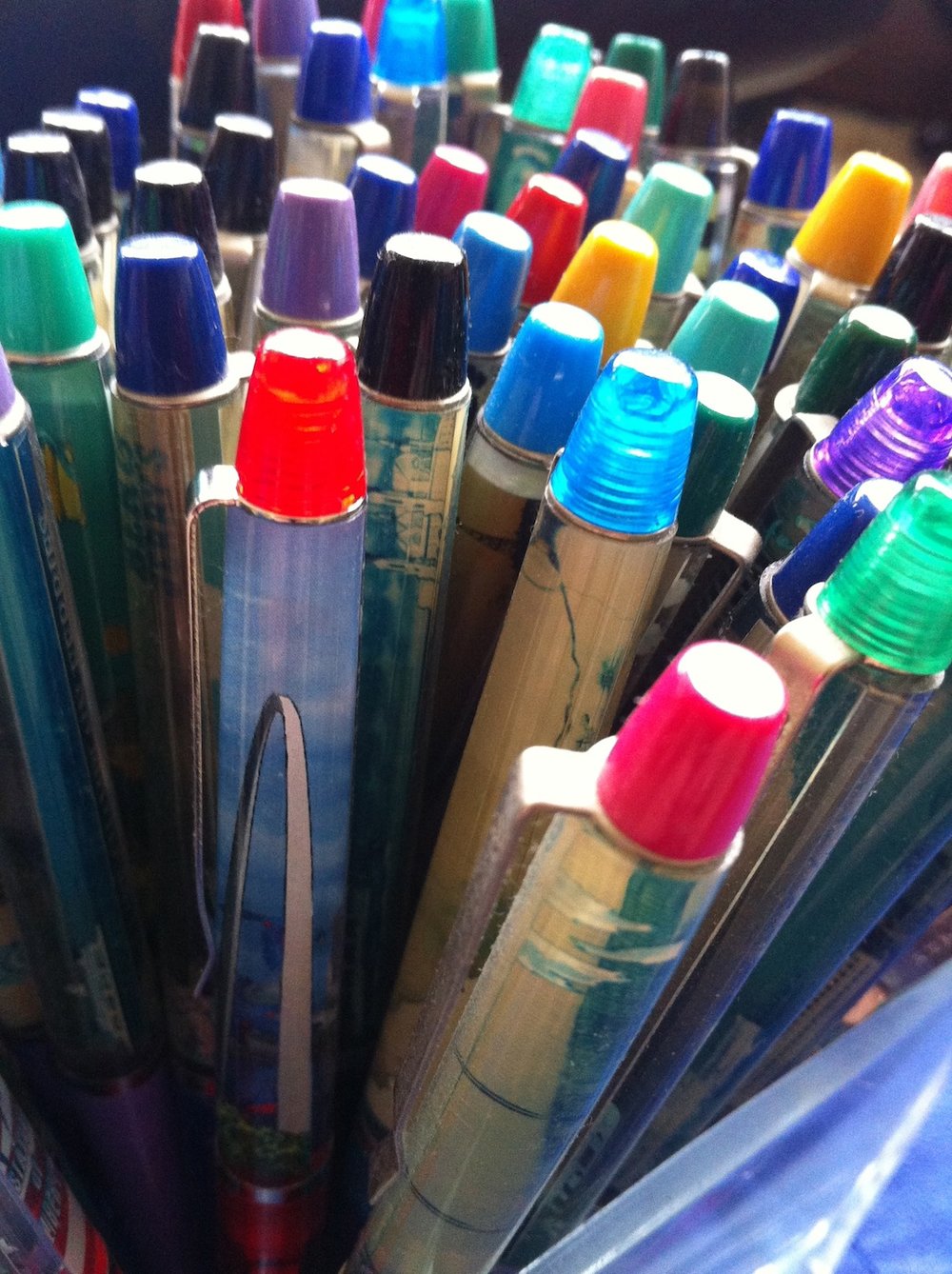
It may surprise you that many organizers are also collectors. I’m one of them. I collect many things, including Pez dispensers, cobalt blue glass, trinkets, floating pens, sparkly things, and beautiful Pinterest images. I no longer collect rocks, cat-related objects, pins, or leotards. Tastes change. Focus changes. Letting go happens.

I was interested in learning more about organizers’ collections, the influence they had on their organizing work, and issues related to letting go. To gain a deeper understanding, I reached out to several of my colleagues, including Janine Adams, Ruthann Betz-Essinger, Nancy Borg, and Karen Fulks. They shared a range of perspectives on the “stuff” of life, including collecting, managing, and letting go of it.

My deepest gratitude goes to each of them for sharing their experiences of collecting and letting go with us. Keep reading for some insights about the path of our possessions.

I asked my colleagues . . . 

  • What do you collect?

  • How has your organizing work influenced your collecting habits?

  • What letting go challenges have you experienced with your collections?

Contained Collections

“When I was in my twenties, I traveled internationally for my work, and I started collecting fountain pens, which were abundant and affordable in other countries. I added to the collection for a few years, and when I stopped traveling so much, I stopped collecting.

The collection lives in a fishing tackle box in the basement. Today, I literally had to dust off the box before opening it (for the first time in probably 20 years), and inside I found 43 neatly stored fountain pens. 

The organizer in me just had to consider letting go of the collection: I certainly don’t use these pens. Heck, I don’t even think about the collection. But looking at the pens, they bring back memories of my travels and, yes, of my youth. Should I let them go? Perhaps. Are they worth enough to sell? I have no idea, but it’s conceivable. Will I sell them? I sincerely doubt it, unless I find myself with a whole lot of time on my hands.

For now, I have plenty of room to store this small, contained collection. Perhaps I’ll give the pens away to a fountain-pen-loving young person one day. In the meantime, I appreciate the opportunity to reacquaint myself with these lovely pens!”

Janine Adams, CPO®, CPO-CD® – Professional Organizer, Blogger, Speaker & Blogger

Useful Collections

“I collect books and anything with Vera Bradley’s name on it.  Since becoming an organizer I have learned that the best collections need to be visible and/or useful. What is the point of something that is unseen or not used? Today, I give away any fiction books I have read, either to a friend or a library. I have also started buying more e-books.  My Vera Bradley collection is a little trickier, but I do rotate my purses and totes on a monthly basis. If I don’t use something within the year, it’s gone. I limit the number of Vera items to the volume of the storage container in which they are kept. Letting go is hard but the more you practice, the easier it gets. Also, knowing that another person might get the same thrill over an item that once thrilled you, makes it easier to give up.”

Ruthann Betz-Essinger, CPO®, MBA – Business & Residential Organizer & Speaker

Memories-Inspired Collections

“When my parents retired and downsized their “giraffe” figurines (both large & small), it was with great sadness that I watched them ‘let go’ of their lifelong collection. It was storytelling at its best. It signified wonderful days gone by and so it felt very heavy-hearted to bid them farewell.

When I married, while I loved the ‘idea’ of starting a collection of something, I understood that interests change and so too would our collections of ‘things.’  I recalled that my parent’s passion had faded though the years, and that those great long-necked treasures had eventually become even greater dust collectors.

35 years later, it is artwork, home décor, and treasured photo albums that fill our home and rekindle memories. We used to collect matchbooks from every restaurant, near and far. Although no longer an active (nor displayed) collection, I still delight in digging into a Ziploc and discover the favorite places that retell our stories.”

Nancy Borg – Professional Organizer & Blogger

Organized Collections

“Fact:  In our house, there are 40+ collections and 10,000 books. Working for years with ‘collectors,’ the easiest way to start with collections is to use the motto of Organizers worldwide: Like with like. And break it down again. For my/our obsessions: alphabetize books, put found money in by date, vintage knit potholders on kitchen walls, group cigar boxes by size, etc. But...snowglobes, the largest collection? After building narrow shelf units, groups formed – states, countries, animals, strange. The collection grew, as did the groups. We moved recently, (ok, 7 years ago), were undecided as to location, so all went to the attic and haven’t been looked at until…today, writing this – yep, still in attic, still undecided, and most fairly intact. I pretend I’m my client. I loved these unique snowglobes. Ha! Past tense & there’s my answer. Easy? No, but if I take pictures, I won’t have to dust them.”

Karen Fulks – Professional Organizer since 1984 & Collector since 1951

Passion, control, loss, and inquisitiveness reside in these stories. We experience unusual relationships to our objects and collections. How do we decide what to keep and what to let go of? Our “things” can have a unique hold on us, and therefore, we create parameters and boundaries around them. These come in both physical and emotional forms, such as fitting them into a specific container or questioning the value of our emotional attachments.

What resonates with you? Are you a collector, or do you know one? How do your attachments to “collected” objects influence your letting go habits? I invite you to share your thoughts about collecting, letting go, and boundaries. Join the conversation!


Lists, Habits, & Next

As I jotted down some notes for today’s post, I realized that literally my next step was just that. Let me explain. The story begins with my trusty electronic “to do” list. I regularly use the 2Do app to help me plan, organize, and manage my action items from tiny “dos” like “Do laundry” or “Buy groceries,” to larger projects such as “Organize 2014 ICD Board Orientation,” or “Plan summer vacation.”

The beauty of 2Do is that I can schedule my action items on certain dates and add customized features like repeating tasks at specific intervals, grouping by type or setting a priority. Once a task is completed, I tap the box to check off the item, a tiny image of a pencil appears, and crosses a line through the words, as in “done!” It’s so satisfying.

This is all background to get to my point. Are you still with me?

One of the things I struggle with is getting enough exercise. I keep telling myself that if I just walked more, a little each day, it would be beneficial for both my mind and body. There’s research to support the health benefit of regular interaction with nature, even if it’s for just five minutes a day. I tried coming up with ideas and incentives to get me up and out, but nothing has worked so far.

Big changes happen with little steps.
— Linda Samuels, CPO-CD®, CVPO

The other day I had an “ah-ha.” As I was organizing and reviewing my “to dos,” I knew that in addition to what was already on the list, I also wanted to take a walk. I needed to feel that spring air. So I wouldn’t conveniently forget, I added, “take a walk” to my list. Guess what happened? I took a walk. 

Was my solution that simple? Apparently, it was. Big changes happen with little steps. The idea of “more exercise” was too daunting for me. However, adding a simple, daily repeat on my “to do” list, wasn’t. This made it doable and measureable.

This one small change will encourage other positive changes. In The Power of Habit, Charles Duhigg writes about keystone habits that if altered can have a positive far-reaching influence on other behaviors. I think in taking a daily walk I’ve identified one of my keystone habits.

What’s next for you? What small step can you take to move you towards your larger goal? What will motivate you to stay committed? I’d love to hear your thoughts. Come join the conversation.

Guess what’s next on my list for today?

Ask the Expert: Todd Henry

Our popular “Ask the Expert” interview series connects you with dynamic industry thought leaders. This year we’ve spoken with psychologist, Dr. Debbie Grove about change and author and minimalist, Joshua Becker about fresh starts. For March, I’m excited to have with us inspiring author, Todd Henry to share his insights about next steps.

I recently finished reading Todd’s latest book, Die Empty, and loved it. He encourages us to live each day purposefully and with more urgency. Die Empty is a must read.  I’m thrilled that Todd was available to join us. My gratitude goes to him for his thought-provoking responses. I know you’re going to enjoy his ideas about next steps. Before we begin, here’s more about him.


Todd Henry is the founder of Accidental Creative, a consultancy that helps people and teams to be prolific, brilliant, and healthy. He teaches companies how to be creative under pressure, collaborate more effectively, and align their activities around the work that matters most. He's also the author of two books, The Accidental Creative and Die Empty, which was named as one of Amazon’s "Best Books of 2013.” You can connect with Todd on Twitter, Facebook or website. 


Linda Samuels:  As an author, speaker, consultant and coach, you inspire individuals and teams to “generate brilliant ideas” and live fulfilled lives. How can we best prepare for “next?”

Todd Henry:  We all face uncertainty daily. It’s a fact of the new marketplace, where most of us are compensated for turning our thoughts into value each day. However, in the face of that uncertainty we are not helplessly at the whim of the workload. We can choose to build practices and structures to help position us to bring our best to what we do each day. Tomorrow’s brilliance is rooted in the soil of today’s activity.


Linda:  What if “next” isn’t obvious?

Todd:  It’s never obvious, or at least the best ideas typically aren’t. That’s why daily practice is so critical. It’s what allows you to problem find, not just problem solve. Those who see patterns, recognize opportunities, and are poised to take advantage of them when they arise are the people who win the future.


Linda:  In your book, Die Empty, you talk about the importance of “making steady, critical progress each day on the projects that matter, in all areas of life.” What is a favorite strategy for moving forward?

Todd:  The most important element of this is defining a through-line, or an outcome that you are committed to. It’s easy to get carried along by the work, or to allow the flow of life to cause you to drift from opportunity to opportunity or project to project, but when you have a specific through-line, or outcome that you are committed to it helps you contextualize all of your daily activities and measure whether they are advancing you toward your overall objectives. It’s amazing how defining what you are about suddenly brings clarity to your priorities.


Linda:  What is your most surprising discovery about figuring out “next?”

Todd:  The most surprising thing is that it’s rarely the “a-ha” that everyone seems to crave. Brilliant insights, innovations, and works of art rarely emerge in a flash of fire, but instead are a smolder over time that eventually grows into a blaze. The key is to be mindful, have practices that help you to ask better questions, and to pay attention for those little hunches, moments of insight, or seemingly irrelevant ideas that could be the foundation for something really big. In many ways, it’s learning how to listen to your inner voice even when it seems to be slightly off-topic.


Linda:  What has been your biggest personal challenge around taking next steps?

Todd:  I tend to have “shiny object syndrome,” meaning that I tend to bounce from exciting new project to exciting new project. As a result, I’ve had to have other people in my life to keep me focused on the results I’m seeking and follow-through on projects until they reach their intended end. Book projects are good for me, because they are a long-arc project with a dedicated end date, and they are easy to work on in “chunks” of thought, so I get to satisfy the wandering attention span while still making steady progress on a long-arc project.


Linda:  Is there anything you’d like to share that I haven’t asked?

Todd:  The most important thing to remember is that today matters. We have a tendency to believe the lie that tells us we’ll always have tomorrow to do today’s work. We don’t. It’s important to spend your finite resources (focus, assets, time, energy) each day in a way you’ll not regret later. Engage with urgency and diligence, because those are the foundation of hustle, and hustle is the best antidote to lifelong regret.


Todd, there are so many gems here. Some ideas that resonate with me include that next often isn’t obvious, ask better questions, listen to your inner voice, enlist the help of others so that you can do your best work, and that “today matters.” What wonderful ideas to contemplate and act on.

Please join Todd and me as we continue the conversation. We’d love to hear your ideas about next steps. What are you thinking about?

Chronic Disorganization & Next

Earlier this year, John Hunt interviewed me for the Smead “Keeping You Organized” series. We talked about chronic disorganization, clutter, and next steps. With winter’s thaw bringing signs of spring, hope, and change, I wanted to highlight some ideas from my conversation with John. You can watch the interview in its entirety at the bottom of this post.

Chronic Disorganization

Disorganization manifests itself in various ways, from mild to severe and from temporary to ongoing. In the early 1990s, organizing pioneer Judith Kolberg noticed that certain clients did not respond well to traditional organizing techniques. She developed the term chronic disorganization to describe this group and was the founder of the National Study Group on Chronic Disorganization (NSGCD). In 2011, NSGCD changed its name to The Institute for Challenging Disorganization (ICD). I’m ICD’s President-Elect, and I will become President on July 1st.  ICD is a 501(c)(3) non-profit association that offers a wealth of education, research, and strategies about chronic disorganization for professionals and the public.

The definition of chronic disorganization

  • Having a history of disorganization

  • Self-help efforts to change have been unsuccessful

  • Disorganization undermines the quality of life

Next Step

After reading the definition of chronic disorganization, maybe you’ve had an “ah-ha” moment and realized that you or someone you know has this challenge. Learning more is a great next step. Download several of ICD’s easy-to-read, free fact sheets.

Favorite ICD Fact Sheets:

  • Are You Chronically Disorganized?

  • Are You Situationally Disorganized?

  • How Do I Find A Professional Organizer That’s Right For Me?          

  • Readiness for Change

  • Tips for Communicating With the Chronically Disorganized

  • Time Management for the Chronically Disorganized

Hope

What I love most about every new season, month, or day is that auto-reset button. The natural cycle allows us to get creative and begin again (even after we’ve failed.) The reset encourages possibilities. Possibilities breed hope. So, if you’re feeling challenged by the organizing piece in your life, remember that change is possible.

  • Learn more

  • Reach out for help

  • Discover ways of organizing that work for you

  • Remain hope-filled

Linda’s Interview About Chronic Disorganization

What’s next for you? Are you or someone you know chronically disorganized? Are you ready for change? Come join the conversation and share your thoughts about disorganization, change and hope.