5 Tips for Ensuring the Best Organizing Help

As a professional who’s been helping people get organized for over 25 years, I’ve learned a few things about working with clients. My goal has always been to provide the best, most personalized service possible so that my clients receive the quality organizing help they deserve. While several factors contribute to delivering this type of service, the overarching theme is effective communication.

As an organizing professional specializing in working with chronically disorganized clients who struggle with the organizing aspect of their lives, my client/organizer relationships tend to span a long period of time. Maintaining an open dialogue is essential.

5 Tips for Ensuring the Best Organizing Help

1. Use Two-Way Street

The best relationships are truly based on a two-way street. While I believe in the client is always right” maxim, there still needs to be open, honest dialogue. It’s essential to clearly discuss the expectations and boundaries of both the client and the organizer. The client-organizer relationship is collaborative in nature, so being clear about needs and expectations will result in better service and more effective organizing help.

2. Accommodate Environmental Preferences

Many of my clients are sensitive to their environments. Sound, light, scent, movement, and temperature can enhance or detract from a productive organizing session.  I’m always watching out for these types of issues, but it’s wonderful when a client lets me know about their preferences. This way, I can be more aware of their needs so that they will have a positive organizing experience. Some of the preferences and requests I’ve encountered have included:

  • Wearing solid, dark colored clothes instead of patterns and bright colors to accommodate visual processing sensitivity

  • Being quiet, not talkative, while working to accommodate attention and focus challenges

  • Playing upbeat music to create a happier mood while organizing

  • Not wearing scented products due to aroma sensitivities

  • Being less active with my body language (as in don't move hands wildly while talking) due to visual processing sensitivity

  • Talking more slowly and loudly due to auditory impairment

  • Adjusting the room temperatures frequently (windows opened or closed, air conditioner on or off, heat up or down) to accommodate body temperature fluctuations

3. Clarify Goals

The more the client invests in communicating and clarifying their organizing goals, the better help they’ll receive. Flexibility is an essential aspect of any project, especially when the projects are multi-faceted. Yet even so, giving some thought to each organizing visit helps to get things moving in a positive direction. There are times when my clients get overwhelmed and aren’t sure what they want to focus on. It’s helpful to take some time at the beginning of the organizing visit to discuss possibilities and to figure out some options together. The clearer clients are about what they want, the better organizing help they’ll receive.

4. Practice Self-Care

I love organizing and particularly helping others to organize. However, not all of my clients approach organizing with the same love and zest. They have the desire for the results, but they don’t necessarily enjoy doing the work to get there. Although I try to keep the atmosphere fun and upbeat, all of the decision-making can be fatiguing for my clients. To get the most out of their sessions, it’s beneficial for them to practice pre-session self-care. This includes showing up well-rested, minimizing distractions (such as kids, email, phones, and pets), and being properly fed and hydrated. Then, during the sessions, knowing when a water, bathroom, or snack break is needed is also important. I watch out for the signs, but it’s great when my clients self-advocate. Then I can better support them.

5. Do Check-Ins

One of the keys to getting the best help possible is to do periodic check-ins with your clients. These can be done before, during, after, or in between organizing sessions. A simple, “How are you doing?” can yield a lot of important feedback. Some clients will readily express what they’re feeling and experiencing, while others need to be drawn out. It’s helpful to do a check-in at the start of a session to set the intentions (goals and timing) for that day. Checking in several times while organizing is important, too. Doing a wrap-up and check-in is also helpful. Touching base between sessions can also be valuable. A check-in provides info-gathering moments that make time for sharing feedback and incorporating needed adjustments. 

Do any of these tips resonate with you? Do you have any you’d like to add to the list? I’d love to hear your thoughts. Join the conversation!


Why Do I Love Helping People Get Organized?
Linda Samuels, CPO-CD®, CVPO™

When I was growing up, my parents used to have conversations with us about our future goals and desires. Their philosophy, which they practiced in addition to preaching, was to follow your passion and do work that you loved. If you did that, it wouldn’t feel like work. I watched both of my parents create successful careers in music and computer graphics that they were passionate about.

As a young adult with my parents’ sage advice deeply instilled, in 1993, launched my organizing services company, Oh, So Organized! The concept was simple. Combine my love of helping people with my organizing abilities to help those that were overwhelmed and challenged by the disorganization in their lives. While I identified organizing as a skill that I was born with, I also recognized that it was teachable skill. For the past 25 years, I’ve had the privilege of working in a field that I’m passionate about.


In the book Wait, What? James Ryan writes . . .

“Luckily for all of us, many people are interested in helping others; some devote their careers and lives to it. Not everyone is so inclined, of course, and most people are self-interested at least some of the time. An evolutionary biologist or psychologist might say that we are always self-interested, and that our effort to help others is simply our attempt to feel good about ourselves.”


I understand Ryan’s perspective, but I view helping others as a win-win scenario. The person needing help receives that help. It’s a win for them. As a result the helper feels good too. A personal win. It’s a positive scenario. The key is giving help that the receiver wants in a compassionate, non-judgmental way. It’s essential to focus on the receiver’s needs and not what we think they need. Being respectful and listening is essential.

Helping others to get organized isn’t just about organizing life’s stuff.
— Linda Samuels, CPO-CD®, CVPO™

Helping others to get organized isn’t just about organizing life’s stuff. It includes clarifying goals, editing the unessential, honing decision-making skills, letting go of the things that no longer support you, changing habits, and setting up viable, organizing systems. The process requires time and patience. It can be messy and emotional. I have such admiration for the way my clients face overwhelm and organizing challenges. They have such determination and never give up. They inspire me every day. I love being part of their journey and feel honored to have their trust. We’ve created a unique reward program for our clients. Click on the link to learn more about our Client Loyalty Program.

If you’re struggling with the disorganization in your life or know someone that is, please reach out for help. You don’t have to go it alone. While I’d love to be that person for you, finding the right fit is important. This is a personal services business. There are several factors to consider. To gain understanding about finding the best person, which includes a series of questions to guide you, read 6 Tips for Hiring a Professional Organizer. The article is an excellent starting point to help you determine your organizing needs and the type of help you want.

Have you enlisted help from an organizer? Are you an organizer who offers help? I’d love to hear more about your experiences. What are your thoughts? Join the conversation!


How to Climb Mountains to Boost Your Motivation

As I’m just back from our summer vacation in Maine, I have to admit that my motivation to jump into regular activities (like writing and working on the next projects) hasn’t quite kicked in yet. Vacation mode of waking up without an alarm, wearing no watch, spending uninterrupted time with my family, and exploring new places continues to permeate my heart and mind.

I don’t know about you, but I like to give myself one full day post-vacation to unpack, do laundry, return calls, go through snail mail and email before resuming my normal pace. As I settle in to write this post, I have a vacation motivation experience I’d like to share with you.

I wouldn’t describe myself as athletic.  It’s not that I don’t enjoy a long walk, swimming or an occasional bike ride, but you won’t find me actively engaged in sports. I prefer gentle exercise and stretching.

How Three Mountains Boosted Motivation

Mohegan Island

During this vacation, there was a lot of exploring. We walked all over. Maine is such a gorgeous place with beautiful seascapes, rocky shores, and wonderfully lush terrain. For those that love to hike, it’s a paradise. Before our children joined us mid-week, my husband and I took an easy hike to the top of Monhegan Island. What a gorgeous, magical place. No cars are allowed on the island. It’s quiet and peaceful with an abundance of wildflowers gracing the hills. If you ever have a chance to travel there, which involves a ferry ride, definitely go.

While I was huffing and puffing a little bit, I made it to the top of the cliff. We sat and enjoyed our lunch. There were amazing views several hundred feet above sea level of blue sky above and water crashing against the shore below. The sun was bright. Sounds of rushing waves and seagulls squawking could be heard. One seagull decided to accompany us for lunch as we sat on the cliff’s edge. I think he was hoping for some scraps.

Cadillac Mountain

A few days later, the family took a trip to Acadia National Park. Our first stop was Cadillac Mountain with breathtaking 360-degree views of Mount Desert Island.  We did some walking off of the path and onto the sides of the cliffs. It was fairly easy, although you had to watch your footing. 

Champlain Mountain

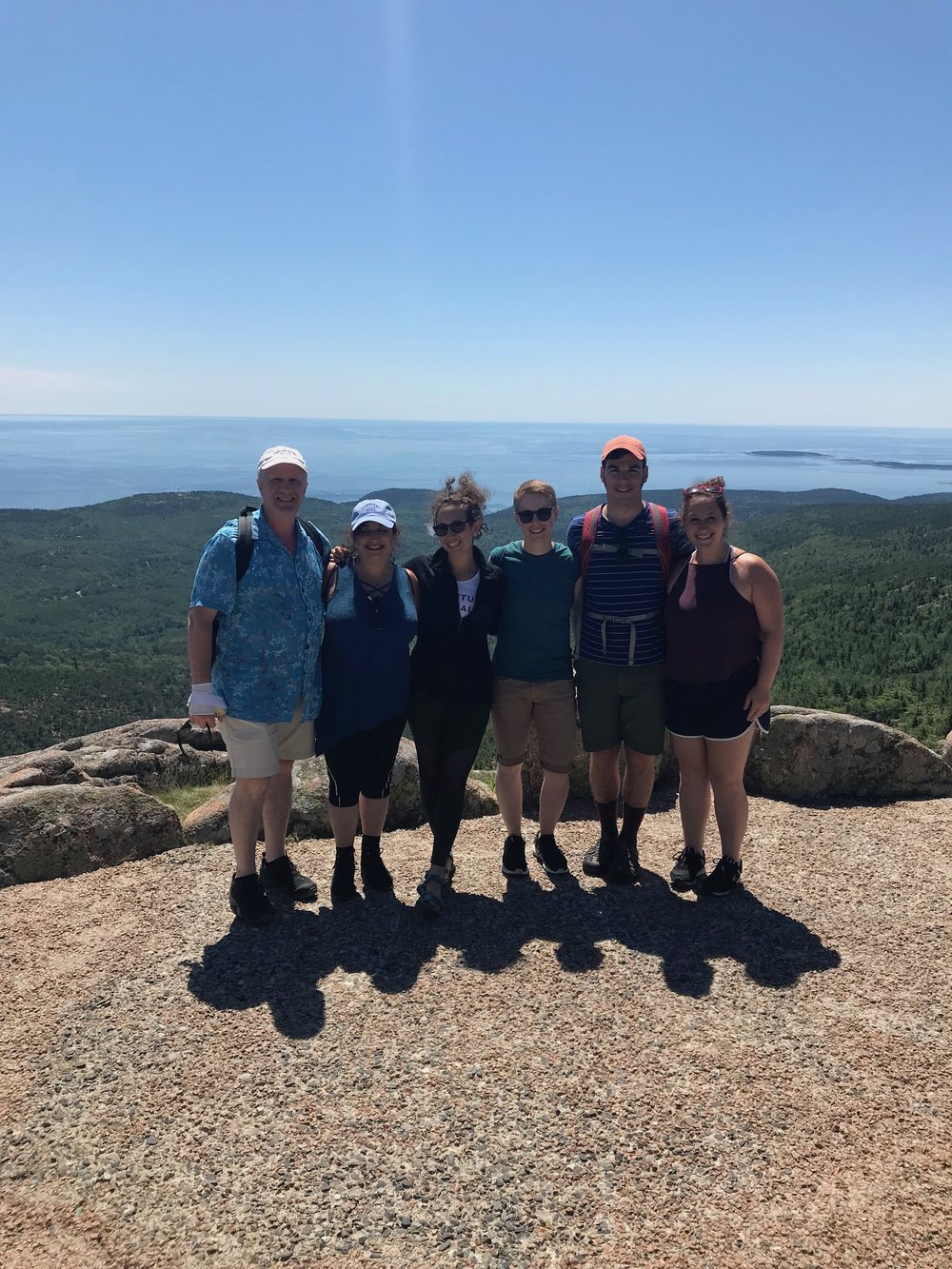
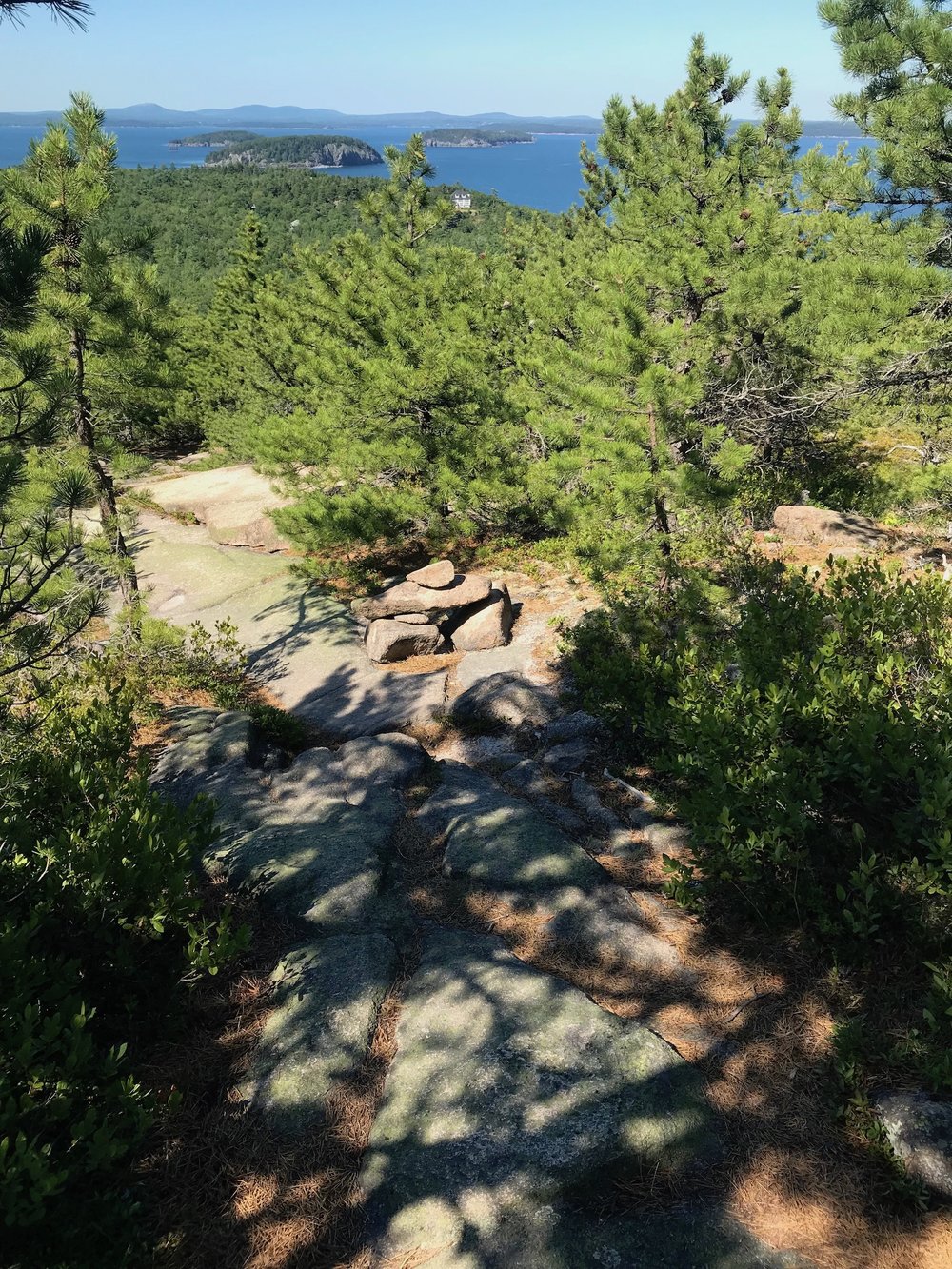
Following that we took a longer hike to the top of Champlain Mountain. It was a 2.2-mile round trip hike, which seemed doable. We thought it was going to be on level ground and relatively easy. None of us realized beforehand that the hike was an uphill climb on uneven paths and involved vertically climbing the rocks at some points. Remember before when I said I wasn’t athletic? So as you might imagine, this was especially challenging for me. Our kids and their partners (30 years younger,) climbed easily and were way ahead of my husband and I. While I kept going, taking short breaks as needed, I was getting physically tired and wasn't sure I could make it to the top. Doubt set in.

Every so often, one of the kids would double back to check on us. Or, they’d call out to encourage us that we were getting close and almost there. At one point, my husband asked me if I wanted to stop and head back down. He knew I was having a hard time. However, I knew I was closer to the top than the bottom. I was determined and motivated to meet the family at the top. The last stretch was especially challenging, as it was almost a straight climb up without shade on sometimes-slippery rocks.

My husband climbed behind me to make sure I was OK. But I was slowing up even more. I asked him to climb in front of me to help give me the visual motivation and pacing that I needed to reach the top. We finally arrived. The kids were waiting and cheered us on.  The views were incredible and well worth the effort. 

So what kept me motivated to keep going?

There were a few things . . .

First there was the accountability piece: people were waiting for me. Secondly, the goal was within reach. It required that I push myself beyond my normal limits to get there. Isn’t that often the case? We’re so close to our goal and then we just give up. Yet when we do push through, it feels exhilarating. Lastly, there was the celebration. The woohooing, cheering and picture taking helped to commemorate the goal. When we’re struggling with motivation, our goal isn’t always so clear. The next time I’m feeling challenged, I’m going to conjure up images of climbing Champlain Mountain along with that wonderful feeling of making it to the top. We often need to reach beyond our comfort zone to arrive at our destination.

Do you have an image or story that you use to help motivate you? I’d love to hear your thoughts. Come join the conversation!


How to Work the Motivation Pendulum to Your Advantage

You never know when inspiration will happen. During a recent conversation at one of the many BBQs I’ve enjoyed so far this summer, the seed ideas for this post began germinating. At the time I didn’t connect the dots to motivation. However, after a good night’s sleep and morning mindfulness practice, an interesting link surfaced that I’m about to share with you. It gave me a new perspective about motivation that I hadn’t fully realized before. I hope it will be useful for you too. 

In the conversation I had with a parent, she shared with me how frustrated and unhappy she was about her high school-aged child being home for the summer with no specific or productive plans. She relayed that her child had promised she would “do things,” but with a few weeks into the summer, her plans were non-existent. The mom didn’t want her daughter sitting around all summer “wasting” her time and doing nothing. From other stories that the mom shared about her daughter, it seemed as though she was regularly busy and engaged in life. But for this particular moment in time, she wasn't motivated to do anything. 

It made me think about the times I’ve worked hard and for prolonged periods on a project. When those projects ended, my energy was depleted. The projects took a lot of sustained motivation to keep going and see them through. Post project, I needed non-pressured downtime to reflect and not do so that I could regroup and gear-up for next.

We live in a time when constant doing is the norm. It’s expected. Only when we’re on vacation or sleeping, do we allow ourselves (guilt-free) to stop and do less. However, I propose that we need these stopping or not doing periods more frequently. Let’s honor the motivation pendulum instead of expecting constant motivation to accomplish and to be busy. Let’s appreciate and respect the value of pausing after those big-push times. 

The amount of activities, assignments, projects, and things that kids (and parents) have to juggle during the school year is immense. It’s no wonder that our children need a break from the intense, frenetic pace. Taking part of or the entire summer to pause can be a great way for our kids to restore their motivation reserves. And the truth is that having the summer off is one of the luxuries of childhood. Unless you’re a teacher, which a few of my friends are, most adults don’t have that opportunity anymore. 

Whether you’re a kid or an adult, allow some downtime after expending sustained energy. Your motivation will return if you allow yourself time to come back to yourself.

What is your experience with the motivation pendulum? I’d love to hear your thoughts. Come join the conversation!