Ask the Expert: April Lane Benson, Ph.D.
Dr. April Lane Benson

Dr. April Lane Benson

The “Ask the Expert” interview series connects you with industry thought leaders. This year we’ve spoken with Leslie Josel about motivation, David Allen about time management, Peter Walsh about clutter, Sheila Delson about letting go, Laura Berman Fortgang about next steps, Judith Kolberg about change, and Sue West about fresh starts. This month I’m thrilled to bring you a dynamo in the field of psychology, Dr. April Lane Benson, to share her insights and experience about enlisting help.

April and I met in 2004 when she spoke at the National Association of Professional Organizers New York chapter (NAPO-NY) meeting about compulsive buying. I became a fan immediately. Since then, I’ve had the pleasure of talking with her and hearing her present many times. She’s straightforward, energetic, compassionate, and the expert on shopping addiction. My deepest thanks goes to April for taking the time to join us. Before we begin, here’s more about her.

April Lane Benson, Ph.D., is a nationally known psychologist specializing in the study and treatment of compulsive buying disorder. She edited I Shop, Therefore I Am: Compulsive Buying and the Search for Self  (2000) and authored To Buy or Not to Buy: Why We Overshop and How to Stop (2008). April recently conducted empirical research on the efficacy of the Stopping Overshopping treatment model; results will be published in early 2014 in the Journal of Groups in Addiction and Recovery.

Linda Samuels:  You are a nationally known psychologist who specializes in the treatment of compulsive buying disorder. What is the tipping point that motivates people to reach out for help?

April Lane Benson:  People reach out for help when their behavior has either become unmanageable to themselves, or poses such a big issue for someone else that the other person insists on it. Overwhelming debt is a big motivator for many; feeling enormously burdened by the lying and secrecy that are often part and parcel of this problem is another trigger. As far as other people’s reactions being the catalyst for the compulsive buyer to get help, these are common scenarios. A couple is trying to get a mortgage and in that process, the debt of one member of the couple is revealed. Family members may find a compulsive buyer’s secret stashes or find a credit card or money has been stolen. There may no longer be any room to navigate at home because of such an overabundance of stuff.

Linda:  What conditions make self-help a viable option?

April: If someone has a history of having been able to utilize self-help resources productively for another behavior or is doing so currently, he or she is a good candidate for self-help. Someone who has one or two individuals who are willing to be very involved in a nuts and bolts way with the compulsive buyer and function as shopping support buddies is another good candidate. Knowing about the availability of self-help resources, books, audiotapes, online support groups, and in-person support groups is also key to making it a viable option.

Linda:  When seeking professional help is the appropriate option, what are some useful questions to find the right fit?

April:

  • Has the provider worked with compulsive buyers before? Approximately how many?

  • What does the treatment consist of?

  • What kind of success rate does the potential provider have?

  • What method or school of thought does the potential provider utilize?

  • How long is the treatment?

  • How much will it cost?

  • Will any other family members be involved?

  • Will the provider collaborate with a professional organizer if the client wishes?

Linda:  As professional organizers we often encounter clients with shopping addictions. What is important for us to understand so that we can best help our clients?

April:  It’s important for organizers to understand that there are sometimes deep psychological issues that are maintaining the compulsive buying behavior and that the emotional underpinnings of the problem need to be understood and worked with alongside the behavioral interventions.  Organizers need to be very clear about their own boundaries and be aware of the differences between organizing, coaching and psychotherapy.

Linda:  What has been your biggest personal challenge around enlisting help?

April:  For many years, I engaged in a self-defeating habit that no one in my life saw as a significant issue. In part because of that feedback and also because of my own ambivalence about change, it took a long time for me to seek professional help.  By the time I did, I was so clear about wanting to change and ready to change that it no longer mattered what anyone else thought.  What a great decision!

Linda:  Is there anything else you’d like to share about seeking help that I haven’t asked?

April:  It’s important that professional organizers know that there’s no shame, and more likely wisdom, in telling the client that some of what he/she needs goes beyond your area of expertise and that you’ll assist him/her in getting help. This is great modeling for the client who needs to know that effective help is available and that it’s a strength, rather than a weakness to ask for it.

Thank you, April for sharing your ideas about enlisting help. You’ve provided many ways to think about getting the type of support that’s needed. I love your list of questions for finding the right type of professional help. Perhaps what I found most encouraging was your perspective that asking for help is a “strength rather than a weakness.” What a great thought to end with.

I invite you to join April and me as we continue the conversation. We’d love to hear your thoughts about enlisting help. What resonates with you?

As a update to this interview, I am devastated to share that April died on March 29, 2021. She was a tremendous and positive force in this world. I will miss our conversations, touch points, her warmth, and energy. Her presence will be sorely missed. While April is gone, her legacy lives on. In 2019, April sold her business to her friend and colleague, Carrie Rattle. She was trained by April and has taken on the important work of helping those struggling with shopping addiction. If you need help, or know someone that does, please reach out to Carrie.

Dreams Need Help, Too
Dreams Need Help Too

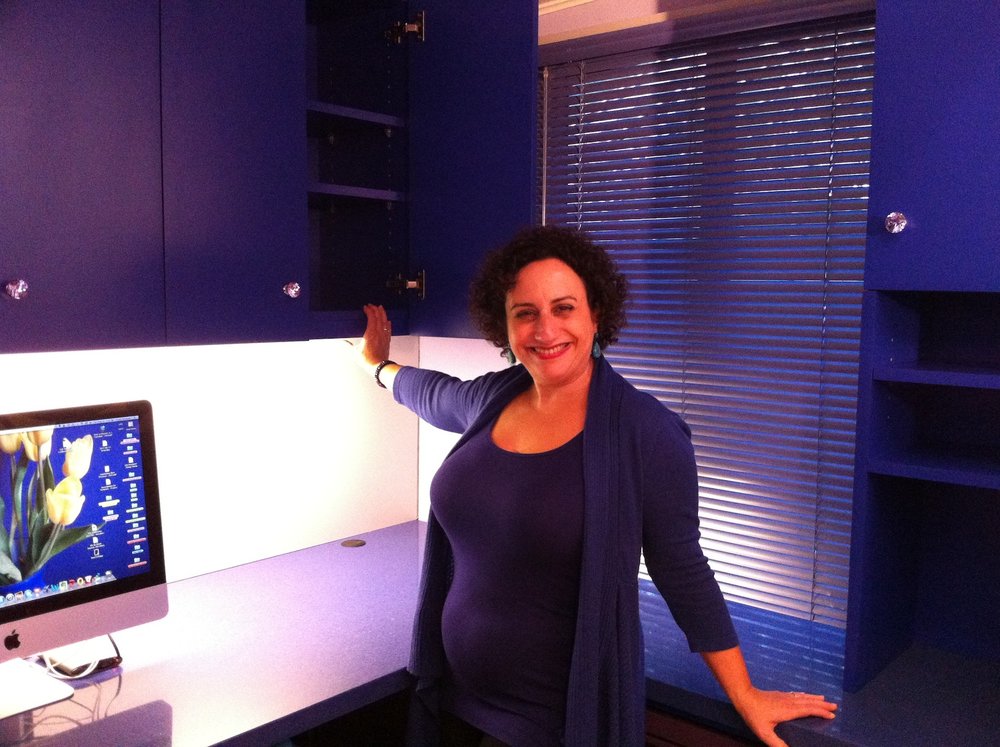
We all have dreams, don’t we? One of mine, which has taken almost a decade to come to fruition, has recently been realized. My office area was transformed from a crazy hodgepodge of furniture into a beautifully designed office space created and organized just for me.

Guess what? It didn’t happen quickly or on its own. I needed lots of help along the way. It was a learning process that required patience, persistence, creativity, and collaboration with others. To all the fellow goal chasers and dream seekers, I'd love to hear your thoughts.

Which “help” tips resonate with you? Who and what has helped you in the pursuit of your dreams? Some things helped me. Read on and then join our conversation.

Dreams Need Help – 8 Tips

1. Dream Help

Having someone to support, expand, mull over, and tweak your dream is essential. We all need at least one dream buddy to share our journey with. My dreaming partner was my wonderful husband, Steve. He encouraged me to own the dream and not limit my thinking.

2. Letting Go Help

In preparation for my new space, I needed to review and edit my office contents. Letting go of some physical items was part of this process. As a professional organizer, I’m good at asking others those classic letting go questions like, “Do you want it?” or When was the last time you used it?” or “Is it worth the real estate, energy, and maintenance?” However, I found it helpful when someone else (such as my husband or daughter) posed the questions to me. Hearing the questions out loud from an objective person helped me become more decisive and enabled me to let go of the unessential.

3. Design Help

Putting specifics to my dream meant I first needed to understand how I wanted my office space to look and feel. Words at the top of the list included purple, sparkly, organized, happy, fun, spacious, and calm.

For visual inspiration, I perused my Pinterest boards (mainly Oh, So Luscious Color!, Oh, So Colorful Spaces!, and Oh, So Organized Office!). My husband listened to my ideas, incorporated them into the design, made the best use of the space, created lovely three-dimensional drawings, and helped me select materials and colors.

When everything was installed, the family agreed it was truly a “Linda space.”

4. Heavy Lifting Help

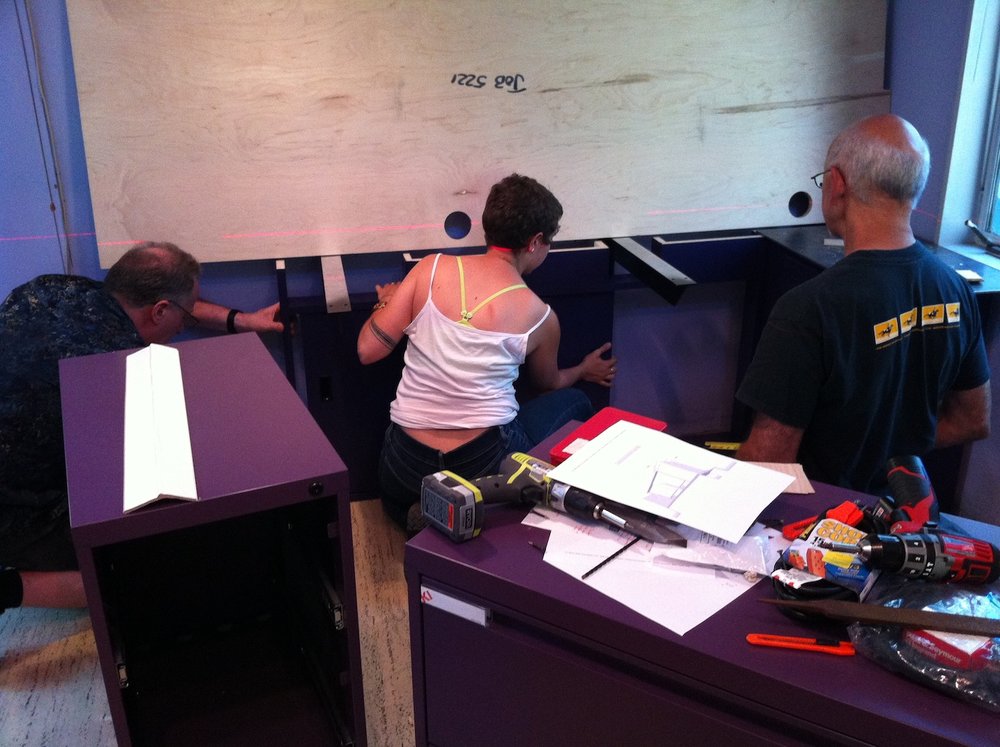
Some dreams require brawn. Mine sure did. I needed physical help with manufacturing, disassembling my office, moving furniture, and installing the new cabinets and countertop. I could not have done this without the muscle team, who included Steve, Nick, Allison, and some talented vendors. Thank you.

5. Patience Help

Patience was mostly an inside job. I had to remind myself that all things worth doing take time. They will and can get done, but adjustments for when they happen will be necessary. It’s the when that can be most trying when pursuing a dream.

6. Discomfort Help

I’m not proud to admit this, but I was extremely out of sorts during the twelve days we had to disassemble my office and temporarily relocate it to the living room. This gave me an entirely new appreciation for what my clients experience regularly. It feels terrible when our environment doesn’t support us.

My living and working areas were in disarray, which made it extremely challenging to function and focus. Fortunately, my family was there to help me navigate being uncomfortable by encouraging a positive perspective and keeping me focused on the goal. My husband gently reminded me, “The chaos will only last a short while.” My daughter, Allison, used a different yet equally effective approach. She said, “Mom, change and chaos are good for you.”

7. Organizing Help

It was joyful being my own client and organizing my new space. Before organizing “stuff” back into the office, I appreciated the emptiness of the space. I felt calm seeing the uncluttered surfaces that had almost no visual noise. As I put things away, I was selective about what deserved a “home.”

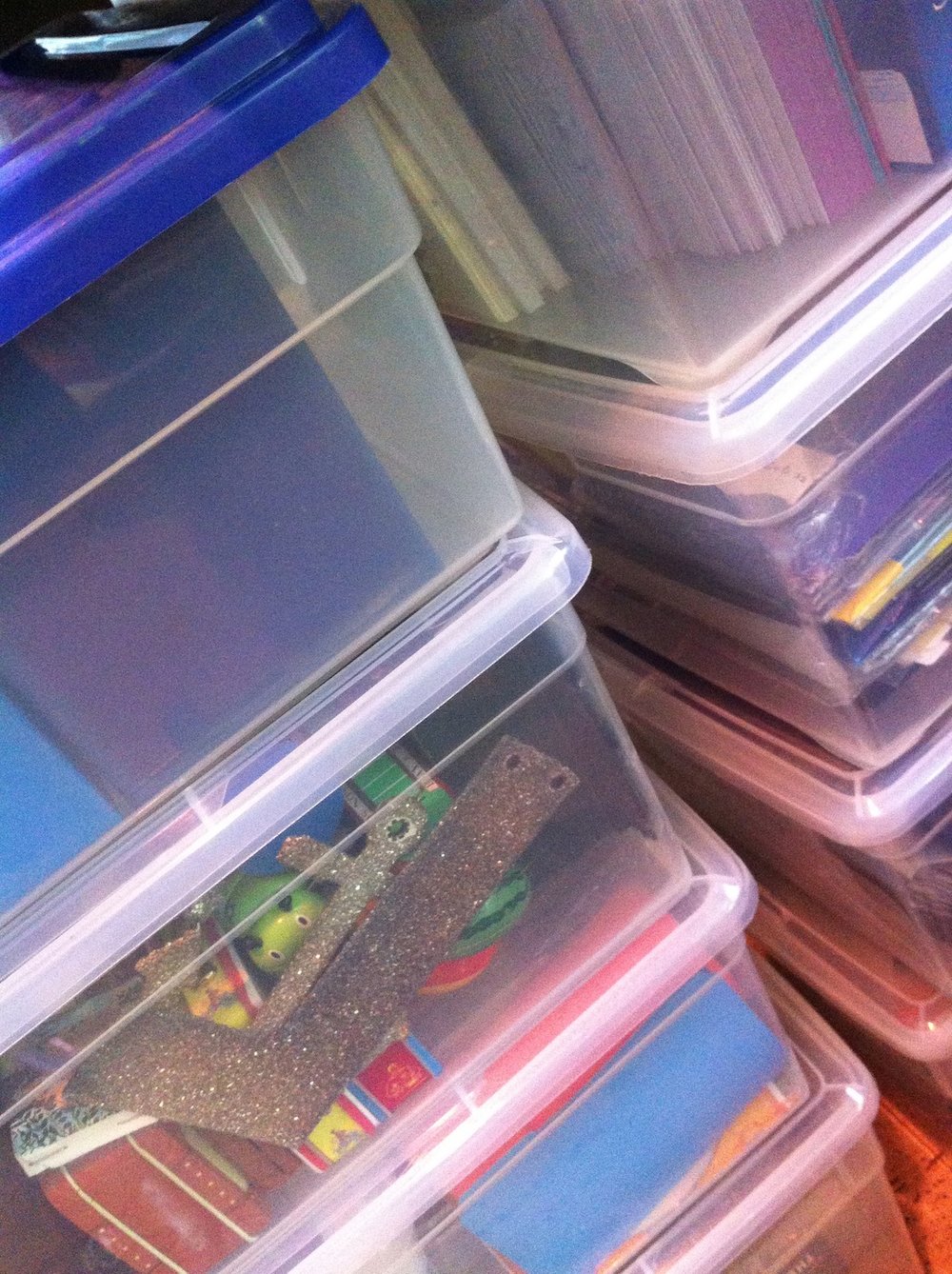
Only what I loved and used most returned. I’m still deciding the fate of the many small toys (imagine a miniature Mr. Potato Head or glitter-covered Eiffel Tower) that have always been part of my office decor. A few toys have returned. Before more come back, I’m waiting to see how the space feels with less.

8. Cheerleading Help

Family and friends provided a great deal of encouragement along the way. The high fives, ooohs, ahhs, and “It’s going to be great!” helped me to stay vision-focused and excited. When it was time to select cabinet knobs, I created a quick survey on Facebook. People weighed in on their favorite knob option. The feedback was wonderful. I am grateful for the many cheerleaders who have supported me along the way. Special heartfelt thanks to Steve, Allison, Cassie, Mom, Yota, Peggy, and Elisa for their extra enthusiasm and support.

My space is no longer just an office. It’s now a well-designed space for possibilities, creativity, problem-solving, thinking, planning, writing, teaching, communicating, and being. Thank you to all those who helped nurture and encourage my dream.

What has your experience been when pursuing a dream? Did you go it alone? Did you enlist help from others? I look forward to hearing your thoughts.


Doing It All Yourself...Or Not!

Do you have a hard time asking for help? Especially for those who are more accustomed to giving than receiving, enlisting help can be particularly challenging. I was curious what my colleagues in various helping professions thought about this idea. I asked Sue West, Kim Oser, Geralin Thomas, Ellen Delap, Andrea Sharb, Helena Alkhas, and Yota Schneider, “What was a benefit you received when you recently enlisted help?” While their responses ranged from general to specific, in each case, the benefit they got was a welcome and unexpected surprise. Their enlisting help discoveries are inspiring and encouraging. My gratitude goes to each of them for making time to reflect and share.


What was a benefit you received when you recently enlisted help? . . .

 Great Collaboration

“Asking for help meant that I couldn’t do it all, yet I wanted to! Time and again, I‘ve been proven wrong. Earlier this year, I was talking with a colleague about wanting to create a time management workshop, but with a different perspective. I was stuck. I was asking for advice, and instead, I got so much more. We created the program together and in record time. We learned from and used respective strengths, e.g., networking for workshop hosts or operational details. For workshop participants, the content was richer, and our interaction brought greater engagement. One question and look at all that’s happened! Yet again!” 

Sue West, COC®, CPO-CD® Certified Organizer Coach & Certified Professional Organizer in Chronic Disorganization


Great Support

“It is so easy to take everything on ourselves but it is not always the best solution. We often get tripped up by our fears and go nowhere. I recently was looking to start using an unfamiliar social media resource. I did some research and then contacted a colleague whose success with this resource I admired. I not only learned ways to use it but her help knocked down the fear and enabled me dive in. It is amazing how much easier life can be and how you can achieve greater success when you just reach out for a little help.”

Kim Oser, CPO® Certified Professional Organizer, Productivity Coach & Blogger


Great Expertise

“Recently, I was contemplating a client-discount for large blocks of time booked with a team of subcontractors. I asked my accountant for ideas on how to approach this and make it a win-win-win for me (the owner of the company), the client, and the sub-contractor.  She immediately did the math and delivered the bottom line:  if/when I discount clients, my subcontractor's percentage of earnings increases while mine decreases unless the sub-contractor decreases her rate as well. That is extremely useful knowledge to have when planning projects, budgets and team members' rates.”

Geralin Thomas, CPO-CD®Instructor & Consultant for New Professional Organizers


Great Partnerships

“Asking for help has always been natural to me with my team player attitude. When you ask for help, you are signaling to others that it’s not only okay to ask, but everyone’s work and life are all the better for it. Others respond and also ask for help as well. Professionally I ask for help in tasks that I am less familiar with, such as technology or software use. I like to be very specific about what help I need and create a timeline that will work for everyone. This strategy has created great partnerships.”

Ellen Delap, CPO®  – Certified Professional Organizer & Family Manager & Productivity Consultant


Great Accountability

“I’ve been considering offering a group coaching course for ADHD adults for well over a year. I even have a number of individuals interested in participating. I noticed recently that I was having trouble moving past the conceptualization phase. I therefore enlisted the help of a fellow coach who I thought would share my enthusiasm for creating and offering this course. The benefit of asking for help in this situation is accountability. Working with someone else and breaking down and assigning tasks needed to get the course rolling is helping me move beyond conceptualization and into realization.”

Andrea Sharb, ACC, CPO-CD®, COC, CPO® Professional Organizer & Certified Coach 


Great Savings

“From the babysitter to the graphic designer I have learned the hard way not to try to do it all. While I'd love to take care of things myself, I realized that I was spending more energy, time and money when I didn't enlist help. I finally listed all the activities that would cost me more, both personally and in my business, if I didn't delegate or outsource. Now, I keep a list of resources (free & paid) that I go to on a regular basis. I am more focused, more productive and more relaxed. My favorite help is the grocery delivery service.”

Helena AlkhasProfessional Organizer & Social Media Virtual Assistant


Great Solace

“I was raised to be self-reliant to a fault. Through life experience, I had to learn the art of asking and receiving. My most recent experience of asking for help was last October when my father was suddenly hospitalized. I traveled to Greece to be with him. He declined within three days of my arrival. I found myself in a decision making position that I wasn't completely prepared for. I had to find the fine balance between asking for what I needed without becoming a burden. I gave up expectations and allowed people to help in small ways that were easy for them but made a huge difference to me. Looking back, I know that it was because of this network of "helping angels" that I was able to maintain my focus, stay centered, and see my Dad through his final journey. I feel blessed and grateful.”

Yota Schneider, Seasons of Change Certified Master Coach – Life Transitions Coach, Workshops & Retreat Facilitator, Blogger, & Mindfulness Meditation Practitioner


Enlisting help is the topic we’ll focus on this month. I love how the stories shared by my colleagues are a great way to begin our dialogue. What resonated with you? Do you easily ask for help or do you tend to do everything yourself? I’d love to hear your thoughts. Come join the conversation and share your thoughts about enlisting help successes, challenges, and ideas.

Motivation & Deadlines

Have you ever experienced a surge in motivation when a deadline is looming? Sometimes we purposely wait until the last minute to finish (or start) projects because we need or want that adrenaline boost.

Each of us functions differently. Usually, my personal pattern and preference is to work regularly over an extended period of time and not feel rushed to complete things. I realize this isn’t always possible or desirable.

With two of my recent projects, motivation and deadlines influenced the process. One project was preparing for my first ICD board meeting as President-Elect. It involved reading several books, reports, and documents, completing forms, having several phone conversations, and reading and responding to emails. Even though I paced myself, some of the work ended up being completed close to the deadline. Delaying completion of last few items gave me the energy push that I needed.

My other project, the redesign of my office area, has been a long process. There has been dreaming, planning, sketching, discussing, and manufacturing. Finally, after many months, the installation will be soon (as in this week!) Months ago, I went through my files and drawers. I let go of things I no longer wanted, so that I’d be ready to reorganize what I did want when my new space was ready.

The next step was more challenging to complete. This involved emptying the drawers, surfaces, and space. I wanted the change, but not the discomfort and disruption that the transition would bring.

So I told myself, “Change is positive. Discomfort is temporary.” Last night my motivation kicked in. I boxed up my desk contents. In the process, I edited and released more things. With my positive focus, visions of “done” and working in a beautiful, organized workspace motivated me to forward.

How do deadlines influence your motivation? I’d love to hear your thoughts. Come join the conversation.