

9 Time Management Dos & Don'ts

9 Time Management Dos & Don'tsWhat are your favorite dos and don’ts for successful time management? I asked this question to a wonderful group of productivity, organizing, and coaching colleagues (Jill Farmer, Laurene Livesey Park, Stacey Vulakh, Janet Barclay, Ellen Delap, Juliet Landau-Pope, Sheila Delson, Yota Schneider, Jane Perdue). Their responses are insightful practical, and doable. My gratitude goes to each of them for making time to reflect and share. If you’re feeling overwhelmed by your lack of time or ability to manage it, I encourage you to keep reading and try some of these terrific time management strategies.


What are your favorite dos and don’ts for successful time management? . . .

1. Do Mindset Shift. Don’t ...

“Take a deep breath and recognize there IS enough time. Telling yourself there's not enough time throws you into ‘flight or flight’ mode, where it's really hard to focus and prioritize. Launching your action from that frenzied not enough space costs you LOTS of time. Instead, tap into the 3 C's—being calm, clear and connected. That's where you're going to be most efficient and productive, getting more done in less time while avoiding depletion and burnout. This mindset shift from lack based thinking to harvesting abundance will help you recapture enormous chunks of time.”

Jill Farmer – Author, Master Certified Coach & Speaker


2. Do Switch Gears. Don’t ...

“Do allow yourself time to ‘switch gears’ between activities.  Take a short walk if you’ve been sitting at your desk for a couple of hours, and you’ll find you come back to the next task refreshed and more productive.

Don’t forget to include travel time to and from activities, and don’t assume that you’ll hit all green lights and no traffic jams!  In my experience, many chronically late people employ some kind of magical thinking that includes teleporting from one location to another in the blink of an eye.  This is obviously not realistic!”

Laurene Livesey Park, CPO-CD® – Professional Organizer, Speaker & Author


3. Do Prepare Next. Don’t ...

“Do schedule regular strategic planning sessions with yourself. Schedule time (ideally at the end of each day and week) to plan and prepare for what's coming up next. It takes less than 10 minutes to scan your calendar and devise a strategy.

For example, is your off-site meeting near the dry cleaner? Bring your dirty laundry. Heading to the doctor? Meet a colleague for coffee 30 minutes beforehand and then write thank you notes (or simply relax with a magazine) while in the waiting room.

Don’t say 'yes'. Time is finite and the quickest (and simplest) way to have more time is to say, 'Let me get back to you' when asked to do something. Then, take a moment to think about the request and assess whether it’s in line with your priorities.”

Stacey Vulakh  – Time & Productivity Expert


4. Do Schedule Tasks. Don’t...

“My favorite ‘do’ is to move each actionable email I receive out of my inbox and into my task management system with a due date.

My favorite ‘don’t’ is downloading new messages throughout the day. I’m still working on this one!” 

Janet Barclay – Virtual Assistant


5. Do Assess Priorities. Don’t...

“We are all busy and have so many opportunities each day.  First assess priorities. Does a commitment truly give you a personal or professional return on investment? It sounds so simple but this is so hard to carry out. Once committed, stay committed and use your planner to keep up to date on tasks and deadlines. Plan a weekly time to review what’s coming up and write this planning time in as well.  The best time management requires a once a week review to stay on top of everything.”

Ellen Delap, CPO®  – Certified Professional Organizer & Certified Family Manager


6. Do Make Decisions. Don’t...

“Do learn to make decisions, especially when you’re feeling overwhelmed or ‘stuck’ because there’s so much to do. What are your primary goals? What do you want to prioritise? What could you drop from your schedule? What resources or support do you need?

Don’t aspire to perfection when excellent will do. There’s nothing wrong with high standards but perfectionism and procrastination are closely related… and both will get drain your time and energy.”

Juliet Landau-Pope, CPCC – Procrastination Coach & Professional Declutterer


7. Do Capture Goals. Don’t...

“Do make planning an established weekly routine. Good planning captures important goals and ensures that they are achieved by identifying what activities (action steps) are required to achieve the goal or desired outcome. 

Don't confuse good planning practices with calendar scheduling; they simply are not the same.  For example, one can fill up a calendar with busy-work activities, say between 9AM and 5PM five days a week, but if the action steps that support the goal (as mentioned above) are not included in your scheduled activities, it’s not likely the goal will be realized. Good planning minimizes time-wasting.”

Sheila Delson, CPO-CD® – Professional Organizer & Author


8. Do Schedule Wants. Don’t...

“Some of my favorite strategies are ‘downloading’ often and writing things down, scheduling time to do what I want to do, and sending email reminders to myself. Yet, what really makes a difference for me is my mental attitude. Time management doesn’t work when I feel overwhelmed. I remind myself that I have all the time I need to do the things I really need to do.

When I get stuck in the doing instead of the looking at the big picture and making adjustments, is when I get in trouble. Sometimes, there is a reason that an action items keeps getting pushed back."

Yota Schneider – Life Transitions Coach 


9. Do Play. Don’t...

“Do give yourself permission to take time to play and reflect. While our crazy go-go world may encourage us otherwise, not every moment has to produce a tangible output. Downtime renews the spirit and fosters creativity.

Don't confuse the urgent with the important. While both give us the satisfaction of crossing things off the 'to-do' list, one keeps us mired in today, and the other moves our agenda forward.”

Jane Perdue – Principal


Did you discover some nuggets of wisdom in this rich variety of responses from shifting mindsets, preparing next, making decisions to having playtime? Which ones resonated with you? Do you have a favorite time management do or don’t? I’d love to hear your thoughts. Come join the conversation and share your best time tips, successes, or challenges.

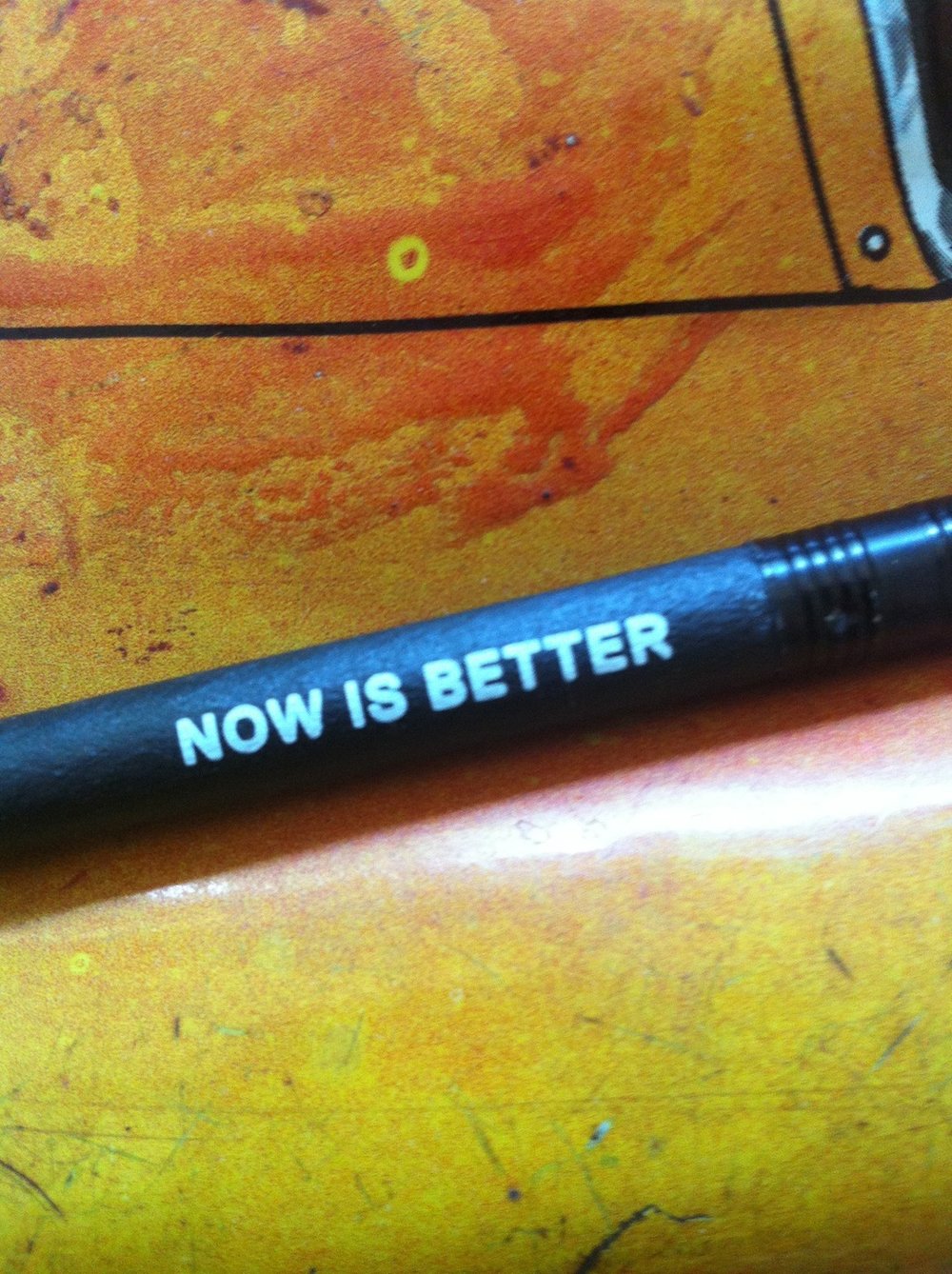
Now Is Better

On a recent visit to the Jewish Museum in New York City, I saw Six Things, a collaborative installation by designers Stefan Sagmeister and Jessica Walsh. The piece included short videos, a sound-activated sculpture, and six maxims taken from Sagmeister’s journal that he says have increased his happiness.

While all six ideas resonated with me, I couldn’t stop thinking about one in particular, “Now Is Better.” It’s so concise and clear. It speaks of mindfulness, being present, realizing that the past happened and the future hasn’t arrived. Sagmeister’s three words remind us to embrace this moment and time.

I’m not saying that the past isn’t relevant or that the future doesn’t matter. The past holds our history, lessons, and memories —both good and bad. The future encompasses our hopes, dreams, fears, and the possibilities that lie ahead. However, we can’t turn back time or fast forward. We can be here right now.

Do you find yourself wanting to return to the past? Are you stuck? Do you find yourself wishing for this time to end so that you can move on to that next thing? Does your future focus detract from or enhance your current experience? What would happen if you focused your energy and thoughts on where you are right now? What would that look like? What would that feel like? Would it change anything?

I am grateful for the past. I look forward to the future. I am happy to be here with you now. Where are you? What are your thoughts now? I’d love to hear your ideas. Join the conversation.

Ask the Expert: David Allen

David Allen "Ask the Expert" interview about ProductivityBased on your outpouring of positive feedback, once again I'm happy to bring you the “Ask the Expert” interview series, which connects you with industry thought leaders. We’ve spoken with Peter Walsh about clutter, Sheila Delson about letting go, Laura Berman Fortgang about next steps, Judith Kolberg about change, and Sue West about fresh starts. This month I’m excited to have with us the world’s leading personal productivity guru, David Allen, to share his insights and wisdom about time management.

David’s book, Getting Things Done – The Art of Stress-Free Productivity, is a favorite in my collection, and is well worn and highlighted. Some of his concepts that I find most valuable are the ideas of gathering all your “to dos” in one place and then moving each one along by focusing on its “next” action. It’s an understatement to say that David has many fans. He’s an international best-selling author of three books, has over one million Twitter followers and over one-hundred thousand members in his LinkedIn GTD® Enthusiasts group. My sincere thanks goes to David for taking the time to join us. A special thanks to Kathryn for making it happen. Before we begin, here’s more about David.

David Allen is widely recognized as the world’s leading expert on personal and organizational productivity. His thirty-year pioneering research and coaching to corporate managers and CEOs of some of America’s most prestigious corporations has earned him Forbes’ recognition as one of the top five executive coaches in the U.S. Time Magazine called his flagship book, Getting Things Done, “the definitive self-help book of the decade.” Fast Company called David “one of the most influential thinkers” in the arena of personal productivity. He is the engineer of GTD®, the popular Getting Things Done® methodology that has shown millions how to transform a fast-paced, overwhelming, overcommitted life into one that is balanced, integrated, relaxed, and has more successful outcomes. David is the Founder and Chairman of the David Allen Company. You can connect with David on Twitter, LinkedIn, Facebook, blog or website.


Linda Samuels:  You are internationally known as the “personal productivity guru.” While there is no quick fix for being more productive, where is a good place to begin?

David Allen:  Stress-free productivity means being in a personal state of relaxed, focused control and engaging in meaningful activity. A prime requirement for that condition is having a total inventory of your commitments with yourself – one that is current and objectified and well defined, at all the levels they exist (from “get cat food” to “get a new job” to ”get enlightenment”.) So job one is to capture and clarify that roster. Start by collecting all the particles around your environment that don’t belong there permanently and put them in your into your IN-tray (or a note to represent them, if they won’t fit). Then use pen and paper to empty your head of any- and everything else that has your attention. From there you’ll need to move on to determining the outcomes desired and next actions required for each of them. That whole process can take 10 to 20 hours, but anything you can start doing along those lines will move you in the right direction.


Linda:  Life requires that we get things done. Anna Quindlen said, “I wish I had treasured the doing a little more and the getting it done a little less.” What is your perspective?

David:  Big Secret: Getting Things Done is not about getting things done. It’s about achieving appropriate engagement with all of your involvements. In order to feel comfortable with whatever you’re doing, you need to feel OK with what you’re not doing. So, not getting things done, for the most part, is a hallmark of optimal productivity! Of course, if your purpose on the planet is actually to complete, accomplish, and express, you’ll need to be getting those things done, in order to be at peace with yourself. Once you really catch what this game is about, and the optimal rules of engagement, playing the game, itself, is the reward. Indeed.


Linda:  What is your most surprising discovery about focusing on the “next” action step?

David:  That the decision about the most mundane aspects of our life (what visible, physical activity do I need to do, to move the needle on this?) is core to the sense of fulfilling our agreements with ourselves. If you think you should be doing something about a situation with your parents or your kid, but haven’t yet decided what the very next thing to do about it is, you’ll be in stress and not fully present in your life.


Linda:  What has been your toughest personal time challenge?

David:  Realizing how much of a clear context, in terms of time and environment, is required to do sustained, creative thinking. I can’t write the next chapter of anything without a good four-hour block of free space and warmed up fingers with a great laptop.


Linda:  If you had an unexpected extra hour on a particular day, how would you spend that time?

David:  Beats me. When it shows up, I’ll let you know. I trust my spontaneous, intuitive hunches.


Linda:  Is there anything you’d like to share that I haven’t asked?

David:  The experience of stress-free productivity is one of a very natural flow. But it doesn’t consistently happen by itself. It requires specific practices that often seem unnatural and unnecessary at first. (“Write everything down? You’ve got to be kidding!”) Once they become habitual, however, you’d never think of doing anything else.


Thank you, David for sharing your thoughts about stress-free productivity and time management. Something you said which jumped out at me is the idea of “appropriate engagement.” Be comfortable with what you choose to do and not do. That in fact, not getting things done is the “hallmark of optimal productivity.” I love this perspective.

I invite all of you to join David and me as we continue the conversation. We’d love to hear your ideas about productivity, GTD®, and time management. Which concepts resonate with you? What are your recent productivity challenges or successes? 

Time Took Care Of

Time Took Care ofOne of my favorite concepts to share is letting go of a something (most frequently paper) because time took care of it. When working with clients, this call to action often becomes the go to phrase for deciding a thing's relevance.

Particularly with old piles of paper, many pieces can quickly be released using this concept. Because time has passed, the item on the paper expired, the event happened, the opportunity to take action isn't available, or it's no longer of interest. When organizing, those papers are easily identified, and usually with great delight and a sense of humor, my clients allow them to exit as they say, “Time took care of.”

It occurred to me that while time took care of  is one of my paper management strategies, the idea is also useful in other situations. For instance, normally I write my blog posts over the weekend or on Mondays so that they're ready to share on Tuesday mornings. However, this particular week, I didn't stick to my plan. I got mad at myself for deviating, and then realized how pointless that was. Time took care of that particular deadline. There was no going back, only forward. So here I am with you, posting later than I’d planned. I've let go of being annoyed with myself over what I didn’t do on time. That no longer matters. I’ve moved ahead to be here now.

Another scenario is with clothing. Perhaps you purchased something, decided to return it, never got to that errand, and now it's too late to return or exchange. Or maybe you bought something for your kid, they never wore it, and they've outgrown that size. What do you say? “Time took care of!” Instead of holding onto something that you don't want or doesn't fit (along with the guilt,) let them go. Donate. Give to a friend. Release yourself from thoughts about what you didn't do.

I know that there are many things you did do. Stop to acknowledge those. Don't waste your time with guilt over what time took care of. Let go. Move on. Focus on now.

What are you ready to let go of? What has time taken care of? I’d love to hear your thoughts. Come join the conversation.