Posts in Enlisting Help
5 Tips for Ensuring the Best Organizing Help

As a professional who’s been helping people get organized for over 25 years, I’ve learned a few things about working with clients. My goal has always been to provide the best, most personalized service possible so that my clients receive the quality organizing help they deserve. While several factors contribute to delivering this type of service, the overarching theme is effective communication.

As an organizing professional specializing in working with chronically disorganized clients who struggle with the organizing aspect of their lives, my client/organizer relationships tend to span a long period of time. Maintaining an open dialogue is essential.

5 Tips for Ensuring the Best Organizing Help

1. Use Two-Way Street

The best relationships are truly based on a two-way street. While I believe in the client is always right” maxim, there still needs to be open, honest dialogue. It’s essential to clearly discuss the expectations and boundaries of both the client and the organizer. The client-organizer relationship is collaborative in nature, so being clear about needs and expectations will result in better service and more effective organizing help.

2. Accommodate Environmental Preferences

Many of my clients are sensitive to their environments. Sound, light, scent, movement, and temperature can enhance or detract from a productive organizing session.  I’m always watching out for these types of issues, but it’s wonderful when a client lets me know about their preferences. This way, I can be more aware of their needs so that they will have a positive organizing experience. Some of the preferences and requests I’ve encountered have included:

  • Wearing solid, dark colored clothes instead of patterns and bright colors to accommodate visual processing sensitivity

  • Being quiet, not talkative, while working to accommodate attention and focus challenges

  • Playing upbeat music to create a happier mood while organizing

  • Not wearing scented products due to aroma sensitivities

  • Being less active with my body language (as in don't move hands wildly while talking) due to visual processing sensitivity

  • Talking more slowly and loudly due to auditory impairment

  • Adjusting the room temperatures frequently (windows opened or closed, air conditioner on or off, heat up or down) to accommodate body temperature fluctuations

3. Clarify Goals

The more the client invests in communicating and clarifying their organizing goals, the better help they’ll receive. Flexibility is an essential aspect of any project, especially when the projects are multi-faceted. Yet even so, giving some thought to each organizing visit helps to get things moving in a positive direction. There are times when my clients get overwhelmed and aren’t sure what they want to focus on. It’s helpful to take some time at the beginning of the organizing visit to discuss possibilities and to figure out some options together. The clearer clients are about what they want, the better organizing help they’ll receive.

4. Practice Self-Care

I love organizing and particularly helping others to organize. However, not all of my clients approach organizing with the same love and zest. They have the desire for the results, but they don’t necessarily enjoy doing the work to get there. Although I try to keep the atmosphere fun and upbeat, all of the decision-making can be fatiguing for my clients. To get the most out of their sessions, it’s beneficial for them to practice pre-session self-care. This includes showing up well-rested, minimizing distractions (such as kids, email, phones, and pets), and being properly fed and hydrated. Then, during the sessions, knowing when a water, bathroom, or snack break is needed is also important. I watch out for the signs, but it’s great when my clients self-advocate. Then I can better support them.

5. Do Check-Ins

One of the keys to getting the best help possible is to do periodic check-ins with your clients. These can be done before, during, after, or in between organizing sessions. A simple, “How are you doing?” can yield a lot of important feedback. Some clients will readily express what they’re feeling and experiencing, while others need to be drawn out. It’s helpful to do a check-in at the start of a session to set the intentions (goals and timing) for that day. Checking in several times while organizing is important, too. Doing a wrap-up and check-in is also helpful. Touching base between sessions can also be valuable. A check-in provides info-gathering moments that make time for sharing feedback and incorporating needed adjustments. 

Do any of these tips resonate with you? Do you have any you’d like to add to the list? I’d love to hear your thoughts. Join the conversation!


Why Do I Love Helping People Get Organized?
Linda Samuels, CPO-CD®, CVPO™

When I was growing up, my parents used to have conversations with us about our future goals and desires. Their philosophy, which they practiced in addition to preaching, was to follow your passion and do work that you loved. If you did that, it wouldn’t feel like work. I watched both of my parents create successful careers in music and computer graphics that they were passionate about.

As a young adult with my parents’ sage advice deeply instilled, in 1993, launched my organizing services company, Oh, So Organized! The concept was simple. Combine my love of helping people with my organizing abilities to help those that were overwhelmed and challenged by the disorganization in their lives. While I identified organizing as a skill that I was born with, I also recognized that it was teachable skill. For the past 25 years, I’ve had the privilege of working in a field that I’m passionate about.


In the book Wait, What? James Ryan writes . . .

“Luckily for all of us, many people are interested in helping others; some devote their careers and lives to it. Not everyone is so inclined, of course, and most people are self-interested at least some of the time. An evolutionary biologist or psychologist might say that we are always self-interested, and that our effort to help others is simply our attempt to feel good about ourselves.”


I understand Ryan’s perspective, but I view helping others as a win-win scenario. The person needing help receives that help. It’s a win for them. As a result the helper feels good too. A personal win. It’s a positive scenario. The key is giving help that the receiver wants in a compassionate, non-judgmental way. It’s essential to focus on the receiver’s needs and not what we think they need. Being respectful and listening is essential.

Helping others to get organized isn’t just about organizing life’s stuff.
— Linda Samuels, CPO-CD®, CVPO™

Helping others to get organized isn’t just about organizing life’s stuff. It includes clarifying goals, editing the unessential, honing decision-making skills, letting go of the things that no longer support you, changing habits, and setting up viable, organizing systems. The process requires time and patience. It can be messy and emotional. I have such admiration for the way my clients face overwhelm and organizing challenges. They have such determination and never give up. They inspire me every day. I love being part of their journey and feel honored to have their trust. We’ve created a unique reward program for our clients. Click on the link to learn more about our Client Loyalty Program.

If you’re struggling with the disorganization in your life or know someone that is, please reach out for help. You don’t have to go it alone. While I’d love to be that person for you, finding the right fit is important. This is a personal services business. There are several factors to consider. To gain understanding about finding the best person, which includes a series of questions to guide you, read 6 Tips for Hiring a Professional Organizer. The article is an excellent starting point to help you determine your organizing needs and the type of help you want.

Have you enlisted help from an organizer? Are you an organizer who offers help? I’d love to hear more about your experiences. What are your thoughts? Join the conversation!


How to Get Great Mindfulness Help for Anxiety with Change

Summer is coming to a close. Families are gearing up for the new school year, which includes every stage from preparing little ones for kindergarten to launching older kids off to college. Even if there are no longer kids in the picture that you need to help, this part of the summer season is often a transition time. We can feel the days shortening and the temperatures getting slightly cooler, especially in the northeast where I live. Here’s the thing. When we are in the midst of change and transition, we can often feel anxious about the past and some trepidation about the future. That’s normal.

Practicing mindfulness, both formally through meditation and informally by allowing ourselves to focus on the present, can be enormously helpful in navigating transitions with less stress and more enjoyment.

As you may know, I’ve been exploring mindfulness beyond my customary way of being, including daily mindfulness meditation, journaling, reading, and formal learning. I’m grateful for the wonderful teachers and guides I’ve had so far, including Laurence Magro, Jon Kabat-Zinn, Amy Reyer, Ellen Langer, Tara Bennett-Goleman, and Daniel Goleman. I’m so thankful for finding them at this juncture in my life.

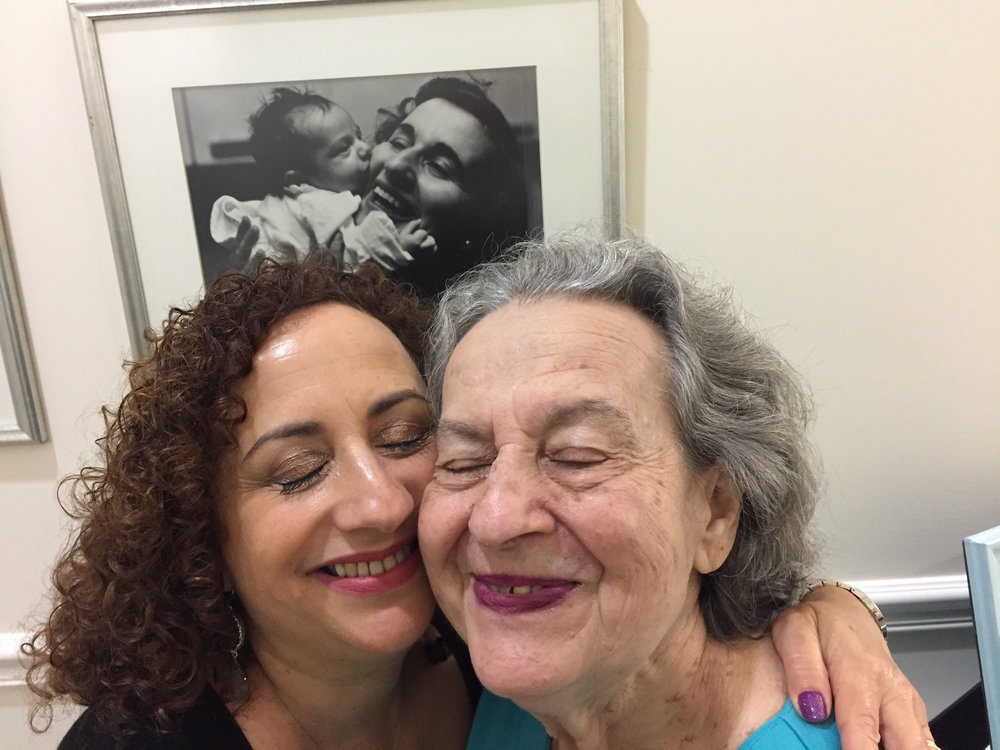
Just the other day, I had one of those ah-ha moments. There’s another mindfulness teacher who has been helping me my entire life, especially over the past few years. It's my mom. She has vascular dementia. At this point, her memory of the past is fairly compromised. The future is no longer a real concept because her short-term memory has been affected as well. She lives very much in the present. She finds joy in the present through playing piano, listening to music, singing, dancing, having conversations, being with people who care about her, exploring the garden, holding hands, enjoying a beautiful day, or being playful. When I’m with her, I enter her world wherever she is, and we experience each moment for all that it is. She’s helped me to appreciate the now even more, to savor these precious moments with her. I slow myself down so that I can be here now.

These past few weeks, I’ve missed being with you as I’ve been involved with family that needed my time and attention. I’m so happy to be back. I look forward to hearing your thoughts. Come join the conversation! What discoveries have you made from those that help or guide you?

 
LSamuels Signature.jpg
 
3 Useful Ideas to Help Increase Your Happiness

We could all use a bit more happiness in our lives, couldn’t we? While traveling recently, I noticed someone reading a Time magazine special edition, The Science of Happiness. The cover was splashed with happy-looking emojis. I finally got my hands on a copy and read it, with yellow highlighter in hand, from cover to cover. I’m generally a happy, positive person most of the time. Even so, I loved the idea of learning about the science behind happiness and the possibility of finding ways to experience even more joy.

Some researchers think that genetics are behind 50% of the variations in happiness and 10% are due to life circumstances. This is great news because it means the remaining 40% presents opportunity for you to increase your happiness. We can break that down to small, manageable parts. As author Margaret Wander Bonanno said,

“It is only possible to live happily ever after on a day-to-day basis.”


3 Ways to Help Increase Your Happiness . . .


Mindfulness

Being present, refusing to multitask, and bringing your full attention to what’s happening right now is one way to increase happiness. This can be challenging to do with so many sounds, people and thoughts vying for your attention. It requires practice, like exercising a muscle, to be mindful. One suggestion made by Emma Seppala, Ph.D. author of The Happiness Track: How to Apply the Science of Happiness to Accelerate Your Success is to take technology breaks. She suggests,

“One of the greatest ways to find joy is to spend a half-day or whole day on a technology fast. That means no screen time. None.”


Generosity

Doing good in the world can translate into donating money to causes and organizations we believe in. According to Michael Norton, co-author of Happy Money: The Science of Smarter Spending, bringing this idea closer to home can boost your happiness even more. He says,

“While giving to charity brings more happiness than spending money on yourself, our research finds that doing things for people you know makes you happiest.”


Gratitude

Have you noticed that you’ve become more grateful as you’ve aged? One study discovered that for each 10 years of life, gratitude increases by 5%. In addition, according to writer Ellen Seidman, research suggests that people who are regularly grateful, those that are actively aware of the “goodness in life and the sources of it – are generally healthier and happier.” To experience the full benefits of gratitude, you need to both feel the love, like recording your appreciation in a gratitude journal and show the love as in writing a letter (the more specific the better) to express gratitude to your friends and loved ones. Robert Emmons, Ph.D., psychology professor and author of Gratitude Works! says,

“When people are grateful, they feel more alert and alive.”


Do any of these increasing happiness concepts resonate with you? I’d love to hear your thoughts. Come join the conversation!