Posts in Embrace Change
What Are Today's Interesting Finds? - v22

The newest installment (v22) of the “What’s Interesting?” feature is here with my recent discoveries that inform, educate, and relate to organizing and life balance. I’ve included unique and inspiring change-related finds, which reflect this month’s blog theme. You are such a beautiful, engaged group. I am grateful for your presence and wisdom.

I look forward to your participation and additions to the collection I’ve sourced. What do you  find interesting?

What’s Interesting? . . .

1. Interesting Read – Navigating Change

Change can be challenging, even for the most adventurous of us. If you are in the midst of transition or know someone who is Transitions – Making Sense of Life’s Changesauthor and transition management consultant, William Bridges who died in 2013, provides an excellent guidebook on coping with change. Bridges explores strategies for embracing and the universal stages of transitions- Endings, The Neutral Zone, and The New Beginnings.He writes about, “…the difficult process of letting go of an old situation, of suffering the confusing nowhere of in-betweenness, and of launching forth again in a new situation.” He offers two powerful questions to ask whenever you are in transition– “What is it time to let go of in my own life right now?” and “What is standing backstage, in the wings of my life, waiting to make its entrance?” Bridges message is practical and hope-filled.

2. Interesting Product – Cultivating Change

Mindfulness+Cards.jpg

One of the essentials for cultivating change is to develop better awareness about our present experience. In this delightful and well-organized box of Mindfulness Cards created by author and founder of Mindfulness Everywhere, Rohan Gunatillake encourages users to create “small meaningful moments of mindfulness throughout the day, making it easy and fun to bring you back to the here and now.”  The cards are grouped into four categories- Rest & Balance, Curiosity & Joy, Insight & Awareness, and Kindness. Practicing mindfulness can bring about the remarkable, unexpected changes.

3. Interesting Tech  – Focusing Change

Brain+fm.png

Change the way you focus, relax, meditate, recharge, and sleep with AI composed music to enhance your experiences. The Brain.fm app, available on iOS and Android platforms, plays music designed for your brain to influence cognitive states in positive ways. Specifically composed pieces include the promise to help you focus better to get more work done with fewer distractions, calm your mind from your ongoing chatter, or have a more peaceful night’s sleep. The developers have continuing collaborations with auditory neuroscientists to research the efficacy of their findings. How exciting that positive change can be delivered through your headphones!

4. Interesting List – Organizing Change

Make+Shit+Happen.jpg

Sometimes a bit of humor can go a long way in motivating us to change. I hope that no one takes offense to Knock Knock’s irreverent twist on the traditional to-do list with the Make Shit Happen pad. Setting goals, especially big ones, can be a challenge. With this spaciously sized list, you are encouraged to think big and then go small with next steps. If you’re looking to improve your organizational skills and change the way you manage your time, this list could help.

5. Interesting Thought – Directing Change
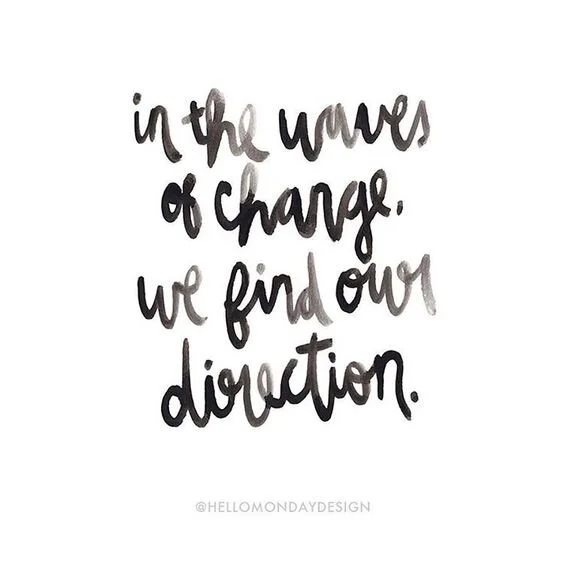
Waves+of+Change.jpg

Change is almost always unsettling. We’re traveling from a known to an unknown destination. We might be riding way outside of our comfort zone as we stretch ourselves to grow and experiment. The path is rocky and unclear. Yet is because of our struggle, those times of challenge, and uncertainty that we find our way forward.

What are your exciting finds? Which of these resonate with you? I’d love to hear your thoughts. Join the conversation!

 
What Wonderful Change Is Emerging Beneath Your Surface?
Wonderful+Change.jpg

Change is all around us, as was evident on a recent walk. As I moved along a familiar Hudson River path, I noticed something unusual. Instead of flowing freely, the river’s surface was mostly frozen.

Sitting on a boulder along the river’s shore, I was mesmerized by the sounds and movement of the ice cracking and shifting. The frozen pieces were continually adjusting, pushing, sliding, and floating away. The tempo and noises changed as sections of ice piled-up and then released back to the river. While expansive portions of the river’s surface were frozen, there was a gentle motion beneath the ice. The rumblings below were covered with a mixture of stillness and agitation above.

How often is that true for us? Internally we begin to change even though it might be barely visible to others. We think about what we might want to do next? We ponder varying options and scenarios. We have conversations with ourselves that are either uplifting or discouraging. We might even get to the point of being overwhelmed just from thinking about change. We might appear frozen on the surface, yet inside we are full of activity and movement.

Then the ice cracks. A positive idea or word of encouragement breaks through. We see the light of possibility and change. The ice begins to thaw. Movement slowly occurs as we turn our thoughts into actions. The ice melts into our sea of change.

Change

What changes or shifts are you noticing? Did any ideas resonate with you? I’d love to hear your thoughts. I invite you to join the conversation!

 
When Scared and You Want to Make a Change, Where Is the Best Start Point?
If+Change+Scares+You.jpg

As a professional organizer and coach, my work focuses on helping people facilitate the changes they want in their lives. Change doesn’t just happen in one quick moment. It takes time, contemplation, and bravery to get to the point of action. It’s at that time when I’m usually contacted. My clients’ desire for change related to organizing issues has been percolating for some time. They got to a certain point on their own, and they want my help to continue. They might feel overwhelmed, stuck, afraid, or unsure of how to get from where they are to where they’d like to be.

I’ve had the pleasure of working with many new and long-time clients. While each person and their situation are different, there are certain similarities in how we work together. Understanding these could be useful for you as you pursue the changes you seek.

So where do we start? . . .

1. Acknowledge Thoughts and Feelings

When we face things that are challenging for us, we think and feel in a variety of ways. We might feel like we’re going to fail, especially if we’ve had a history of unsuccessful attempts. We might feel anxious that we are beyond help. We might feel scared to let go of stuff, thoughts, and feelings, even if they are no longer serving us well. We might feel overwhelmed because there’s so much to do, and we can’t imagine that we will ever get everything done. We might be ruminating about the negative comments others have made about us. We might be generating our negative thoughts and beating ourselves up for what we didn’t do in the past.

Guess what? This is all completely normal. It’s helpful to say these things out loud and just let them land. It’s OK. It’s part of the process. We all come to the table with “stuff.” We bring positive and negative stuff.

We give space for these thoughts and feelings to be heard. We acknowledge them without dwelling on them. I listen for the forward-moving ideas to help us shift the energy and perspective to the next stage.

2. Get Clarity

Notice that we’re still talking here. This is an essential part of the change (and organizing) process. We’re in the curiosity and discovery phase. I keep listening and asking questions. We’re learning new things that will inform what happens next. We’re digging down to what the client wants to accomplish in a more significant way, and also during that particular session. We talk about expectations and outcomes. We get on the same page with where we are heading. We’re building trust.

3. Prepare Tools

Once we’ve discussed thoughts, expectations, and direction, we gather the tools necessary to do the work. If needed, we set up recycling, trash, donation, and shredding bins or bags. We gather markers, tape, sticky notes, folders, or a pad of paper for making notes. We make the supplies easily accessible, so they’ll enhance the flow of the action phase. It’s OK if, along the way, you need to grab additional items. That can happen. We don’t always anticipate everything in advance. Organizing is a fluid process. However, if you can begin with the basics as you set up, it will make the decision-making process more efficient.

4. Dive In

It’s time. We talked. We outfitted the physical space with the necessary tools. Now it’s time to make decisions that align with the changes you want. Where you start isn’t as important as the questions that get asked. What stays? What goes? What is useful? What has overstayed its welcome? It helps to set a few decision-making boundaries. These can expand as you work. For instance, you might decide that all of the empty shopping bags can go without looking at each one. You might opt to recycle magazines that are older than two years without looking at every issue or page. You might decide that small-sized clothes that no longer fit can be donated without trying on each piece. These types of parameters help things move along more quickly. It allows you to make some global decisions without having to look at every single thing.

5. Check-In

Guess what? Making decisions can be exhausting and emotionally draining. Checking in occasionally is important. I watch for decision fatigue. When the quality of the choices starts to deteriorate (as in keeping everything or letting go of everything), the client is likely experiencing decision fatigue. At this point, I’ll suggest a short break. Maybe they need some fresh air, a quick stretch, a snack, a cup of coffee, or a bio break. It’s also an excellent time to assess where we are, check on our timing, and see how they’re doing overall.

There are other aspects of change and the organizing process, such as reviewing and relishing in your accomplishments and determining next steps. However, they aren’t as relevant to getting started, so I’m not going to elaborate on those now.

Change can be energizing, but starting can be scary. Some of the ideas I shared can help you move past the challenges so that you can create the changes that you want. If you’re having difficulty on your own, reaching out for help when you’re stuck, afraid, or overwhelmed is an excellent choice to make. 

When fear inhibits the change process, where do you begin? I’d love to hear your thoughts. Join the conversation!

 
One Interesting Way to Use Mindfulness to Focus Change

If you’re feeling overwhelmed with disorganization, with life seeming not quite right, or with wanting a change, but not knowing where to begin, you’ve come to the right place. The idea of change can paralyze us. We have the tools, but ignore the clues that daily life gives us. We move so fast that we don’t notice the indicators. Can you identify with this?

It’s not uncommon to go through our busy days on autopilot. We set up systems and patterns for convenience and efficiency, but as time goes on, things change. The systems that once worked no longer do. Or, the systems haven’t been maintained, so they no longer function. Maybe we never established effective systems in the first place. But we keep going. We ignore that things don’t feel right. Our piles of clutter irritate us, but we ignore them. We’re annoyed that we can’t get out of the door on time, but we keep getting out late each day anyway. We’re experiencing stress due to the disorganization on a regular basis, but we stuff those feelings away. Status quo has taken over and the way forward eludes us.

I’m proposing one simple, but not necessarily easy technique. Use mindfulness to help you focus on which changes to make. When we’re mindful of the present moment, we increase our awareness of our moment-by-moment experience. After all, how can we make a change if we aren’t fully aware of our challenges? I invite you to slow down. Instead of ignoring irritations during your day, note them. You don’t need to dwell on them, but increase your awareness of them. These will be your clues for identifying potential areas to change.

For example, let’s say that every day you are about to leave the house and you can’t find your keys. So each morning you go through the “hunting for keys” scenario, which in turn makes you late getting to your appointment. You’re annoyed and stressed, but you keep going anyway, repeating the same pattern day after day. You stuff that stress away. This isn’t healthy harboring this type of daily stress.

However, consider this one small tweak. Activate some mindfulness. Instead, the next time you’re late getting out of the door, notice what’s going on. Start by being present with the issue. Be mindful of your actions. What are you feeling? What are you doing? Use mindfulness to help you identify potential indicators for change. By living more mindfully, you can figure out strategies to help solve the “lost keys” and other challenges. You may be surprised when you become more aware and present. You might just notice where you stashed your keys when you come home at night. Or you might decide that it’s time to give your keys a “home” so that you can always find them.

Beginning with awareness is the key. What have you noticed about change? Have you used mindfulness in the process? I’d love to hear your thoughts. Come join the conversation!