What Wonderful Change Is Emerging Beneath Your Surface?
Wonderful+Change.jpg

Change is all around us, as was evident on a recent walk. As I moved along a familiar Hudson River path, I noticed something unusual. Instead of flowing freely, the river’s surface was mostly frozen.

Sitting on a boulder along the river’s shore, I was mesmerized by the sounds and movement of the ice cracking and shifting. The frozen pieces were continually adjusting, pushing, sliding, and floating away. The tempo and noises changed as sections of ice piled-up and then released back to the river. While expansive portions of the river’s surface were frozen, there was a gentle motion beneath the ice. The rumblings below were covered with a mixture of stillness and agitation above.

How often is that true for us? Internally we begin to change even though it might be barely visible to others. We think about what we might want to do next? We ponder varying options and scenarios. We have conversations with ourselves that are either uplifting or discouraging. We might even get to the point of being overwhelmed just from thinking about change. We might appear frozen on the surface, yet inside we are full of activity and movement.

Then the ice cracks. A positive idea or word of encouragement breaks through. We see the light of possibility and change. The ice begins to thaw. Movement slowly occurs as we turn our thoughts into actions. The ice melts into our sea of change.

Change

What changes or shifts are you noticing? Did any ideas resonate with you? I’d love to hear your thoughts. I invite you to join the conversation!

 
When Scared and You Want to Make a Change, Where Is the Best Start Point?
If+Change+Scares+You.jpg

As a professional organizer and coach, my work focuses on helping people facilitate the changes they want in their lives. Change doesn’t just happen in one quick moment. It takes time, contemplation, and bravery to get to the point of action. It’s at that time when I’m usually contacted. My clients’ desire for change related to organizing issues has been percolating for some time. They got to a certain point on their own, and they want my help to continue. They might feel overwhelmed, stuck, afraid, or unsure of how to get from where they are to where they’d like to be.

I’ve had the pleasure of working with many new and long-time clients. While each person and their situation are different, there are certain similarities in how we work together. Understanding these could be useful for you as you pursue the changes you seek.

So where do we start? . . .

1. Acknowledge Thoughts and Feelings

When we face things that are challenging for us, we think and feel in a variety of ways. We might feel like we’re going to fail, especially if we’ve had a history of unsuccessful attempts. We might feel anxious that we are beyond help. We might feel scared to let go of stuff, thoughts, and feelings, even if they are no longer serving us well. We might feel overwhelmed because there’s so much to do, and we can’t imagine that we will ever get everything done. We might be ruminating about the negative comments others have made about us. We might be generating our negative thoughts and beating ourselves up for what we didn’t do in the past.

Guess what? This is all completely normal. It’s helpful to say these things out loud and just let them land. It’s OK. It’s part of the process. We all come to the table with “stuff.” We bring positive and negative stuff.

We give space for these thoughts and feelings to be heard. We acknowledge them without dwelling on them. I listen for the forward-moving ideas to help us shift the energy and perspective to the next stage.

2. Get Clarity

Notice that we’re still talking here. This is an essential part of the change (and organizing) process. We’re in the curiosity and discovery phase. I keep listening and asking questions. We’re learning new things that will inform what happens next. We’re digging down to what the client wants to accomplish in a more significant way, and also during that particular session. We talk about expectations and outcomes. We get on the same page with where we are heading. We’re building trust.

3. Prepare Tools

Once we’ve discussed thoughts, expectations, and direction, we gather the tools necessary to do the work. If needed, we set up recycling, trash, donation, and shredding bins or bags. We gather markers, tape, sticky notes, folders, or a pad of paper for making notes. We make the supplies easily accessible, so they’ll enhance the flow of the action phase. It’s OK if, along the way, you need to grab additional items. That can happen. We don’t always anticipate everything in advance. Organizing is a fluid process. However, if you can begin with the basics as you set up, it will make the decision-making process more efficient.

4. Dive In

It’s time. We talked. We outfitted the physical space with the necessary tools. Now it’s time to make decisions that align with the changes you want. Where you start isn’t as important as the questions that get asked. What stays? What goes? What is useful? What has overstayed its welcome? It helps to set a few decision-making boundaries. These can expand as you work. For instance, you might decide that all of the empty shopping bags can go without looking at each one. You might opt to recycle magazines that are older than two years without looking at every issue or page. You might decide that small-sized clothes that no longer fit can be donated without trying on each piece. These types of parameters help things move along more quickly. It allows you to make some global decisions without having to look at every single thing.

5. Check-In

Guess what? Making decisions can be exhausting and emotionally draining. Checking in occasionally is important. I watch for decision fatigue. When the quality of the choices starts to deteriorate (as in keeping everything or letting go of everything), the client is likely experiencing decision fatigue. At this point, I’ll suggest a short break. Maybe they need some fresh air, a quick stretch, a snack, a cup of coffee, or a bio break. It’s also an excellent time to assess where we are, check on our timing, and see how they’re doing overall.

There are other aspects of change and the organizing process, such as reviewing and relishing in your accomplishments and determining next steps. However, they aren’t as relevant to getting started, so I’m not going to elaborate on those now.

Change can be energizing, but starting can be scary. Some of the ideas I shared can help you move past the challenges so that you can create the changes that you want. If you’re having difficulty on your own, reaching out for help when you’re stuck, afraid, or overwhelmed is an excellent choice to make. 

When fear inhibits the change process, where do you begin? I’d love to hear your thoughts. Join the conversation!

 
Simple Ways to Embrace Your Fresh Start With Power of Two
Power+of+Two.jpg

Do you notice patterns in life? They might grab your attention in the form of color, design, sound, behaviors, or habits. Some of these help us sequence our lives to maintain order or organize our days. For instance, without overthinking about it, I have a waking up pattern that eases me into my day. Perhaps you do too.

There are other types of patterns I notice from the way light floods into a room casting its beautiful shadows, or the intricate designs on the petal of a flower, or the gentle clicking beat of my turn signal when I’m driving the car. Patterns can be seen and heard everywhere. This month two kept appearing. What did that mean? I thought about it in the context of gratitude and fresh starts. More than other times, we feel an energy surge that comes with the beginning of a new year. It is still the first month of the year. Many of us are thinking about our goals and laying the groundwork that will influence the coming days.


The Power of Two

So getting back to the power of two. Coincidentally, these twos that I observed arrived in the form of “R” words, which I’ll share with you.

Rainbows

In an earlier post I wrote this month, How to Boldly Reset Your New Year With Intent, Flow, and Rainbows, I described and shared a video of my New Year’s Day walk at the Croton Dam when I saw the most magnificent rainbow. Just last week, as I was driving home from a client’s organizing session, a huge rainbow arched over the sky. How unusual to see two spectacular rainbows in the same month!

When we start something new, there is excitement, anticipation, and even some anxiety. There is also hope that something different is possible. Hope encourages us to embrace growth opportunities and experience life to its fullest. Hope makes us feel that things will work out and improve. These two rainbow sightings reminded me that hope is an essential ingredient for new beginnings.

Radio

The power of two continued. Twice this month I had the pleasure of being a guest on WNYC’s “All Of It” with the fabulous host, Alison Stewart. You can read more about those experiences (including behind the scenes looks) in the January 7th and January 21stposts. During the shows I loved talking with Alison and her listeners about organizing, overwhelm, letting go, and moving forward. The responses have been positive with many great outcomes that are laying the foundation for new opportunities this year. 


Relationships

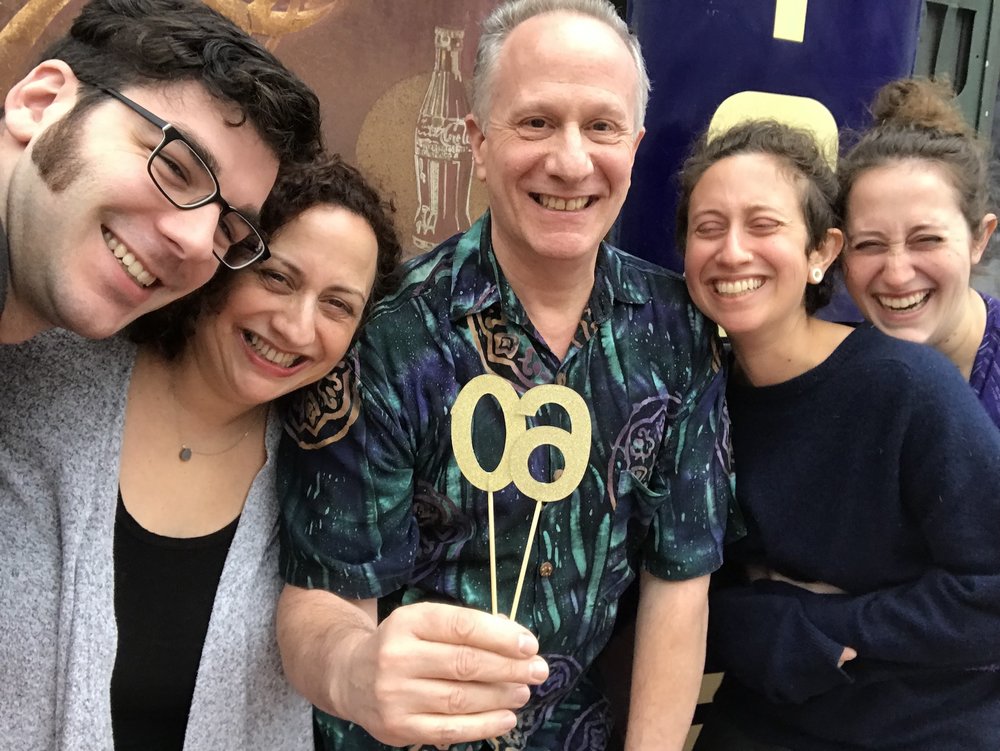
In life, there’s doing, and there’s just being. For me, there’s nothing more beautiful than spending time with my little family (Steve and our daughters). And as it turns out, my husband feels the same way. For Steve’s milestone birthday (The big 6-0!), I organized a weekend at home to be with Allison, Cassie, and her boyfriend, Dezii. We cooked, ate, hung out, played games, talked, toasted, and sang “Happy Birthday” multiple times. As I looked around, I noticed many quiet moments of intimate conversations between two people. We give and receive so much positive energy and love from those one-on-one interactions. There’s nothing quite like the power of two people bonding in a simple, genuine way. Beginning the year spending time with the people I love most was a beautiful way to start the year. It filled my heart with gratitude.


Reinvigoration

Continuing with the power of two was part two of Steve’s birthday gift where just the two of us we went away for the weekend. We saw the Andy Warhol exhibit at The Whitney, walked the High Line, and explored Chelsea Market. We continued into Brooklyn to visit our daughter, Allison, at her open studio event at Two Tree Studios. From there we headed to our old stomping ground, Williamsburg (Brooklyn) where we had lived over 33 years ago before its renaissance. There’s something so refreshing about exploring new sights, sounds, tastes, and places. Part two of Steve’s gift reminded me that integral to fresh starts is having intentional, new experiences. So even though we’d been to some of these places before, each time we explore them, we are changed. There are always new things to observe and learn. Being away from your usual environment is rejuvenating and an excellent fresh start enhancer.

Reflection

The last power of two has to do with gratitude for then and now. As I mentioned above, Steve and I used to live in Williamsburg decades ago before it was a happening place. We renovated a loft there in the early 1980s. The neighborhood has changed a lot. When we lived there, it had the highest homicide rate in any community in the five boroughs, not a statistic that my parents were happy about. There were few if any coffee shops or eateries. Although both of us remembered one amazing donut shop (ahh, those hot-out-of-the-oven French crullers,) Effie’s Continental, and Peter Luger’s Steak House. There were no shops with handmade wares and one hundred dollar scented candles. There were no clubs, hotels, expensive condos, or lovely walking parks along the river. As we explored our old neighborhood, we reminisced and appreciated the “raw” time we spent there, including the challenges we faced as we navigated those early years of love, marriage, and life in Williamsburg.

As much as we enjoyed reminiscing, we also recognized how grateful we are for the present. The Hudson Valley has become our home. We are happy to be here by the beauty of rivers in the quiet of the woods. Life will take many paths, and it’s impossible to know where the future will lead. Gratitude and reflection will always be integral to our journey.

Hope, opportunities, people, places, and thoughts. What patterns are you noticing? Have they come in twos, other numbers, colors, or experiences? I’d love to hear your thoughts. Join the conversation!


7 Useful Resources That Will Help You Let Go and Get a Fresh Start
Letting+Go+Resources.jpg

An essential part of getting a fresh start is being able to let go. It’s challenging to move forward when we hold on to life’s physical stuff, habits, thoughts, or relationships that don’t support who we are or where we’re going. Even though we may intellectually understand this, doing something about it isn’t always so simple.

Our belongings often come with emotional attachments, which make it more difficult to part with them. Of course, there’s no need to let go of things just to let go. However, if you’re in a transition, want less stuff, or are clearing out your parents’ home, then releasing to move forward is an integral part of that process.

Last week, I was invited back as a guest on WNYC’s “All Of It” show with the fabulous host, Alison Stewart.

Click here to listen to the podcast.

Listeners had the opportunity to call in and ask their most pressing organizing questions. While we talked about many things, the focus of this show was primarily on clearing out your parents’ home. Alison started the show by reading a passage from her book, Junk, which she wrote after clearing out her parents’ home of 55 years with her sister and friend.

One of the ideas we discuss in the organizing industry is “safe passage.” What we’ve noticed is that when we help our clients find meaningful homes for the possessions they want to let go of, it eases their emotions and attachments and helps them feel good about releasing them. For example, giving items to family, friends, or charities that benefit or that the recipients appreciate provides this safe passage. 

Many excellent resources were discussed during the WNYC show. I’ll share those along with some additional ones.

Resources for Letting Go

1. Art Supplies – Materials for the Arts is a New York organization that collects art supplies, art books, audio and video equipment, beads, jewelry, fabric, flat-screen TVs, musical instruments, office supplies, paper, picture frames, power tools, trim and sewing notions, and more. They make the materials available for free to nonprofit organizations with arts programming, government agencies, and public schools.

2. Books Better World Books is a for-profit e-retailer that collects and sells new and used books online and matches each purchase with a book donation to Book-for-Book. Sales generate funds for literacy and education initiatives in the United States, the United Kingdom, and around the world. Visit their website to find a book drop box near you.

3. Clothing and Household – Many places accept donations of clothing, household items, books, furniture, toys, electronics, etc. Some of these organizations will pick up your items depending on your location. Resources include:

4. Medical Equipment and Supplies The Afya Foundation supports ongoing health missions worldwide with a focus on disaster relief. Recognizing that after surgery, illness, or death, families often have unneeded medical supplies and equipment, they accept these supplies and give them a second life by donating them to others in need. They will take underpads, adult diapers, gauze, IV supplies, manual wheelchairs, walkers, canes, crutches, and more.

5. Records (LPs and More) – WFMU is having a Record Fair April 26-28, 2019, at the Brooklyn Expo Center. They are collecting interesting and eclectic vinyl records and CDs. They will use the records to fill in their music library and generate funds for the station. 

The Archive of Contemporary Music is a non-profit that collects and preserves recorded popular music and music-related materials from around the world. This includes all music formats (LPs, CDs, 8-tracks, etc.), music-related memorabilia, posters, personal papers, press kits, sheet music, songbooks, books, videos, and more.

6. Recycling and Trash – When clearing out a home, heavy lifting will be involved. The Junkluggers are an excellent resource for removing trash, donations, and recycling. They aim to donate as much as possible and will provide you with a tax-deductible receipt. When I cleared out my parents’ home of 60 years, they were my go-to source.

7. Reflections – Letting go often involves the physical process of removing things from their environment. In points 1-6, I provided you with resources for doing this. Another aspect of letting go is navigating the emotional part. Like Alison Stewart, I also cleared out and sold my parents’ home this past year. It was an emotional process and a big learning experience. It’s one thing to help others, it’s quite another to manage a project like this for your family. It gave me a deeper appreciation of the emotions and challenges my clients experienced when I helped them. While I wrote many posts during this process, for my final post in the series, How to Say Goodbye and Let Go With Love, I shared ten gentle ways that I learned to let go. 

Behind the Scenes at WNYC

To listen to WNYC's "All Of It" January 18th podcast with listener questions, their stories, my responses, and more, click here. My segment is the first 20-plus minutes.

To move forward and get a fresh start, letting go happens. Your focus and energy will be on physical possessions or emotional attachments. It helps to have tools and resources. Do any of these resonate with you? Do you have other favorite letting go resources? I’d love to hear your thoughts. Join the conversation!