

Ask the Expert: Harold Taylor

The popular “Ask the Expert” interview series connects you with dynamic industry thought leaders. This year we’ve spoken with Erin Rooney Doland about clutter, Francine Jay about letting go, Todd Henry about next steps, Dr. Debbie Grove about change, and Joshua Becker about fresh starts. For June, I’m thrilled to have with us prolific writer, speaker, and time management guru, Harold Taylor to share his expertise about time.

I’ve had the pleasure of knowing Harold for many years through one of our industry associations, the National Association of Professional Organizers (NAPO.) He’s been a frequent speaker and exhibitor at the annual conference. In 2002, I remember when he came to New York and presented his “Making Time Work for You” workshop for the NAPO-NY chapter professional development series. I still have the fabulous handouts with a great Harold quote that says,

You cannot manage time; but if you manage yourself wisely in the time at your disposal,
time will work for you.
— Harold Taylor

Tonight I'm looking forward to attending the teleclass "Sleep as a Time Management Strategy fot he CD Client" that he's presenting to the Institute for Challenging Disorganization (ICD.) My deepest gratitude goes to Harold for taking the time to join us. Before we begin, here’s more about him.

Harold Taylor,CEO ofHarold Taylor Time Consultants Ltd., has been speaking, writing and conducting training programs on the topic of effective time management for over 35 years. He has written 18 books and has presented over 2,000 workshops, speeches and keynotes on the topic of time and life management. You can connect with Harold on Twitter, blog or website.

Linda Samuels: As time management consultant, speaker, author, and trainer, you’ve been helping others manage their time and lives for almost 40 years. In what ways do the time challenges we had decades ago differ from now?

Harold Taylor:  There is a greater need than ever for time management because of the increasing speed, complexity and distractions of today’s environment. We are working faster, driving faster, communicating faster, eating faster – in short, we’re living faster.

In addition to time problems introduced by the latest technology, such as increased choices, incessant interruptions, unrealistic expectations and concomitant stress, our bodies are not designed to operate at warp speed and we are faced with a variety of ailments to the point that “keeping well” has become another time consumer.

We now have a longer lifespan than any previous generation, yet about a third of us claim we do not have enough time. Technology allows us to quickly dispense with trivial and low-priority activities so we are able to take on more trivial and low-priority activities. The emphasis has been on doing things faster but relatively little emphasis on working smarter.

For example, email is faster than writing or typing letters but we send and receive more messages. Some people in my workshops claim to receive hundreds of emails in a day. Since the line between work and personal time has been eliminated, people answer email and phone calls during lunch hours, text message while driving and watch videos during a son’s baseball game. We are allowing technology to control us rather than the other way around.

Linda:  For those that are especially challenged with time management, what strategies are most effective?

Harold: The most effective strategies in this digital age of speed are to work with purpose, plans and priorities. Most people resist prioritizing because they want to do it all. The consequences include unhealthy and inefficient attempts at multitasking, working longer hours, and cutting back on sleep.

We have to accept the fact that we can’t do everything, and establish a set of personal policies (which identify our values), set specific goals, and schedule appointments with ourselves to actually get the work done. This requires the use of an appropriate planner, a lot of self-discipline, and the commitment to regain control of our time.

Linda:  Can you describe your “holistic time management” approach to living and some of the benefits?

Harold:  I define holistic time management as “applying the strategies necessary to lead a happier, healthier, longer, more productive and fulfilling life.”  It is based on my belief that rather than trying to get more things done in our lifetime through efficiency, it would be more rewarding to focus on extending our lifetime. Not only would we get more done (even if we did nothing to increase our efficiency) we would have more time to enjoy whatever life had to offer.

The major topics covered in a workshop on holistic time management fall neatly into an acronym that spells out the word HOLISTIC – Health;Organization; Lifestyle; Internal body time;Spirituality; Time use; Interpersonal relationships and Cognitive skills. These all impact our longevity as well as our time management.

Linda:  What has been your toughest personal time management challenge?

Harold: My toughest personal time management challenge as I get older is not to become an “activity packrat,” crowding more activities into an already busy schedule without getting rid of other activities in the process. I think this is more difficult as you age since you can finally see the top surface of the sand in the hourglass.

Linda:  Do you have a time management philosophy or mantra?

Harold: I’m not sure if it’s a philosophy or mantra, but I do believe we should never regret having squandered time in the past; because even squandering can be enjoyable, and there are lessons learned, personal growth or other value in everything we have done or not done in the past. And we can’t change it anyway.

Linda:  If you found yourself with an unexpected extra hour on a particular day, how would you spend that time?

Harold: If I found myself with an unexpected hour on a particular day, I hope I would either spend the time doing more of whatever I was doing at the time - or wondering whether I had missed putting the clock ahead in the spring.

Harold, there are so many ideas here that resonate with me like the effect technology has had- how we manage or don’t manage our time. I love the clarity of your message that we need to “accept the fact that we can’t do everything, ” and the that “squandering [time] can be enjoyable.” I also never heard the term “activity packrat.” It’s an interesting concept to consider that our schedules can become just as cluttered as our spaces if we’re not aware.

Please join Harold and me as we continue the conversation. Share your ideas about time management, favorite strategies, and the role technology plays. What are your thoughts?

What Are Today's Interesting Finds? - v2

In March, I introduced a new blog feature, “What’s Interesting?to share my latest discoveries that inform, educate, and relate to organizing and life balance. Round two of this feature includes fun, inspiring, and interesting time-related finds, which reflect this month’s blog theme. You're such an engaged group. I look forward to your feedback, participation, and additions to the collection I've sourced for you. What do you find interesting?


What’s Interesting? . . .

1. Interesting Read - Focus

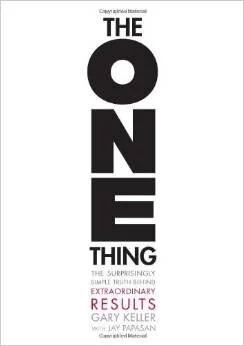
The One Thing by Gary Keller

The One Thing by Gary Keller

On route to Phoenix last month for the NAPO conference, I discovered The One Thing – The Surprisingly Simple Truth Behind Extraordinary Results by Gary Keller. He begins the book with a Russian proverb that highlights his message, “If you chase two rabbits you will not catch either one.” Keller shares strategies for focusing your time and energy around doing the onething that’s most important. He says, “...extraordinary results are directly determined by how narrow you can make your focus.”

2. Interesting Resource – Time Saver

This online resource, CashInMyBag.com, saves you time and pays you money upfront for your used designer clothing and accessories that you want to sell. After providing you with a quote, they’ll send you a box with pre-paid shipping label, making the process quick and easy.


3. Interesting Conference – Disorganization

ICD+Conference.jpg

The Institute for Challenging Disorganization’s (ICD) annual conference is September 18-20, 2014 in Nashville TN. Organizing and related professionals from all over the world will gather to learn from each other and industry leaders including ADHD expert Russell A. Barkley, Ph.D. and organizing pioneer, Judith Kolberg. Sessions include topics such as hoarding, ADHD, coaching, decision-making, and the latest research on chronic disorganization.


4. Interesting Product – Timer

Time Timer.jpg

I am a long-standing fan of Time Timer products. The timers, which have a visual time-elapsing display are available in electronic and physical versions. My favorite product is the 3” square timer, which I use for speaking, coaching, and teaching. At the NAPO conference, Time Timer introduced new options...colored cases instead of just black. I bought the turquoise timer and used it just this week for a coaching session with one of my clients.


5. Interesting Thought - Start

Start+Today.jpg

We only have so much time in a day, week, year or lifetime to accomplish our dreams. Why procrastinate or stress any longer? Start today. Now is all we have.

I’d love to hear your thoughts. What are your interesting finds? Do any of these resonate with you?  Come join the conversation!

LSamuels Signature.jpg
 
What Do You Do With Your Time?
I am definitely going to take a course in time management . . . just as soon as I can work it into my schedule.
— Louis E. Boone
What Do You Do With Your Time?

We receive a gift each day with 1,440 minutes (aka 24 hours).

  • What do you do with your time?

  • Do you have enough time to work, play and relax?

  • Do you desire more time with friends, family or self?

  • Do you wish your time were more focused?

  • Do you feel like your time is being wasted?

  • Do you find it challenging to manage your time?

There are many ways to manage our time. One possibility is to organize using time blocks or containers. Time has a daily repeating pattern. Within that pattern, we need time to work, play, and restore. We each desire a different combination of the amount of time needed, how we define our various areas of priorities.

Set aside time to define your priorities. Think about:

  • What’s most important to you?

  • What are the different areas of life or “containers” that your time will get organized into?

  • Which containers will be larger?

  • Which will be smaller?

  • What combination of containers is right for you?

Once your priorities are clear: 

  • Choose your container sizes.

  • Choose how to fill them.

  • Arrange them in ways that best align with your priorities.

What if you introduced color-coding for your containers or time blocks to enhance visual understanding of where your time is going?

Color isn’t useful for everyone, but if you’re a visual processor like I am, it can work well. For my time blocks, I use purple for business, turquoise for personal, green for professional associations, and pink for kids. Within a given week, at a glance I can see what my time looks like with the big color blocks or containers and whether I’m in alignment with my priorities.

What do you do with your time? How do you organize it? I’d love to learn what works and doesn’t work for you? Come join the conversation.

 
LSamuels Signature.jpg
 
Are You Ready Enough?

As we welcome the new month, we also begin a new time of the year. New evokes opportunity, change, and growth. Time can feel expansive or limiting. What will time be like for you? Do you ever feel like you're not ready? Do you feel like it's not yet your time to do, to try, or to get out there?


“The only reason for time is so that everything doesn’t happen at once.”

 - Albert Einstein


Is fear or lack of confidence holding you back?

  • Maybe you don’t feel ready for organizing your paper piles.
  • Maybe you don’t feel ready to say “yes” to a job with more responsibility.
  • Maybe you don’t feel ready to volunteer.
  • Maybe you don’t feel ready to try something outside your comfort zone.
  • Maybe you don’t feel ready to . . . (fill in the blank).


Here’s the good news. Time helps us get ready, though we might not realize it at first. The “ready” can involve acquiring new skills or making a gentle perspective shift. We’re never 100% ready for venturing towards uncertainty. However, there’s a good chance that we’re ready enough. Know the power of taking small steps. Acknowledge your previous challenges and successes. These prepare you, so when the time comes, you’ll be ready enough.

This past week, I attended the NAPO (National Association of Professional Organizers) conference in Phoenix where professional organizers from around the globe gathered to learn and exchange ideas about our industry. While there, I was invited to speak in Japan at the JALO (Japanese Association of Life Organizers) conference. I’ve never traveled to or presented in that part of the world. While I don’t have all the details worked out, time prepared me to be ready enough to say, “Yes” to this wonderful, exciting opportunity.How does time prepare you? What does ready enough look like? What becomes possible with a perspective shift?