

What's Your Relationship to Clutter?

Are you and clutter on a break? Your space is clear and you’re feeling stress-free. Perhaps everyone around you is clutter obsessed, but it’s not on your radar. Piles that have accumulated on floors, surfaces, corners and closets don’t bother you. Or, does the clutter in your physical space, and also in your schedule and thoughts overwhelm you? What is your relationship to clutter? Are you on a clutter hiatus, oblivious to clutter or overwhelmed by it?

Thinking about this relationship will help locate where you are with your clutter and give you ideas for possible next steps. I recognize that it’s not this black and white. Our relationship to clutter can shift regularly. This is just one concept. Find what makes sense to you.


Clutter Break

  • You know you’re on a clutter break if you can easily move around your space, find what you need when you need it, and are not experiencing daily stress that is often associated with too much clutter.

  • Next Step: Your relationship to clutter is positive. You have no clutter worries and can shift your energy to other areas of your life. Choose what interests you like focusing on better self-care, having more time with friends and family, or learning something new. What’s possible for you?


Clutter Oblivion

  • You don’t quite get what all the fuss is about. You have some piles here and there. What’s the big deal? You sometimes hunt for things, but for the most part you can find what you need. You prefer your things out and visible, but it’s the people you live that don’t like it. They give you a hard time because their clutter tolerance and yours are not the same.

  • Next Step: Conflicts arise when needs are contrary. It’s not that your way or their way is right or wrong, it’s just different. Living with people involves compromise if you desire a more harmonious environment. So what might work? One suggestion is to create zones for communal and private areas? Establish boundary rules for these areas. The private areas can be kept any way the “owner” wants. The communal areas can include respect rules agreed on through compromise. What else might work?

Living with people involves compromise if you desire a more harmonious environment.
— Linda Samuels, CPO-CD®, CVPO

Clutter Overwhelm

  • The spaces, the thoughts, and the schedules are overflowing. There is not enough room to do what you need, have mental energy to feel calm, or time to make any changes. Or, at least it feels that way. The days aren’t flowing well. You spend time hunting for glasses, keys, the library book that’s due. You have so much going on in your head that you feel like it’s going to explode. Your calendar is over-scheduled and you feel like there is not time to relax.

  • Next Step: You always have choices. Especially now because you are so overwhelmed, it’s critical that you take a step back. No prizes are given for those that burn themselves out. Find a quiet space, make a cup of tea, and start to brainstorm about what can be released. For the physical clutter, can a closet, a drawer or a surface be de-cluttered? One small action can make an enormous difference. For the mind clutter, can you take 10-15 minutes to do a brain download? Get those floating thoughts out onto paper, computer or voice message. With the full calendar, think through your commitments. Can you convert any of the “yeses” into “not nows?” Self-care might seem like an impossibility right now. It’s more critical than ever. Break it down. Think small. What single tiny step can you take now?

What is your relationship to clutter right now? What comes next? Come join the conversation and share your thoughts with us.

 
LSamuels Signature.jpg
 
Stepping Back to Let Go

We've all been there. We had our glasses just a moment ago, and now we can't find them...anywhere! Normally I'm pretty good with my glasses. I've devised a system that involves multiple pairs strategically kept in the places I use them (office, nightstand, pocketbook, organizing bag, and car etc.) This makes life simpler and less stressful. My glasses are always ready and waiting.

However, the other day, the oddest thing happened. I walked in the house carrying too many things. When I set the items down on my desk, I knocked over my glasses and heard them drop to the floor. Instead of picking them up right away, I first took care of a few other things. I watered the plants, smelled the newly opened candy-scented irises, sorted the mail, emptied the garbage, and filed some receipts.

Then, I went back to my office to organize the rest of my packages and pick-up my glasses. My dropped glasses had disappeared. I looked everywhere. It’s not a large area. I crawled on the floor, used a flashlight to look beneath the cabinets, and emptied my pocketbook. I kept thinking, "They have to be here. I heard them fall."

I walked into the space and out again, hoping they'd magically appear. Where the heck did they go? Glasses don't have wings! Then I started getting silly. I'm laughing at myself because I just knew they were there and I just wasn't seeing them. I told myself to stop getting nuts and wait for my husband to come home. I figured with another person's perspective, they'd be found quickly.

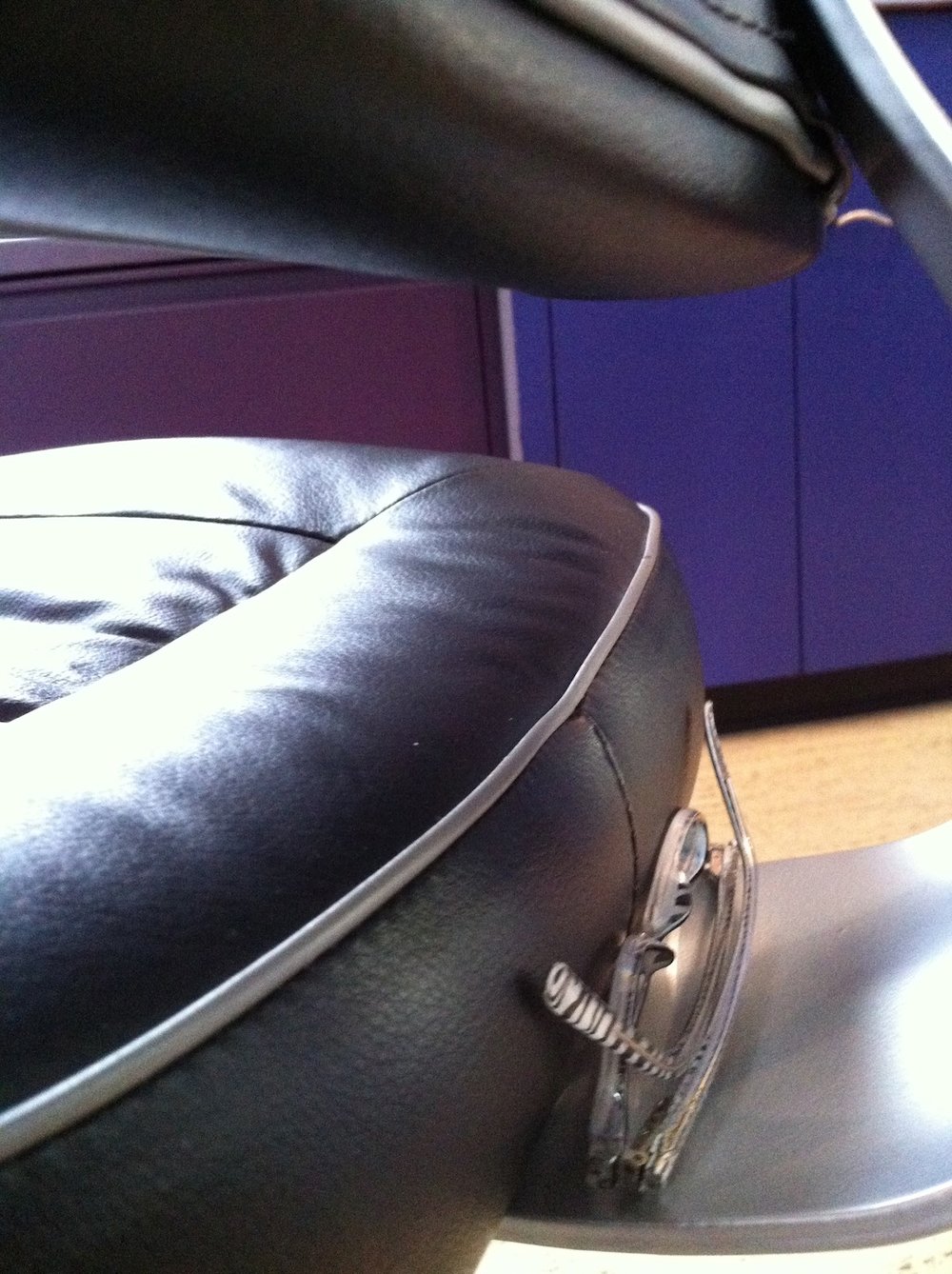
I wanted to let go and stop obsessing. And then it happened. As I stepped back one last time to take an overview of the area, I saw my glasses. They had landed on their edge onto the connecting hardware of my desk chair.

Lesson learned. Sometimes in order to let go, we have to step back. Have you ever found that a different perspective allowed you to let go? What was your experience? Come share with us and join the conversation.

Ask the Expert: Geralin Thomas

Geralin Thomas, Metropolitan OrganizingWe’ve had a tremendously positive response to our “Ask the Expert” feature on The Other Side of Organized blog. In February, John Ryan of The Life Change Network talked about change. In March, Yota Schneider of Open for Success spoke about next steps. This month, I’m excited to introduce you to the vivacious professional organizer, Geralin Thomas to share her wisdom with you about letting go.

Geralin is a wonderful friend and colleague with tremendous energy, style, and grace. My gratitude and thanks goes to her for taking the time to join us.

Geralin Thomas is a professional organizer that trains new professional organizers, provides residential organizing services, and works with hoarding clients. She is founder of Metropolitan Organizing and has been featured on A&E’s Hoarders, The Nate Berkus Show and Today. Geralin is a wife, mother, gardener, painter, documentary lover, and has a passion for fashion. You can connect with her on Twitter, Facebook, Pinterest, blog or website.


Linda:  You are a professional organizer helping clients transform their homes from chaos to calm. You also specialize in working with people that hoard. Why is letting go so challenging for some?

Geralin:  Some folks are sentimental savers. They might say, “Oh, my son made this macaroni necklace for me when he was in 1st grade; I’ve gotta keep it.” Others are utilitarian savers. They could say, “The reason I hang onto all these old tuna cans is because I plan on welding them together to make a lamp for my dog’s house.” A person with a hoarding disorder has these same exact struggles, but they are much more intense. They over-accumulate and find it extremely difficult to let go of things they’ve acquired.


Linda:  If someone is struggling with letting go, what do you suggest?

Geralin: When someone is struggling with letting go, I encourage them to read a blog post I wrote related to this topic, “The 4 Personalities that Save Stuff.” It’s been useful for many of my clients. In addition, I’ve heard from several therapists and social workers that shared it with their clients say it was helpful for them as well.


Linda:  What has been your biggest personal challenge around letting go?

Geralin: Oh, I always dread this question because I’m not a sentimental person and our culture seems to believe that women are supposed to be sentimental.  For me, letting go isn’t a challenge. I don’t save cards, awards, certificates, photos, trophies  – none of that stuff matters to me; it’s just stuff.  Same for projects – I’m very aware of how much or little time I have for projects so typically, all those DIY projects look and sound great but at this point in my life, I don’t have time for them so I don’t accumulate a lot of task-related stuff.  I’d rather spend my time painting or gardening.


Linda:  Do you have a letting go philosophy?

Geralin: I ask someone struggling with clutter if they want to surround themselves with meaningful things. If they answer in the affirmative, I ask, “Is this [thing] beautiful? Useful? Helpful? Does it resonate with who you are right this moment?”  Sometimes people hang onto things that represent who they used to be. Examples include “special occasion” serving dishes or “trophy” sizes of clothes.


Linda:  Is there anything you’d like to share that I haven’t asked?

Geralin: How about I share one of my challenges?  We all have our challenges and mine is packing a suitcase. Let’s just say that if you are stuck on a runway for three hours, you want to sit next to me because I’ll have nuts, chocolates, reading material, manicure supplies, dental floss, tissues, etc.

Warmest thanks, Geralin for taking the time to share your insightful, clear thoughts about letting go. I invite all of you to join Geralin and me as we continue the conversation. What are your thoughts, experiences or questions about letting go? 

Letting Go Even While Blooming

Even in the blooming, there’s a letting go. The other day, as I drove down the block, I was amazed by how quickly the flowering trees had bloomed and then released those blooms. They seemed to blossom overnight and drop their flowers in less than a week. I noticed that once the flowers were down, new growth appeared on the branches. The trees went from being naked, to flower covered, to bathed with green buds. Each day since, the buds have opened into beautiful green leaves, full of life.

I was thinking how similar this is to our own letting go experience. While it seems that we should just be able to let go and be done, in fact, it’s very much a process, and not a singular event. Like the trees, we begin where we are. We grow, but in order to have more growth, we must be willing to release even those things, which are beautiful. We let the first blooms drop to make room for new ones. This process continues.

The opposite of letting go is holding on. Draw inspiration from this spring season. Be willing to let go of the mind and physical clutter that’s weighing you down, the negative thoughts that are stifling your success, the “yeses” in your too-busy schedule that are causing undue stress, and the micromanaging of everyone and everything.

What will you let go of? What will become possible for you? Where are your growth opportunities? Your thoughts are important. Come join in the conversation about holding on, letting go, and growing.